Introduction
Hello! In our last lesson, we learned the crucial question pattern [Place] wa doko desu ka? to ask for directions. You're now equipped to ask where the train station, hotel, or restroom is. But what happens when you get an answer?
Today's lesson focuses on understanding that answer. We'll learn the three most fundamental words for verbal directions in Japanese: migi (right), hidari (left), and massugu (straight). By the end of this lesson, you will be able to understand a simple set of directions, completing the basic cycle of asking for and following directions—a vital skill for your trip.
1. The Three Core Direction Words
Let's start with the absolute basics. Most simple directions will involve telling you to go right, left, or straight.
Here is a fantastic visual that lays out these core terms.
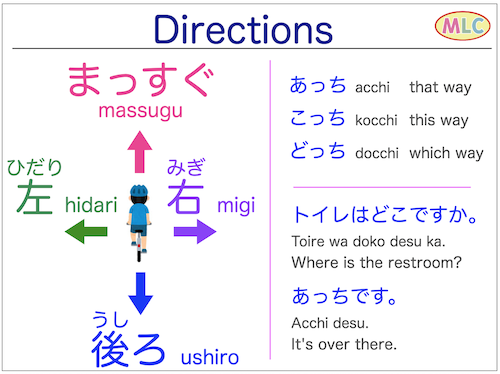
Here are the words in a table for easy reference. While the kanji characters (右, 左) are common on signs, for now, focus on recognizing the spoken words.
| English | Hiragana | Rōmaji | Kanji |
|---|---|---|---|
| Right | みぎ | migi | 右 |
| Left | ひだり | hidari | 左 |
| Straight | まっすぐ | massugu | 真っ直ぐ |
Memorizing these three words is the first and most important step to understanding directions.
2. Forming Simple Direction Phrases
Just knowing "right" or "left" isn't enough; you need to understand the action associated with them, like "turn" or "go." In Japanese, this is done with simple, repeatable patterns that are perfect for a phrase-based approach.
The most common way to receive a direction is as a polite request. We will focus on two key "plug-and-play" phrases:
...ni magatte kudasai(...に まがって ください) — Please turn......itte kudasai(...いって ください) — Please go...
Let's see how this works:
Migi ni magatte kudasai.(右に 曲がって ください) — Please turn right.Hidari ni magatte kudasai.(左に 曲がって ください) — Please turn left.Massugu itte kudasai.(真っ直ぐ 行って ください) — Please go straight.
To see these words and patterns explained clearly, please read the following sections from the Migaku article on Japanese direction words.
Japanese Direction Words: Essential Navigation Vocabulary - Migaku
This article, 'Japanese Direction Words: Essential Navigation Vocabulary', breaks down the core vocabulary and shows how it's used with action verbs. It will introduce you to the words for 'turn' and 'go'.
Please read the following three parts: Under the heading 'Essential Japanese direction words you need to know', find the section 'Basic left and right' to review migi and hidari. Then, find the heading 'Movement verbs for giving directions'. Focus on the first two verbs: iku (to go) and magaru (to turn). Notice the example 'massugu iku' (go straight). Finally, under 'Grammar patterns for direction sentences', look at the first pattern: (Action) + te-form + kudasai. See the example 'Migi ni magatte kudasai' (Please turn right). Don't worry about the grammar of the 'te-form'; just treat itte and magatte as fixed parts of these useful direction phrases.
The key takeaway is that when you hear ...magatte kudasai, you know you need to turn. When you hear massugu itte kudasai, you know to continue straight ahead.
3. Understanding a Real Response
Now, let's put everything together. Imagine you've just asked for directions to Shibuya Station, using the phrase you learned in the last lesson.
You: Sumimasen, Shibuya eki wa doko desu ka? (すみません、渋谷駅はどこですか?)
"Excuse me, where is Shibuya Station?"
A helpful local might reply with the exact phrases we've just learned. The following reading provides a perfect example of such a dialogue.
Japanese Direction Words: Essential Navigation Vocabulary - Migaku
Let's return to the 'Japanese Direction Words' article to see a full, realistic conversation in action. This will show you exactly how your question and their answer fit together.
Please find the heading 'Example dialogues for real situations'. Read Example 1: Finding a train station. Pay close attention to the response given and identify the phrases for 'go straight' and 'turn left'.
As you saw in the example, the response was:
Them: Kono michi o massugu itte, futatsu-me no shingō o hidari ni magatte kudasai.
(この道をまっすぐ行って、二つ目の信号を左に曲がってください。)
"Go straight on this street, and please turn left at the second traffic light."
Even if you don't catch every word like kono michi (this street) or shingō (traffic light), your brain can now latch onto the key instructions: massugu itte (go straight) and hidari ni magatte (turn left). This is often enough to get you where you need to go.
Conclusion
Great work today! You've just learned the other half of the navigation puzzle. By combining what you learned in the last lesson with today's vocabulary, you can now have a complete, basic interaction to find your way around Japan.
Key Takeaways:
- The three essential direction words are
migi(right),hidari(left), andmassugu(straight). - Directions are often given as polite requests using
kudasai(please). - Listen for these key phrases:
Massugu itte kudasai— Please go straight.Migi ni magatte kudasai— Please turn right.Hidari ni magatte kudasai— Please turn left.
Preview of the next lesson:
Now that you can ask for and understand verbal directions to a place like a train station, our next step is to make sure you can navigate it once you arrive. In the next lesson, we will focus on reading essential kanji you'll find all over Japanese train stations, such as 駅 (station), 入口 (entrance), and 出口 (exit). This will powerfully boost your ability to read signs and navigate independently.