Introduction
Hello! In our previous lesson, we covered how to understand basic verbal directions like "turn right" (migi ni magatte kudasai) and "go straight" (massugu itte kudasai). This is crucial for getting you to your destination.
Today, we'll focus on what to do once you've arrived at a train station. Japanese stations can be vast and crowded, but the signage is very systematic. This lesson will teach you to read three of the most important kanji for navigating them: 駅 (station), 入口 (entrance), and 出口 (exit). Mastering these will give you the confidence to find your way into, out of, and around any station in Japan, a fundamental skill for your trip.
1. The Most Important Kanji: 駅 (eki) - Station
Let's start with the single most useful character for train travel.
- Kanji: 駅
- Reading: えき (eki)
- Meaning: Station
This character is your primary landmark. In Japan, station names on signs are almost always followed by 駅. So, if you're looking for Shibuya Station, you'll see a sign that says 渋谷駅.
This is a powerful pattern to recognize. It's similar to how file extensions work in computing; just as seeing .exe tells you that you're looking at an executable file, seeing 駅 tells you that you're looking at a station name.
To see this pattern in action, let's look at an article that focuses on practical kanji recognition.
Tokyo Subway Kanji: Essential Patterns for First-Time Visitors - Llanai
This article, 'Tokyo Subway Kanji: Essential Patterns for First-Time Visitors' from Llanai, is excellent because it focuses on recognizing patterns, not just memorizing characters. We'll use it to understand how 駅 is used on real signs.
Please read the first main section of the article, titled 'Start Here: 駅 (eki) = Station'. Notice the examples provided, like 東京駅 (Tokyo Station) and 新宿駅 (Shinjuku Station). The key takeaway is the [Name] + 駅 pattern.
Once you can spot 駅, you'll immediately be able to identify station signs, even if you can't read the name of the station itself. This helps you filter out all the other information and focus on what matters.
2. Finding Your Way In and Out: 入口 and 出口
Once you're at the station, you need to find the entrance. And when you arrive at your destination, you need to find the exit. These two words are usually displayed on large, clear signs.
- Entrance: 入口 (いりぐち - iriguchi)
- Exit: 出口 (でぐち - deguchi)
These words are compounds of two simpler kanji, which makes them easier to remember:
- 入 (iri): To enter
- 出 (de): To exit/go out
- 口 (guchi): Mouth, opening, or gate
So, you can think of them literally as "enter-opening" (入口) and "exit-opening" (出口). This logic is a great mnemonic.
Let's return to the same article to see how these are explained.
Tokyo Subway Kanji: Essential Patterns for First-Time Visitors - Llanai
The Llanai article also covers these two essential signs side-by-side, which is the best way to learn them.
In the article, find the heading 'Essential Direction Patterns' and read the sub-section 'Entry and Exit (Learn These First)'. The text breaks down the meaning of the characters just as we have discussed.
Now, let's see what these signs look like in the real world. They are often color-coded and accompanied by English text, but being able to recognize the kanji is much faster and more reliable.
Here is a typical sign for an entrance.

And here is a sign for an exit.
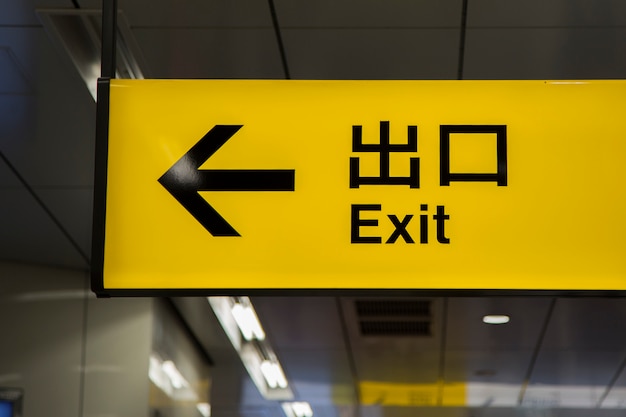
3. A Practical Navigation Checklist
You now have the three foundational kanji for station navigation. Let's put them into a simple, practical workflow you can use when you're in Japan.
Imagine you've just gotten off a train in a large, unfamiliar station. Here's your mental checklist:
- Find the Exit: Scan the overhead signs for 出口 (deguchi). Follow the arrows to get out of the ticketed area.
- Identify the Station (if needed): Once outside, or if you're trying to find your way back, look for the main station sign. You'll recognize it by the 駅 (eki) character at the end of the name (e.g., 東京駅).
- Find the Entrance: To get back into the station, look for signs marking the 入口 (iriguchi).
This simple three-step process of spotting 出口, 駅, and 入口 will handle the vast majority of your station navigation needs. The article you read provides a similar checklist to reinforce this idea under the heading "Your Recognition Checklist."
Conclusion
Excellent work today. You've just learned to read three of the most high-value kanji for any traveler in Japan. While learning kanji can seem intimidating, focusing on these practical, high-frequency characters is the key to efficient learning for your trip.
Key Takeaways:
- 駅 (eki) means "station" and appears at the end of every station name. It's your anchor for identifying where you are.
- 入口 (iriguchi) means "entrance." Look for this sign to get into the station. The kanji 入 suggests entry.
- 出口 (deguchi) means "exit." Look for this sign to leave the platform and the station.
Preview of the next lesson:
Sometimes, large stations have multiple exits leading in different directions (e.g., "East Exit"). To navigate these effectively, you need to know the cardinal directions. In our next lesson, we will learn the kanji for North (北), South (南), East (東), and West (西), building directly on what you've learned today about exits.