Introduction
Welcome! In our last lesson, you learned two of the most essential politeness phrases in Japanese: arigatou gozaimasu (thank you) and sumimasen (excuse me/sorry). With those and your greetings, you can now handle many brief social interactions with courtesy.
Today, we'll complete our foundation by learning how to introduce yourself. This is the final piece of our first module and a critical skill for any interaction beyond a simple "hello." We will cover the standard, three-part sequence for a basic introduction, focusing on the pattern "[Name] desu. Yoroshiku onegaishimasu." By the end of this lesson, you'll be able to confidently introduce yourself in a polite and natural way, a key step toward your travel goals.
The Standard Self-Introduction
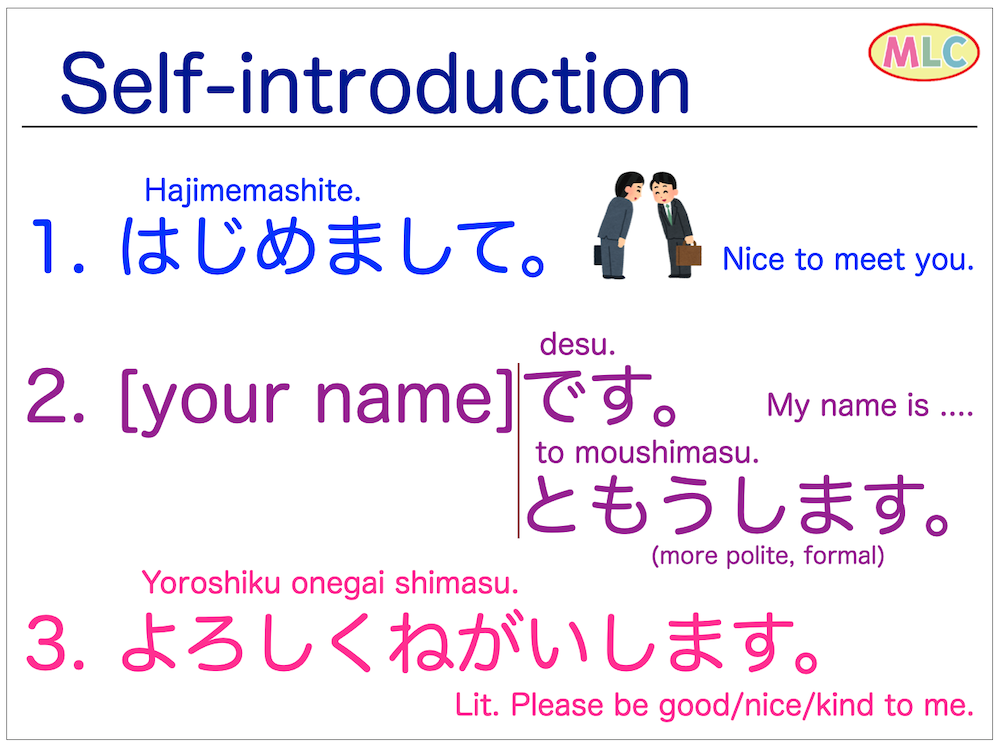
A basic self-introduction in Japanese is a clean, three-part sequence. Committing this entire sequence to memory is one of the best things you can do as a beginner.
- The Opening:
Hajimemashite(はじめまして) - Your Name:
[Your Name] desu(です) - The Closing:
Yoroshiku onegaishimasu(よろしくお願いします)
Let's break down each part.
1. Hajimemashite (はじめまして)
This is the standard phrase you use when meeting someone for the very first time. It translates closely to "Nice to meet you" or "How do you do?"
- Pronunciation:
ha-jee-may-mah-sh-tay - Think of it as the formal handshake that begins the conversation. You say it once at the very beginning of the encounter.
2. [Your Name] desu (です)
This is the simple, direct way to state your name. You've seen desu before; it's the polite verb that functions like "is" or "am."
- Pronunciation:
[Your Name] dess(Remember theuis very soft or silent). - This is a perfect example of the "plug-and-play" approach you prefer. You just insert your name and you're done. For example, if your name is "John," you would say "John desu."
- A quick note: A more complete sentence would be
Watashi wa [Name] desu(私は [Name] です), which means "I am [Name]." However, in Japanese, the subject ("I" orwatashi) is almost always dropped when it's obvious from the context, which it is during a self-introduction. Using the shorter[Name] desuis more natural and common.
3. Yoroshiku onegaishimasu (よろしくお願いします)
This is a culturally rich phrase with no single English equivalent, but it's an absolutely essential part of an introduction. It politely closes the introduction and sets a positive tone for your future relationship, however brief. It can mean:
-
"Nice to meet you."
-
"I look forward to working with you."
-
"Please be kind to me."
-
Pronunciation:
yo-ro-sh-ku o-nay-ga-ee-she-mah-ss -
For your travels, think of it as the polite and indispensable phrase that wraps up your introduction. You'll say it to hotel staff, shopkeepers, and anyone you meet for the first time.
Putting It All Together: A Visual Guide
This image provides a clear, step-by-step visual summary of the introduction sequence. It's a great reference to help you remember the flow.
Hearing it in Context
Now let's hear how this sounds in a natural conversation. The following resource from NHK WORLD-JAPAN features a short dialogue where a character introduces herself.
Lesson 2: I'm Tam. I'm a student.
This skit from NHK's 'Easy Japanese' course will let you hear the full introduction sequence in a conversational context. Don't worry about understanding every word; just focus on the rhythm of the introduction.
In the 'Skit' section, click the 'Listen #2' audio player. Pay close attention to the lines spoken by the character Tam (around the 0:35 mark): 'Hajimemashite. Tamu desu. Gakusee desu. Yoroshiku onegai-shimasu.' (Note: 'Gakusee desu' means 'I am a student.' You can ignore this part for now, as stating your name is sufficient for travel situations.)
As you heard, the phrases flow together smoothly. To better understand the final, crucial part of that sequence, let's look at the explanation for Yoroshiku onegaishimasu from the same resource.
Lesson 2: I'm Tam. I'm a student.
This section provides a concise explanation of the meaning and usage of 'Yoroshiku onegaishimasu,' reinforcing its importance.
Scroll down to the 'Bonus Phrase' section and read the short explanation for 'Yoroshiku onegai-shimasu.' This will help solidify why this phrase is so important at the end of an introduction.
Practice and Cultural Tip
Now it's your turn. Practice saying the full phrase aloud with your own name:
Hajimemashite. [Your Name] desu. Yoroshiku onegaishimasu.
- Cultural Tip: A self-introduction is almost always accompanied by a bow in Japan. As a foreigner, you are not expected to be perfect, but a slight nod or a small bow of the head and shoulders while you introduce yourself shows respect and will be very well received. You typically bow as you say
Hajimemashiteand again as you sayYoroshiku onegaishimasu.
Conclusion
Great job! You have now learned the complete, polite sequence for a basic self-introduction. This is one of the most practical and high-value things you can learn before your trip.
Key Takeaways:
- A standard self-introduction follows a three-part structure:
Hajimemashite->[Name] desu->Yoroshiku onegaishimasu. Hajimemashiteis the opening for meeting someone for the first time.[Name] desuis the simple, natural way to state your name.Yoroshiku onegaishimasuis the essential, polite closing phrase that sets a positive tone for the interaction.
With this lesson, you've completed the first module of the course. You now have the foundational phrases for greetings, politeness, and introductions.
Preview of the next lesson:
Now that you have a set of core spoken phrases, we'll turn to a goal you've highlighted as very important: reading. In our next lesson, we will begin Module 2: Reading and Writing. We'll start by learning to recognize and read the 46 basic characters of Hiragana, the first of Japan's three writing systems. This will be your first major step toward reading signs, menus, and station names.