Introduction
Welcome to your next lesson! In our last session, we covered the essential time-based greetings: ohayou gozaimasu, konnichiwa, and konbanwa. You now have the basic tools to greet people politely throughout the day in Japan.
Today, we will build on that foundation by learning two of the most powerful and versatile phrases in the Japanese language: arigatou gozaimasu (thank you) and sumimasen (excuse me / sorry). Mastering these is absolutely critical for navigating Japan politely and smoothly, aligning perfectly with your goal of practical communication for your trip. By the end of this lesson, you'll be able to express gratitude and handle minor social situations with confidence.
1. Expressing Gratitude: Arigatou Gozaimasu (ありがとうございます)
This is the standard, polite phrase for "thank you." You will use it constantly in shops, restaurants, and hotels.
- Pronunciation:
ah-ree-gah-toh go-zah-ee-mah-ss - You've already encountered
gozaimasuin our previous lesson, so you'll recall that the finalusound is very light, almost silent.
Levels of Politeness
A key aspect of Japanese is adjusting your level of formality. For gratitude, here are the main forms you should know:
Arigatou gozaimasu(ありがとうございます): This is the polite, all-purpose "thank you" that you should use as a traveler in almost every situation.Arigatou(ありがとう): This is a more casual "thanks," used with friends and family. While you will hear it, it's best to stick to the more polite form.Dōmo(どうも): A very light, informal "thanks." You might use it when a clerk hands you your change. It can be combined to makedōmo arigatou gozaimasufor an even more formal "thank you very much."
Thanking for a Completed Action
There is one more important variation. When you are thanking someone for something that has just been completed, you use the past tense.
Arigatou gozaimashita(ありがとうございました)- Pronunciation:
ah-ree-gah-toh go-zah-ee-mah-sh-tah
You would use this, for example, after finishing a meal at a restaurant, when checking out of your hotel, or after someone has finished helping you with directions. It shows appreciation for the service that has been rendered.
To get a better feel for how to use this phrase naturally, please read the following section from an article for travelers.
15 Essential Japanese Phrases for Tourists - AA Japan Tours
This section from the 'AA Japan Tours' blog provides excellent context on when and how to use 'Arigatou gozaimasu' and its variations, along with some cultural background.
Please read the section titled '4. Arigatou gozaimasu (ありがとうございます) – Thank You'. Pay close attention to the explanation of when to use the standard form versus the past tense form, 'Arigatou gozaimashita'.
2. The Multi-Tool Phrase: Sumimasen (すみません)
If arigatou gozaimasu is essential, sumimasen is your Swiss Army knife for Japanese social etiquette. It's an incredibly useful and versatile word.
- Pronunciation:
soo-mee-mah-sen
Sumimasen has three primary uses that you will find invaluable during your travels:
- To get someone's attention ("Excuse me"): This is how you politely flag down a waiter in a restaurant (
Sumimasen!), or how you would begin a question to a stranger or a station attendant (Sumimasen, ...). - To apologize for a minor inconvenience ("Sorry"): If you accidentally bump into someone on a crowded train or street, a quick
sumimasenwith a nod is the perfect response. - To say "thank you" for something that caused an inconvenience: This is a key cultural point. If someone holds a door for you or picks up something you dropped, you can say
sumimasen. It acknowledges their trouble and expresses gratitude simultaneously. It conveys a sense of, "Thank you for going through this trouble for me."
For a deeper dive into the nuances of this phrase, please read the next section from the same article.
15 Essential Japanese Phrases for Tourists - AA Japan Tours
This next section explains the versatility of 'sumimasen', highlighting its various uses and the cultural mindset behind it.
Please read section '5. Sumimasen (すみません) – Excuse Me / I’m Sorry'. Focus on understanding the three different situations where this single phrase can be used.
Sumimasen vs. Gomen Nasai
You might also hear Gomen nasai (ごめんなさい), which also means "I'm sorry." The key difference is that gomen nasai is a more direct apology and is typically used when you've made a mistake and feel genuine regret. Sumimasen is more of a social lubricant for navigating public spaces and interactions politely. As a traveler, sumimasen will cover nearly every situation you'll encounter.
Summary and Practice
You've now learned two phrases that are the bedrock of Japanese politeness. The image below is a great cheat sheet for these and other basic phrases.
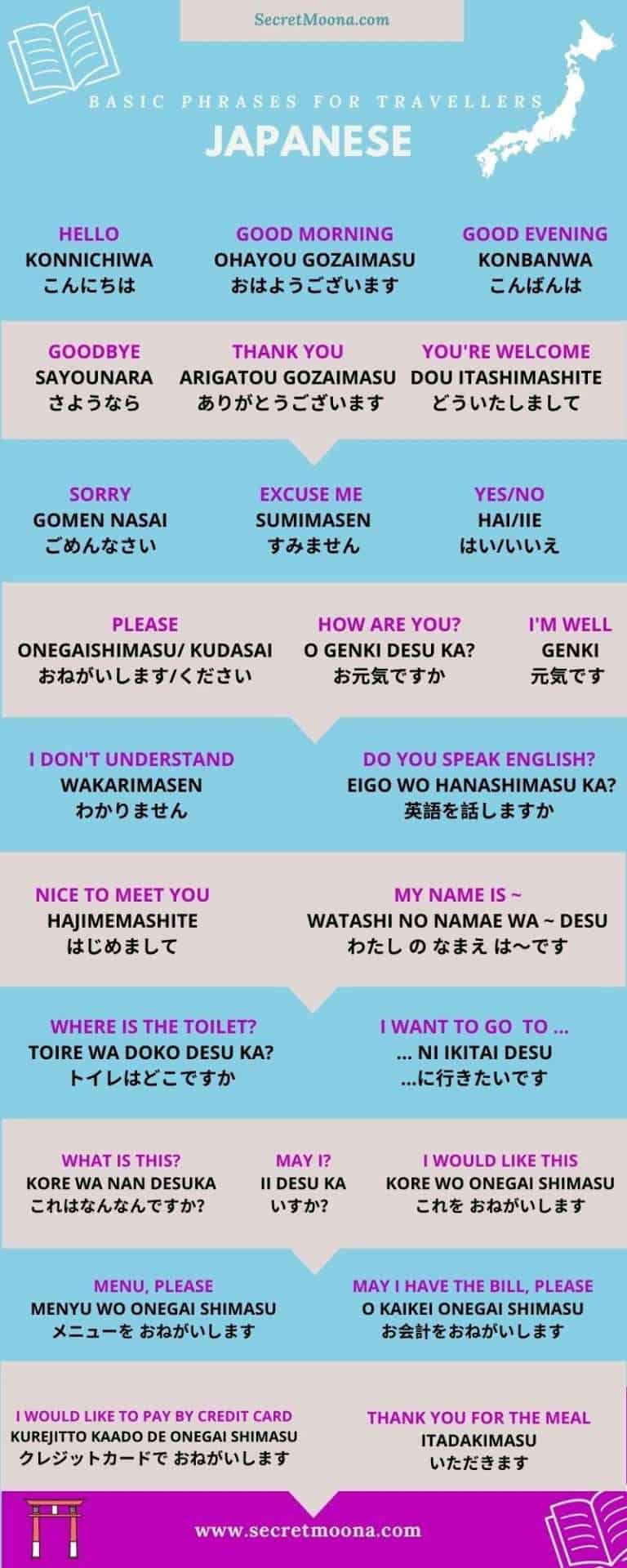
Let's run through a few scenarios. Which phrase would you use?
-
You want to order another drink in a restaurant. How do you get the waiter's attention?
- You would say:
Sumimasen!
- You would say:
-
A shop assistant wraps a gift for you beautifully. What do you say as you receive it?
- You would say:
Arigatou gozaimasu.
- You would say:
-
You are leaving a guided tour. How do you thank the guide for their help during the tour?
- You would say:
Arigatou gozaimashita.(Because the tour is now complete).
- You would say:
-
You need to squeeze past someone to get off a crowded train. What do you say?
- You would say:
Sumimasen.
- You would say:
Conclusion
Excellent work today. By adding arigatou gozaimasu and sumimasen to your vocabulary, you've taken a massive step toward interacting respectfully and effectively in Japan. These are not just words; they reflect a cultural emphasis on gratitude and social harmony.
Key Takeaways:
Arigatou gozaimasu(ありがとうございます) is your standard, polite "thank you."- Use the past tense,
Arigatou gozaimashita(ありがとうございました), to thank someone for a service that is now finished. Sumimasen(すみません) is a versatile phrase used to get attention ("Excuse me"), to apologize for minor things ("Sorry"), and to thank someone for an inconvenience.
Preview of the next lesson:
Now that you can greet people and thank them, it's time to introduce yourself. In our next lesson, we'll learn the simple but essential pattern for stating your name: [Name] desu, and the crucial follow-up phrase, Yoroshiku onegaishimasu.