Introduction
Welcome back! In our last lesson, you took a significant step by learning to recognize the 46 basic hiragana characters. This is the foundation for reading Japanese, and I hope you've had a chance to practice with the quiz tools.
Today, we'll build directly on that knowledge. Think of the basic hiragana as your initial set of tools. Now, we're going to add a few simple modifiers that will dramatically expand what you can do with them. Specifically, this lesson covers how to read hiragana with diacritics (special marks) and in combined forms.
By the end of this lesson, you will be able to:
- Recognize hiragana characters with the
dakuten(゛) andhandakuten(゜) marks. - Read
yōon, which are combined hiragana sounds.
Mastering these will unlock the ability to read almost any word written in hiragana, putting you in a great position to decipher menus and signs during your trip to Japan.
Part 1: Modifying Sounds with Dakuten and Handakuten
The first concept we'll cover involves adding small marks to existing hiragana characters to change their sound. This is a very efficient system. You don't need to learn new shapes, just a new rule.
There are two marks:
- Dakuten (゛): Looks like a small double quote. It "voices" a consonant sound. For example, it turns a 'k' sound into a 'g' sound.
- Handakuten (゜): A small circle. It is only used with 'h' sounds, changing them to 'p' sounds.
The Tofugu guide you used in the last lesson explains this system perfectly. Let's work through it.
Learn Hiragana: The Ultimate Guide - Tofugu
We'll continue with the 'Learn Hiragana: The Ultimate Guide' from Tofugu. This section explains how the dakuten (゛) and handakuten (゜) marks systematically change the pronunciation of certain hiragana rows.
Read the section titled 'Dakuten & Han-Dakuten.' Pay close attention to the four transformations it covers: か (k) → が (g), さ (s) → ざ (z), た (t) → だ (d), and は (h) → ば (b) / ぱ (p). The mnemonics provided can help you remember these changes.
As you read, pay special attention to the few exceptions noted in the guide:
- し (
shi) becomes じ (ji), notzi. - ち (
chi) becomes ぢ (ji), notdi. - つ (
tsu) becomes づ (zu), notdu.
In modern Japanese, じ and ぢ sound identical, as do ず and づ. You just need to be able to recognize them when reading.
Pronunciation Practice
Reading is one thing, but hearing the sounds is crucial. Now, listen to the correct pronunciation of these modified characters.
Download Free Hiragana Katakana Charts (PDF)
This audio resource from MLC Japanese Language School will let you hear the sounds you've just learned to read.
On the webpage, find the 'Practice with Audio' section. Click on the sixth audio link, the one that starts with 'ga, gi, gu, ge, go...'. Listen to these sounds a few times to connect the written character with its correct pronunciation.
This chart provides a complete visual reference for the characters you've learned so far, including the ones with dakuten and handakuten.
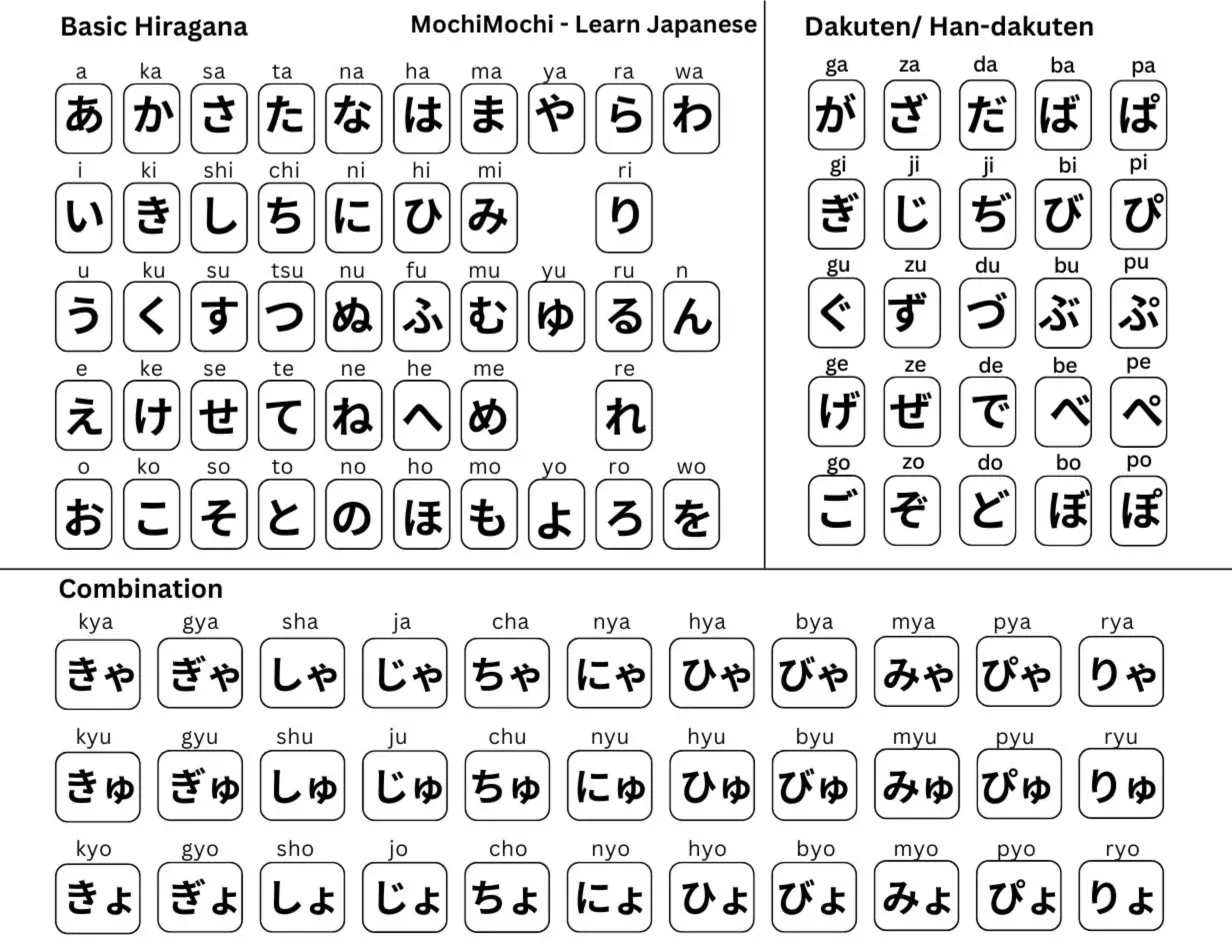
Part 2: Combining Sounds with Yōon
The next and final modification for hiragana is combining characters to create new, blended sounds. These are called yōon (拗音).
The rule is simple: you take a hiragana character from the 'i' column (like き ki, し shi, に ni, etc.) and combine it with a small version of や (ya), ゆ (yu), or よ (yo).
For example:
- き (
ki) + ゃ (smallya) → きゃ (kya). The sound is a single, quick syllable, notki-ya. - し (
shi) + ゅ (smallyu) → しゅ (shu). - り (
ri) + ょ (smallyo) → りょ (ryo).
Let's return to the Tofugu guide to see all the possible combinations.
Learn Hiragana: The Ultimate Guide - Tofugu
This next section of the Tofugu guide explains the yōon combinations. It provides a complete list of these blended sounds.
Read the section titled 'Combination Hiragana.' Go through the list and see how each 'i'-column character combines with the small ゃ, ゅ, and ょ. You don't need to memorize the whole list right now, but understand the pattern.
You'll encounter these sounds frequently. For instance, the word for "today" is きょう (kyō), and "hospital" is びょういん (byōin).
Pronunciation Practice
Once again, let's pair reading with listening.
Download Free Hiragana Katakana Charts (PDF)
This audio file from MLC contains all the yōon sounds.
Return to the 'Practice with Audio' section on the MLC page. Click the seventh and final audio link, which begins with 'kya, kyu, kyo...'. Listen to these blended sounds to get a feel for how they are pronounced.
A Note on the Small tsu (っ)
While reading the Tofugu article, you may have noticed a section on the small tsu (っ). This character is unique: it has no sound on its own. Instead, it creates a brief pause, effectively doubling the consonant that follows it.
- かこ (
kako) vs. かっこ (kakko) - notice the slight pause before the 'k' sound. - きた (
kita) vs. きった (kitta) - notice the pause before the 't' sound.
We won't focus heavily on this today, but it's important to recognize it when you see it. Think of it as a "glottal stop" or a "hiccup" in the word.
Daily Practice
You now have a complete set of hiragana reading skills. The key to making it second nature is consistent, short practice. The tools from the last lesson are still your best bet.
The MLC Quizlet deck is particularly useful, as it includes the dakuten variants.
Download Free Hiragana Katakana Charts (PDF)
For ongoing practice, use the Quizlet flashcards from MLC Japanese. This will help you drill both basic and modified hiragana until recognition becomes automatic.
Revisit the 'Practice with Quizlet' section and click the 'Hiragana Quiz' link. Use the 'Flashcards' and 'Learn' modes to practice all the hiragana, including the new forms you learned today.
Conclusion
Great job! You've successfully added the final layers to your hiragana knowledge. What started as 46 characters has now expanded to cover all the sounds needed for native Japanese words.
Key Takeaways:
- The
dakuten(゛) andhandakuten(゜) marks modify existing hiragana to create new consonant sounds (e.g., K→G, H→P). Yōonare blended sounds created by combining ani-column character with a smallゃ,ゅ, orょ.- With these additions, you can now phonetically read almost any word written in hiragana.
Continue to use the Quizlet deck for a few minutes each day. This short, consistent practice is far more effective than a long, infrequent study session.
Preview of the next lesson:
Now that you've tackled hiragana, we will move on to the second Japanese script: katakana. You'll be pleased to know that katakana represents the exact same sounds as hiragana. The only difference is the shape of the characters and how they are used—primarily for foreign loanwords, which you'll see everywhere on signs, menus, and in stores (e.g., for words like "coffee," "hotel," and "credit card").