Hello. The previous lesson examined rules that can change whether an individual remains enrolled in Medicaid. This lesson examines a different route by which the law can affect Medicaid: it changes how states may raise their share of program funding and how high certain payments to providers may be. Those are federal constraints, but a particular state’s response—finding other revenue, changing payments, or proposing a different program design—is not dictated by the law.
The aim is to trace the money without treating a reduction in a financing tool as an automatic cut to a named patient’s coverage. Allow about 40–45 minutes, including the readings.
Why a provider tax can support more than its own dollar amount
Medicaid generally reimburses a state for a share of eligible spending. That share is the Federal Medical Assistance Percentage, or FMAP. If an eligible payment is and the illustrative federal share is , the accounting is:
A state can use revenue from a tax on health care providers to finance some of its share. The illustration below makes the mechanism concrete.
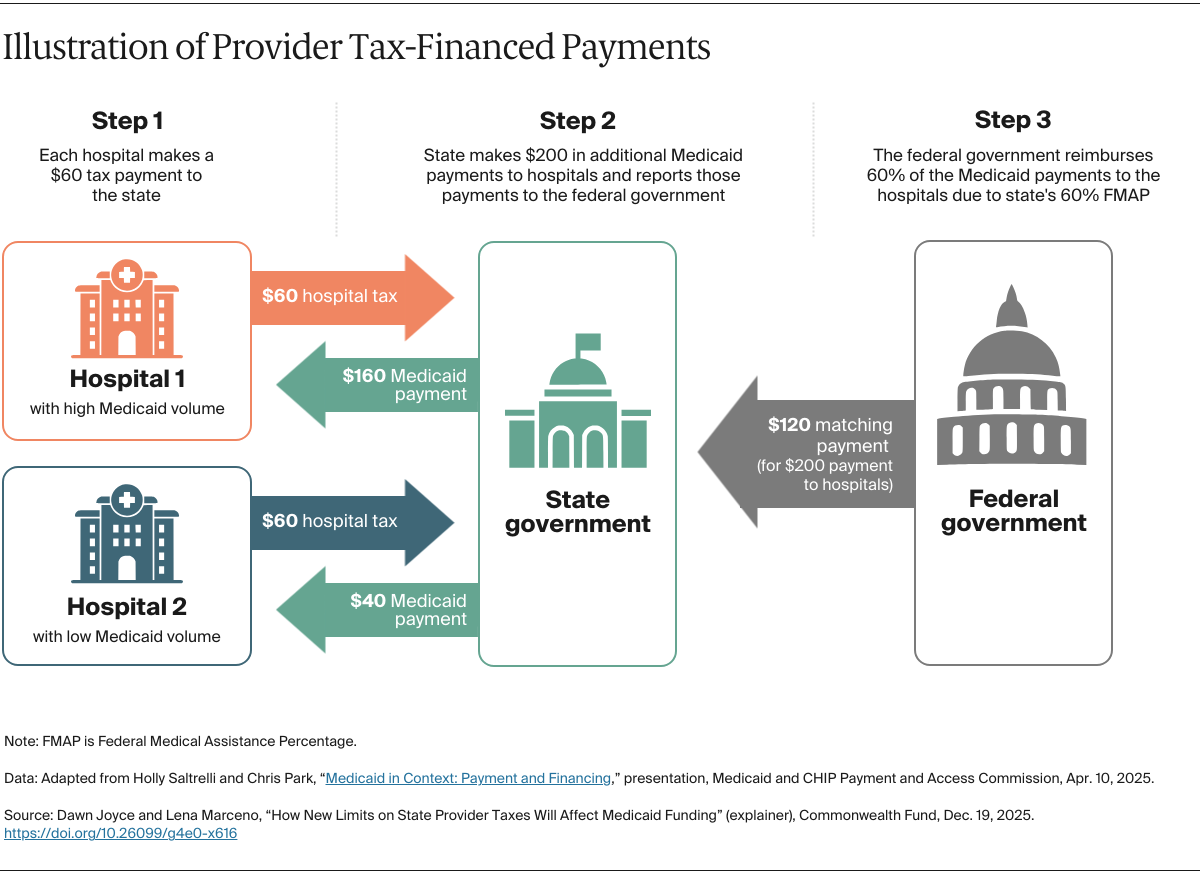
At a 60% FMAP, $200 in eligible payments requires an $80 state share and brings $120 in federal reimbursement. The two taxes raise $120 altogether; the picture does not specify how the $40 beyond the state share for these particular payments is used. Notice also that equal $60 taxes do not mean equal Medicaid payments: the hospitals receive $160 and $40, respectively. The drawing illustrates financing, not a determination that this particular tax satisfies every legal condition.
Provider taxes are subject to federal rules, including rules about taxing a provider class broadly and uniformly and not guaranteeing that taxpayers get their tax costs back. One important existing rule provides a safe harbor under a hold-harmless test when a tax rate does not exceed a specified percentage of net patient service revenue. A safe harbor is not a general authorization for every tax below that rate, nor is its threshold a universal ban on every tax above it.
Health Provisions in P.L. 119-21, the FY2025 ...
Read the Congressional Research Service explanation for the financing rules behind the illustration and the enacted provider-tax change.
In “Section 71115. Provider taxes,” read the “Background” on printed p. 15, beginning with the financing background. Then read “Provision Summary” on printed p. 16, from the new limits. Focus on the distinction between a tax already in place on the enactment date and a new tax, and between expansion and nonexpansion states.
What the provider-tax limit actually changes
Section 71115 restricts states’ use of provider taxes under the hold-harmless guarantee-test safe harbor for fiscal years starting on or after October 1, 2026. The tax rate in place on the law’s July 4, 2025 enactment date is an important reference point. For both expansion and nonexpansion states, a new provider tax cannot enter through this safe harbor at a positive rate; an existing tax cannot simply be increased under it. That is more precise than saying the statute abolishes all provider taxes.
The treatment of existing taxes then diverges:
- In a nonexpansion state, the relevant safe-harbor threshold for an existing tax is generally fixed at its enactment-date rate.
- In an expansion state, most existing provider-tax thresholds are limited to the lower of their enactment-date rate or a scheduled ceiling: 5.5% in FY2028, 5.0% in FY2029, 4.5% in FY2030, 4.0% in FY2031, and 3.5% from FY2032 onward. Existing nursing-facility and intermediate-care-facility-for-individuals-with-intellectual-disabilities taxes are excluded from this particular phase-down.
The “lower of” language matters. A state whose applicable existing rate was already 3% does not gain permission to raise it to 5.5% in FY2028. Nor does the schedule mean every expansion state loses the same number of tax dollars: the effect depends on its existing taxes, rates, and tax bases.
There is a separate change to waivers of the usual uniform-tax requirement. Section 71117 makes specified tax designs ineligible for a waiver on the theory that they are generally redistributive—for example, a design that imposes a higher rate on Medicaid taxable units than on non-Medicaid units. It is effective on enactment, although the HHS Secretary may set a transition period of up to three fiscal years. This rule concerns how a tax is structured; it is not the FY2028–FY2032 percentage schedule.
Health Provisions in P.L. 119-21, the FY2025 ...
Return to the CRS report to see why the uniform-tax waiver rule must be kept separate from the safe-harbor phase-down.
In “Section 71117. Requirements regarding waiver of uniform tax requirement for Medicaid provider tax,” read “Provision Summary” on printed p. 18, beginning at the waiver change. The passage ends just before “Section 71118.” Focus on the three disqualifying tax designs and the distinct effective-date rule.
Suppose, purely for illustration, that the two-hospital example’s tax revenue fell from $120 to $60 while the state still wanted to make the same $200 in eligible payments at a 60% FMAP. The required state share would still be $80. With only $60 of tax revenue available for it, the state would need $20 from another source to maintain those payments. If it supplied no replacement funds and reduced otherwise adjustable, eligible payments instead, a $20 reduction in state financing could correspond to $50 less in total payments, including $30 less federal reimbursement.
That is a conditional calculation, not a statutory order to cut payments by $50. The hypothetical revenue decline is not the law’s prescribed dollar amount. A state might replace funds, redesign financing within the rules, or alter payments or optional program choices, subject to other Medicaid requirements and approvals. The provider-tax limit alone does not tell us which response a state will choose.
A second constraint: ceilings on certain managed-care payments
A state-directed payment is different from a provider tax. It is a payment arrangement under which a state directs how a Medicaid managed-care plan pays providers for covered services, subject to federal approval. The tax concerns a possible source of the state’s funding; the directed-payment rule concerns how high certain provider payments may be. The hospital illustration above is a general financing picture, not a diagram of a managed-care contract.
For specified state-directed payments—including those for inpatient and outpatient hospital services, nursing-facility services, and qualifying practitioner services at academic medical centers—Section 71116 directs a change from a ceiling based on the average commercial rate to one based on the Medicare payment rate. The new ceiling is 100% of Medicare in expansion states and 110% of Medicare in nonexpansion states. It applies to payments furnished during rating periods beginning on or after enactment, with statutory grandfathering for certain existing arrangements that meet the law’s submission or approval conditions. Eligible grandfathered payments begin stepping down January 1, 2028, by 10 percentage points each year until they reach the applicable Medicare-based ceiling.
Health Provisions in P.L. 119-21, the FY2025 ...
Read the CRS account of state-directed payments to distinguish the new ceiling from the grandfathering rule.
In “Section 71116. State directed payments,” read “Background” across printed pp. 16–17, from payment background. Then read “Provision Summary” on printed p. 17, from ceilings and phase-down. Pay attention to the eligible services, the rating-period language, and the conditions for grandfathering.
Consider a hypothetical service for which the relevant Medicare rate is $100. If an expansion state’s otherwise permissible directed-payment rate were $150, the new ceiling would eventually allow no more than $100 under this provision. That illustrates a $50 difference in the provider payment, not a $50 reduction in every hospital’s revenue: actual effects depend on which payments qualify, when their rating periods begin, whether grandfathering applies, service volume, and what the state does with other payments.
The two limits can interact. Less permissible provider-tax revenue may make the state share harder to finance, while a lower directed-payment ceiling can restrict one way of paying providers even if the state finds other revenue. They do not produce a single automatic calculation of coverage losses or hospital closures.
The rural program is funding, but not replacement matching money
The same law establishes a Rural Health Transformation Program, appropriating $10 billion per fiscal year from FY2026 through FY2030—$50 billion over those five years. States must apply with a rural health transformation plan; approved states receive allotments. The program has permissible uses such as workforce support, technology and care-delivery improvements, and certain provider payments specified by the CMS Administrator. It does not require a state matching contribution.
Its most important financing distinction here is explicit: a state may not use these allotments to finance the nonfederal share of Medicaid spending. The funds can support eligible rural health activities, but they cannot simply be inserted as the missing $20 state share in the earlier matching example.
Health Provisions in P.L. 119-21, the FY2025 ...
Use the CRS description of the Rural Health Transformation Program to separate its grant-like allotments from ordinary Medicaid matching funds.
In “Section 71401. Rural Health Transformation Program,” read the first paragraph of “Funding” on printed p. 34, from the appropriation. In “Application” on pp. 34–35, begin where eligibility to apply is described and continue through the plan and restriction; the latter ends immediately before “Deadline for Approval.” Then consult “Allotments” on p. 35, from the allocation rules. Finally, on pp. 36–37, read from “No Matching Payment” through “Terms and Conditions” and “Use of Funds,” starting at conditions and uses. Focus on what the statute funds, what requires a state plan or administrative specification, and what the money cannot finance.
The statute sets the total appropriation and the allocation framework: half of each year’s funding is divided equally among states with approved applications, while the other half is allocated under specified criteria and administrative judgment. Thus, “$50 billion for rural health” is a national, multiyear appropriation, not $50 billion for each state, an automatic payment to each rural hospital, or a dollar-for-dollar offset to the provider-tax and directed-payment limits.
Keep the three decisions distinct
A useful way to read a claim about a state Medicaid budget is to identify which decision it describes.
| Claim | What the enacted law establishes | What still depends on implementation or state choice |
|---|---|---|
| “The state can collect its old provider-tax revenue indefinitely.” | New safe-harbor limits and, for many existing taxes in expansion states, a scheduled threshold phase-down. | Which taxes are affected, how much revenue changes, and how the state replaces or reallocates funds. |
| “Hospitals must all be paid at the Medicare rate now.” | A Medicare-based ceiling for specified state-directed payments, with distinct expansion-state and nonexpansion-state limits and possible grandfathering. | Which arrangements qualify, their timing, and the state’s approved payment design. |
| “Rural funding restores the lost federal Medicaid match.” | A separate, time-limited rural program with specified uses and no state-match requirement. | Approved state plans and allotments; its funds cannot finance Medicaid’s nonfederal share. |
The core distinction is between a financing constraint and a chosen response. In the simplified example, a shortfall in money available for the state share explains why a state might seek other funds or change adjustable payments. It does not establish that the law commands a specific eligibility cut, provider-rate cut, or service reduction.
Key takeaways
Provider taxes help states finance their Medicaid share and thereby support federally matched spending. P.L. 119-21 narrows a tax safe harbor, phases down relevant thresholds for most existing provider taxes in expansion states, and separately restricts certain tax designs seeking a uniformity waiver. It also places Medicare-based ceilings on specified state-directed payments, subject to timing and grandfathering rules. The Rural Health Transformation Program supplies separate, temporary funding for approved state plans, not money a state can use as its Medicaid matching share.
The next lesson returns to coverage, examining Marketplace and Medicare changes—and why effects attributed to this law must be distinguished from the separately scheduled expiration of enhanced Affordable Care Act subsidies.