Hello. This module turns from taxes to health coverage. In this lesson, you will use the enacted law as a set of separate eligibility tests: which adults are affected, what can satisfy or excuse the work-related requirement, how often eligibility is renewed, and how a distinct immigration-status restriction can change the result. The central distinction is between a federal requirement and a choice a state is allowed to make when implementing it.
By the end, you should be able to work through a short adult case without assuming that “not working” means “ineligible,” or that an exemption from work-related requirements also means an exemption from renewal.
Start with the coverage category and the date
P.L. 119-21, enacted July 4, 2025, calls its Medicaid work-related rule a community engagement requirement. It generally begins January 1, 2027. Its principal target is the Medicaid adult expansion group: adults generally aged 19 through 64 who qualify through that coverage category. Certain adults receiving qualifying coverage through a Medicaid waiver can also be subject to it. It is not a work test for everyone on Medicaid; a parent in another eligibility group, for example, must be assessed under the rules for that group.
The category question matters twice because the law also requires six-month eligibility renewals for almost all members of the adult expansion group beginning with renewals scheduled on or after January 1, 2027. The populations subject to the two changes overlap substantially, but they are not identical. An adult can be excused from demonstrating community engagement and still need a six-month renewal.
Before applying either rule to a case, establish the date and the person’s eligibility group. The January 2027 federal start does not prove that a particular state started earlier: earlier implementation is an option requiring the appropriate state-plan or waiver route. Nor does the possibility of a temporary, federally approved implementation delay mean that every state has one.
What counts—and who does not have to demonstrate it
For a person subject to community engagement, 80 hours in a month is one way to meet the requirement, but paid employment is not the only qualifying activity. The law also recognizes community service, participation in a qualifying work program, and combinations of qualifying activities totaling 80 hours. Enrollment in an educational program at least half-time is another route. A monthly earnings test can also suffice: at the federal minimum wage used in the CMS guidance, earnings of at least $580 meet that test. A separate earnings alternative applies to certain seasonal workers.
Read the CMS guidance with two questions in mind: Is this person in a covered eligibility group? If so, do they need to demonstrate activity at all?
Read the Centers for Medicare & Medicaid Services (CMS) bulletin to distinguish the adults covered by the rule from the activities and exclusions within it.
In Section IV, “Applicable Individuals” (pp. 3–4), read from the paragraph beginning “The Medicaid applicants and beneficiaries who must demonstrate community engagement” through the end of the section; the coverage test anchors the passage. In Section V, “Community Engagement” (pp. 4–5), read the qualifying routes. Then read Section V’s “Exclusions from and Exceptions to Community Engagement Requirements” (pp. 5–7), from the paragraph beginning “Individuals meeting the definition of a” to its final hardship example; the exclusion list covers that span. Focus on which protections apply by law and which short-term hardship exception depends on a state option.
The most useful exclusions to recognize in an adult case include pregnancy or qualifying postpartum coverage; being a parent, guardian, caretaker relative, or family caregiver of a dependent child aged 13 or younger or of a disabled person; qualifying American Indian or Alaska Native status; medical frailty or specified special medical needs; and a veteran’s disability rated as total. Other specified circumstances include participation in a qualifying addiction treatment program and certain connections to SNAP or TANF work rules. Medicare enrollment and some other eligibility circumstances can make the monthly requirement inapplicable. An exclusion is a legal category to establish, not an assumption based simply on whether someone has a job.
For instance, consider a 42-year-old in the adult expansion group who provides care for a dependent 12-year-old child and has no paid hours. The caregiving exclusion, rather than an 80-hour calculation, resolves the community engagement question if the qualifying facts are established. That does not settle whether the adult meets the program’s other eligibility conditions, or whether a six-month renewal applies.
Verification is not the same as working every month
The statute sets monthly ways to satisfy community engagement, but its verification rules ask states to review specified months. At application, the federal minimum is at least one month immediately before the application month. A state may instead require two or three consecutive preceding months, but not a longer application look-back under this provision. Thus, an applicant applying in January 2027 might need to show December 2026, or October through December 2026 if their state elects the three-month option.
At renewal, a state must verify one or more months between renewals, as specified by the state. Those months need not be consecutive. States may also elect to check more often between renewals. It would therefore be misleading to turn “80 hours in a qualifying month” into the blanket claim that every affected adult must submit proof of 80 paid work hours every month.
States must first try reliable information already available to them to establish either compliance or that the rule does not apply. Only if that information is insufficient may they request more from the person. If the state still cannot verify either point, it must send a noncompliance notice and allow 30 calendar days from receipt to demonstrate compliance or inapplicability. An enrolled person keeps Medicaid assistance during that period. Before denying an application or terminating coverage, the state must consider other possible bases of eligibility and provide the required notice and hearing rights.
Continue the same CMS bulletin for the difference between a federal verification rule, a state option, and the procedure following an unsuccessful check.
In Section VI, “Demonstrating and Verifying Community Engagement” (pp. 7–8), read from “States must require applicable individuals who have filed an application for Medicaid” through the paragraph on using available information; verification rules spans the relevant discussion. In Section VII, “Procedures in the Case of Non-Compliance” (p. 9), read its first paragraph from notice to decision; stop before the separate premium-tax-credit discussion. In Section X, “Timeline for Implementation, and Temporary Exemption for Good Faith Effort” (p. 11), read from its opening sentence stating the January 1, 2027 start through the paragraph on when an approved exemption expires. State timing options anchors the latter part.
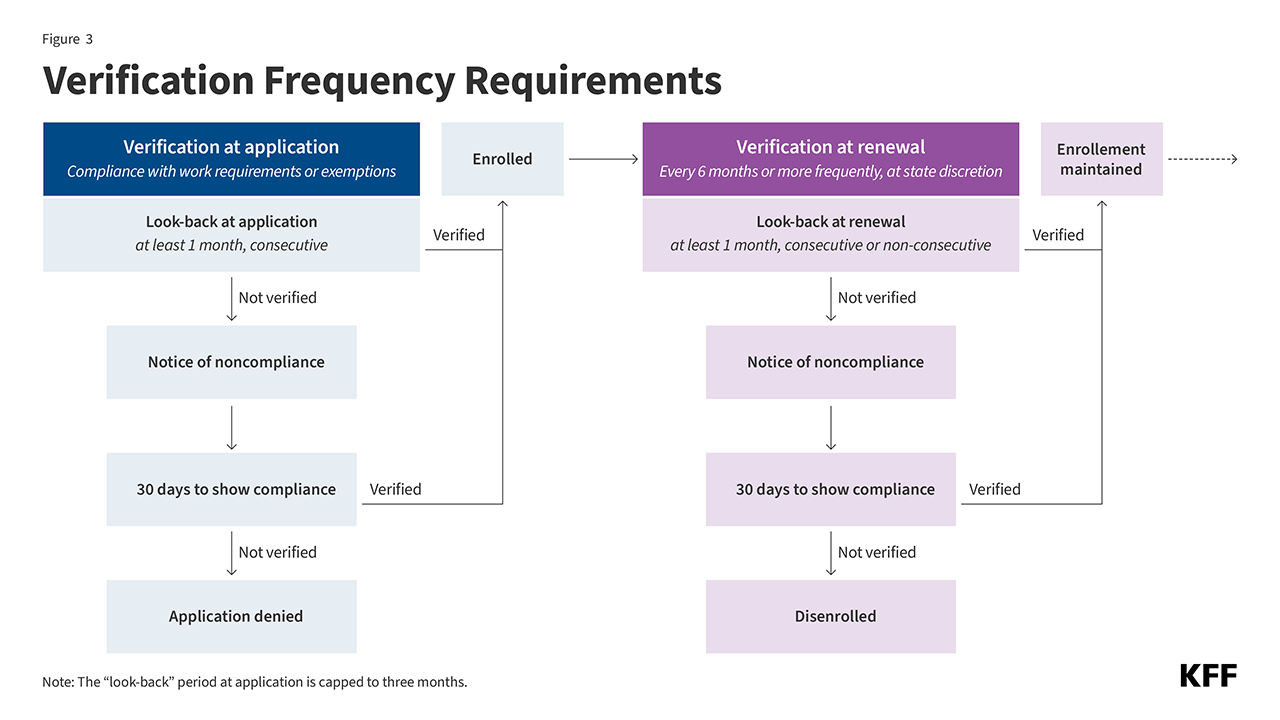
Take a January 2027 applicant who meets the other conditions for adult expansion coverage. Suppose their state chose two preceding months, and the applicant can establish qualifying activity in December but not November, with no applicable exclusion. December alone does not meet that state’s two-month application test. The next step is notice and an opportunity to show compliance or inapplicability, not an instantaneous denial. The 30 days are an opportunity to respond; they do not, by themselves, replace the state’s required look-back months with a new month.
Renewal frequency is a separate question
For almost all people enrolled in the adult expansion group, the law moves periodic Medicaid eligibility renewal from once every 12 months to once every six months, beginning with renewals scheduled on or after January 1, 2027. Certain American Indians and Alaska Natives are exempt from this six-month renewal rule. People in other income-based Medicaid eligibility groups generally keep annual renewals, while different rules govern non-income-based groups. Being excluded from community engagement—for example, because of caregiving—does not itself exempt an adult expansion enrollee from six-month renewal.
CMS guidance gives states two transition options for people already enrolled with a 12-month eligibility period when 2027 begins. A state may bring their renewal forward, subject to the guidance’s safeguards, or keep an already scheduled 2027 renewal and give an eligible person a six-month period after that renewal. Consequently, “the new rule starts in January” does not mean every existing enrollee must have a renewal in January.
Section 71107: Implementation of “Eligibility Redeterminations”
Read this CMS state-director guidance to separate the six-month renewal population from the community-engagement population, then see why existing enrollees may transition on different dates.
In “Populations Subject to 6-Month Renewals” (pp. 3–4), read from “First, this requirement applies” through the January 2027 start; covered renewals anchors it. In “Exemptions for American Indians and Alaska Natives and Treatment of Other Eligibility Groups” (pp. 4–5), read the full list and the paragraph beginning “In accordance with”; other groups anchors the concluding comparison. Read the short paragraph beginning “Thus, states will generally need to make policy” under “Implications for Requirement for States to Establish Medicaid Community Engagement Requirements” (p. 5); overlapping rules states the key distinction. Finally, in “Transitioning to 6-Month Renewals” (pp. 6–10), read its opening statutory-date paragraph and the paragraphs beginning “States have two options,” “Under Option 1,” and “Under Option 2.” You can skip the numbered individual examples; focus on whether an already scheduled 2027 renewal is moved.
An enrollee finishing a period of postpartum coverage illustrates why the eligibility group at renewal matters. The postpartum period is not simply cut to six months because the adult expansion group has a new schedule. At the end of that period, the state considers other bases of eligibility. If the person then qualifies in the adult expansion group, the state must assess applicable community engagement rules and, if enrollment continues in that group, use its six-month renewal period.
Add the separate immigration-status screen
The two CMS readings concentrate on community engagement and renewals. P.L. 119-21 also makes a separate Medicaid and CHIP eligibility change effective October 1, 2026: it narrows the noncitizen categories eligible for federally funded coverage. Alongside U.S. citizens and nationals, the permitted categories include lawful permanent residents, certain Cuban and Haitian entrants, and citizens of nations covered by the Compacts of Free Association. Other existing eligibility conditions—including applicable waiting-period rules—still matter.
For an adult seeking federally funded, full Medicaid coverage, having lawful presence alone does not establish eligibility under this narrower rule. A person whose only relevant status is asylum, for example, should not be treated as eligible merely because they could satisfy an 80-hour activity test; their immigration category must be checked first. Conversely, a qualifying immigration category does not establish income eligibility or remove a community engagement requirement. Emergency-services coverage and coverage financed solely by a state raise different questions; do not infer their outcome from the full-coverage rule.
This change begins three months before the general January 2027 community-engagement start. When comparing a case in September 2026 with the same facts in October 2026, the immigration-status provision may therefore be the decisive new rule—not a work test that has yet to start.
A compact guide for adult cases
Use these screens in order, while remembering that a definite eligibility decision still requires the person’s full facts and the applicable state rules.
| Screen | What to establish | Date or state choice that matters |
|---|---|---|
| Coverage and immigration status | Is there a Medicaid eligibility category, and does the person meet its citizenship or qualifying-status rules? | The narrower noncitizen rule generally takes effect October 1, 2026. |
| Community engagement scope | Is the adult in the expansion group or covered waiver population, rather than another Medicaid group? | General federal start: January 1, 2027; permitted earlier implementation or an approved temporary delay needs separate confirmation. |
| Activity or inapplicability | Does a qualifying activity or earnings route apply, or is the person excluded or excepted? | Evaluate the relevant month and the person’s circumstances in it. |
| Verification and response | Which preceding months does the state require at application? Which months does it check at renewal? Can it verify using existing information? | Application: one to three consecutive preceding months, at state option. Renewal: one or more months between renewals; notice affords 30 days to respond if verification fails. |
| Continued enrollment | Is this person in the group subject to six-month eligibility renewals, and is there another basis for coverage if one test fails? | Six-month renewal rule begins with renewals scheduled on or after January 1, 2027; transition timing for existing enrollees can differ. |
The distinction between the last two rows is especially important. A renewal rechecks eligibility more broadly. A community engagement check addresses one condition of eligibility and may occur at renewal or, if a state elects, more often. Neither check means an otherwise eligible person necessarily loses coverage: available records, exclusions, a response to notice, and other eligibility bases must be considered.
Key takeaways
The enacted law creates multiple screens, not one universal “Medicaid work rule.” For an adult case, establish the coverage group and date first; check the separate October 2026 immigration-status change; then apply the January 2027 community-engagement rule only if the person is in its covered population. Qualifying education, service, work, or earnings—and statutory exclusions—can change that answer. Finally, assess renewal frequency separately: an adult exempt from community engagement may still face six-month renewals.
The next lesson shifts from individual eligibility to state financing: how provider-tax and payment limits can affect state Medicaid budgets, and why a possible state response should not be mistaken for a direct statutory instruction to cut a particular person’s coverage.