The previous lessons separated changes to Medicaid enrollment rules from changes to state Medicaid financing. This lesson turns to two other kinds of coverage: Marketplace insurance, where the central question is often whether someone receives help paying for a plan, and Medicare, where one provision changes who may enroll or remain enrolled.
The key to attribution is to name both the policy and the comparison point. A higher Marketplace bill in 2026, for example, is not automatically an effect of P.L. 119-21: enhanced Affordable Care Act (ACA) tax credits were already scheduled to expire. Allow about 40 minutes, including the readings.
First separate the law from the scheduled subsidy expiration
A Marketplace premium tax credit reduces what an eligible household pays for a qualifying plan. Enhanced credits, introduced in 2021 and extended through 2025, increased that assistance. They also made credits available to some households above 400% of the federal poverty level (FPL) that would not qualify under the otherwise applicable income limit.
P.L. 119-21 did not extend those enhanced credits. Their scheduled expiration and the law’s new restrictions on credits are therefore two distinct explanations for a change in someone’s 2026 costs. Under the current-law comparison used for the estimates discussed here, the expiration was already expected; it was not scored as a new change made by P.L. 119-21.
Health Provisions in the 2025 Federal Budget Reconciliation Law | KFF
Read KFF’s account of the enhanced premium tax credits to establish the comparison point before examining the enacted law’s Marketplace provisions.
In the “Affordable Care Act” portion, find “Expiration of Enhanced Premium Tax Credits.” Begin with the Background paragraph opening “The enhanced premium tax credits were first made available” and read the comparison through the Description’s projected coverage and premium effects. Check the effective-date line immediately below. Focus on why not extending an expiring policy differs from enacting a new restriction.
The distinction also applies to the word premium. A plan’s gross premium is its price before a credit; the net premium is what the household pays after the credit. In a purely illustrative case, a gross premium of $650 and a $450 credit leave $200 to pay. If the next year’s gross premium is $680 and the credit falls to $300, the household pays $380. The $180 increase combines a $30 change in the plan price with a $150 change in assistance. It cannot be attributed to one statute without examining why each component changed.
The following chart illustrates the same attribution problem at the population level. It shows a projection for 2034, not an observed count of people who lost coverage.
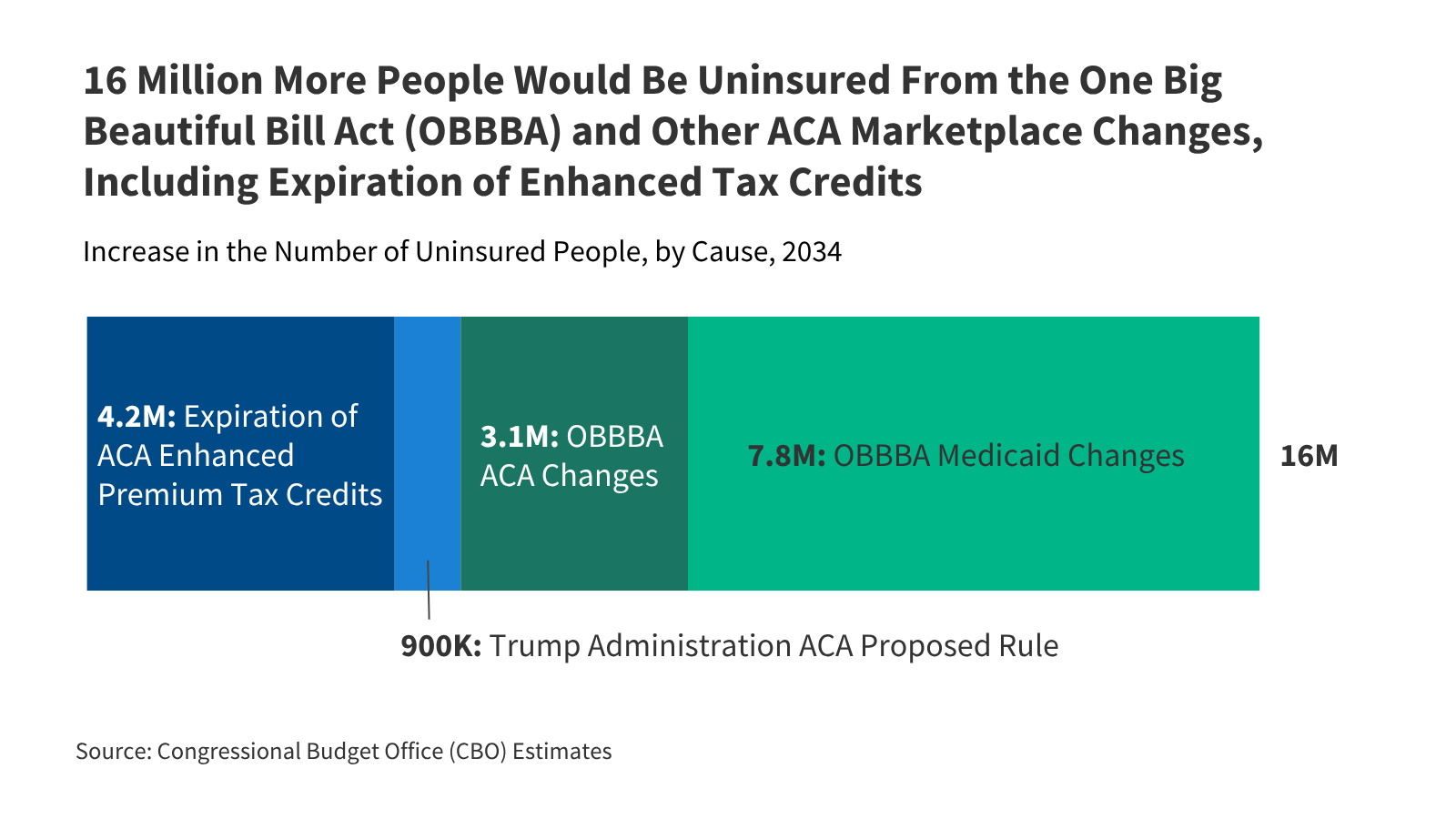
The chart labels 4.2 million of the projected increase as associated with expiration of enhanced credits and 900,000 with a separate proposed rule. Its law-labeled components are 3.1 million for ACA changes and 7.8 million for Medicaid changes. Thus, “the law makes 16 million people uninsured” misattributes parts of this particular projection. The figures are estimates under a specified set of policies, not statements that any identified individual will become uninsured.
What the enacted law changes in the Marketplace
P.L. 119-21’s principal Marketplace coverage provisions concern eligibility for a premium tax credit, verification of that eligibility, and repayment of excess credits. They generally do not say that everyone affected is prohibited from buying a Marketplace plan. Losing financial assistance, being unable to receive it while information remains unverified, and losing the ability to enroll are different outcomes.
The Congressional Research Service (CRS) sets out the enacted provisions together, including distinctions that matter in short coverage cases.
[PDF] Health Provisions in P.L. 119-21, the FY2025 Reconciliation Law
Read CRS’s “Private Health Insurance Provisions: Premium Tax Credit” for the five statutory changes. Its provision summaries are more precise than treating every Marketplace enrollment difficulty as the same legal restriction.
On pp. 29–31, start in “Private Health Insurance Provisions: Premium Tax Credit” with the paragraph explaining what a PTC does. Read Sections 71301–71305, stopping after the provision summary for Section 71305. Pay particular attention to the difference between the two noncitizen provisions, what must be verified under Section 71303, and the type of special enrollment period addressed by Section 71304.
Three provisions can affect assistance starting in 2026, but in different ways.
First, Section 71302 removes a specific route to a credit for a lawfully present person with income below 100% of FPL who is ineligible for Medicaid because of immigration status. Previously, the exception could allow a credit despite income below the usual Marketplace threshold—for example, where a Medicaid waiting period applied. From tax years beginning after December 31, 2025, that exception no longer supplies a credit. This is not a rule that all lawfully present people lose Marketplace assistance.
Second, Section 71304 disallows credits for coverage obtained through certain income-based special enrollment periods not connected to a qualifying change in circumstances. It applies to plan years beginning after December 31, 2025. A person enrolling after a qualifying life event should not automatically be placed in the same category merely because both people enrolled outside the usual open-enrollment period.
Third, Section 71305 removes the income-based limits on repayment of excess advance premium tax credits for tax years beginning after December 31, 2025. Advance credits are calculated using estimated income; the tax return reconciles them against the credit actually allowed. If a household received $5,000 in advance but qualifies for only $4,000, the $1,000 excess must be repaid in full under the new rule, regardless of income. This is a change to the household’s possible tax-time repayment, not a statement that its plan was canceled.
The later changes concern which noncitizens can receive a credit and when eligibility must be verified. From tax years beginning after December 31, 2026, Section 71301 limits the specified noncitizen categories eligible for a premium tax credit to lawful permanent residents, qualifying Compact of Free Association migrants, and Cuban-Haitian entrants. A lawfully present refugee or asylee outside those categories may consequently lose credit eligibility in 2027 even if otherwise allowed to purchase a Marketplace plan. U.S. citizens and nationals remain governed by the other applicable credit requirements.
From tax years beginning after December 31, 2027, Section 71303 allows a credit only where the exchange verifies required application information, including income, household size, residence, relevant coverage status, and any applicable immigration status. For a household with an unresolved verification issue in 2028, the important distinction is between enrolling in coverage and receiving financial assistance for it. Do not describe this as a blanket statutory ban on Marketplace enrollment or assume that every existing plan necessarily terminates.
| If a brief case says… | Check first |
|---|---|
| “My 2026 credit is smaller, or I am above 400% of FPL.” | The scheduled end of enhanced credits, before assigning an effect to P.L. 119-21. |
| “I am below 100% of FPL and barred from Medicaid because of immigration status.” | The law’s 2026 change to the below-100% exception. |
| “I used an income-based special enrollment period without a qualifying life event.” | The law’s 2026 special-enrollment credit restriction. |
| “My estimated income was too low and I received excess advance credits.” | The law’s full-repayment rule, beginning with 2026 tax years. |
| “I am a lawfully present noncitizen seeking a credit in 2027.” | Whether the person falls within Section 71301’s specified categories. |
| “My 2028 application information has not been verified.” | The law’s verification condition for financial assistance. |
A case can involve more than one row. A household’s credit might shrink because enhanced credits expire and then be unavailable for an independent reason under the enacted law. Attribution does not require choosing just one cause when two distinct rules apply.
Medicare: a change to eligibility, with a transition for existing beneficiaries
Medicare requires a different starting question. Section 71201 limits Medicare entitlement or enrollment to U.S. citizens, U.S. nationals, lawful permanent residents, Cuban-Haitian entrants, and qualifying Compact of Free Association migrants, provided they meet Medicare’s other requirements. Being in a listed group does not, by itself, establish Medicare eligibility; age, disability, work history, or other applicable criteria still matter.
[PDF] Health Provisions in P.L. 119-21, the FY2025 Reconciliation Law
Return to the CRS report for the Medicare rule. Read it to distinguish someone seeking Medicare after enactment from someone already covered on enactment day.
In “Medicare Provisions,” find “Section 71201. Limiting Medicare coverage of certain individuals” on pp. 26–27. Begin with the Background paragraph opening “Medicare is available” and read the eligibility rule through the end of its Provision Summary. Note both the July 4, 2025 enactment date and the separate date specified for people already entitled to or enrolled in Medicare.
For someone not already entitled to or enrolled in Medicare on July 4, 2025, the new status restriction applies from enactment. For a person already entitled to or enrolled on that date, whose status is no longer within the permitted groups, the statute provides an 18-month transition: termination takes effect January 4, 2027. It also requires a review and notice process for affected existing beneficiaries.
Compare two otherwise Medicare-qualified asylees. One applies for the first time after July 4, 2025; the new restriction bars that person’s Medicare enrollment. The other was already enrolled on July 4; the transition, review, and notice provisions govern that person’s existing coverage. It would be incorrect to assign both the same immediate termination date. It would also be incorrect to conclude from loss of Medicare alone that either person must remain uninsured: other possible coverage is a separate question.
Finally, Medicare enrollment is not the same as assistance with a Medicare beneficiary’s costs. A low-income beneficiary may also be affected by rules concerning a Medicare Savings Program, which is Medicaid help with Medicare premiums or cost sharing. An effect on that assistance should not be reported as if Section 71201 itself had ended the person’s Medicare entitlement.
A reliable attribution statement
For each coverage account, identify the program, the affected group, the date, and the outcome. Then state what the evidence does not show. Compare these formulations:
-
Too broad: “The new law ended ACA subsidies in 2026.”
More precise: “Enhanced ACA credits were already scheduled to expire after 2025; P.L. 119-21 separately imposed specified credit-eligibility and repayment changes beginning in 2026, with other restrictions beginning later.” -
Too broad: “A Marketplace applicant with missing documents cannot get health insurance.”
More precise: “Starting with 2028 tax years, the law conditions the premium tax credit on verification. An unresolved verification issue does not, by itself, establish that the person is forbidden to enroll in a plan.” -
Too broad: “Medicare coverage ended for all affected noncitizens when the law passed.”
More precise: “The new status restriction applied at enactment to people not already enrolled or entitled; affected people already covered on July 4, 2025 have a statutory transition to January 4, 2027.”
These statements leave room for the facts a short case may not supply: exact immigration category, income, enrollment route, verification result, existing Medicare status, and available alternative coverage. They also keep a statutory rule distinct from a projection of how many people may become uninsured.
Key takeaways
Marketplace attribution starts by separating the scheduled expiration of enhanced ACA credits from P.L. 119-21’s own rules. The law changes a below-100%-of-FPL credit exception, certain special-enrollment credits, excess-credit repayment, specified noncitizens’ credit eligibility, and verification—each with its own start date. A loss of credit is not necessarily a loss of the ability to purchase coverage.
For Medicare, Section 71201 changes eligibility for specified noncitizens, with an immediate rule for prospective applicants and an 18-month transition for affected existing beneficiaries. Coverage projections, including the chart’s 2034 total, must be read against their policy components rather than assigned wholesale to the enacted law.
The next module moves from health coverage to nutrition assistance, beginning with how the law changes SNAP eligibility in adult cases.