Hello! Welcome to the next lesson in our module on CPU and System Architecture.
In our previous session, we explored the critical world of cache coherency. We learned how hardware protocols like MESI maintain data consistency between CPU cores and how software must explicitly manage cache clean and invalidate operations when working with non-coherent peripherals like DMA. This established the importance of ensuring a consistent view of memory for all agents in a system.
Today, we're moving up one level in the memory hierarchy to discuss another fundamental concept in modern computing: virtual memory. This layer of abstraction is managed by the Memory Management Unit (MMU) and is the foundation for how operating systems like Linux and Windows manage processes, memory, and security.
Your learning outcome for this lesson is to: Describe virtual-to-physical address translation via paging and the role of the TLB, analyzing the performance impact of misses.
We will cover:
- The problems solved by virtual memory and the role of the MMU.
- The mechanics of paging and how page tables map virtual addresses to physical addresses.
- How the Translation Lookaside Buffer (TLB) acts as a high-speed cache to make this process efficient.
- The performance implications of TLB misses and page faults—key topics for senior-level interviews.
Why Do We Need Virtual Memory?
In many simple embedded systems, applications run directly on "bare metal," accessing physical memory addresses. With your background in automotive embedded systems, you've likely worked on such platforms, perhaps using a Memory Protection Unit (MPU) for basic region protection.
However, for complex systems running feature-rich operating systems (like Linux in an infotainment system or QNX in ADAS), this direct access model has major limitations. Virtual memory, enabled by the MMU, was developed to solve these problems.
Deep Dive: MMU Virtualization with Xen on ARM
To start, let's get a high-level overview of what problems virtual memory solves and what trade-offs it introduces. The article 'Deep Dive: MMU Virtualization with Xen on ARM' provides an excellent historical context and justification.
Please read the following sections: 'A brief MMU history lesson': This section explains the origins of virtual memory and its key benefits, such as larger address spaces, process isolation, and memory protection. 'Should an MMU always be used when designing a system?': This part discusses the trade-offs, contrasting the simple thread model of many RTOSes with the process model used by operating systems like Linux. This should connect well with your experience.
The key takeaways are that virtual memory provides:
- Isolation: Each process gets its own private virtual address space. A bug in one application cannot corrupt the memory of another application or the OS kernel. This is essential for system stability and security.
- Flexibility: An application's memory can be scattered across non-contiguous physical frames but appear as a single, contiguous block in its virtual address space.
- Efficiency: It enables features like demand paging (loading data from disk only when needed) and allows multiple processes to share a single physical copy of a library.
The Mechanism of Virtual Memory: Paging
The core mechanism used by modern MMUs to implement virtual memory is called paging. The basic idea is to divide both the virtual address space and the physical memory (RAM) into fixed-size blocks.
- A block in virtual memory is called a page.
- A block in physical memory is called a frame.
The MMU's job is to translate each virtual page to a corresponding physical frame. This mapping information is stored in a data structure called a page table.
A virtual address generated by the CPU is split into two parts:
- Virtual Page Number (VPN): The upper bits of the address, which act as an index into the page table.
- Page Offset: The lower bits of the address, which specify the byte's location within the page. This offset is not translated and remains the same in the physical address.
The video below provides an excellent animation of this process and the structure of page tables.
Page Tables and MMU: How Virtual Memory Actually Works Behind the Scenes (Animation)
The video 'Page Tables and MMU' by BitLemon provides a clear, animated explanation of how page tables work and what information they contain.
Please watch the following segments: 00:00 - 02:31: This part introduces the page table as the core data structure for mapping virtual pages to physical frames and discusses the challenge of their size. 02:31 - 04:43: This details the contents of a single Page Table Entry (PTE). Pay attention to the different bits: physical frame number, protection bits (read/write/execute), and status bits (present, dirty, accessed).
Each process has its own page table. When the OS performs a context switch, it updates a special CPU register (e.g., TTBR0 on ARM, CR3 on x86) to point to the page table of the next process to run.
The Performance Problem and its Solution: The TLB
There's a significant performance issue with this scheme. To execute a single memory access (e.g., MOV R0, [R1]), the CPU would need to:
- Access main memory to read the page table to find the physical address.
- Access main memory again to read the actual data at that physical address.
This effectively doubles the time for every memory access, which is prohibitively slow. To solve this, hardware designers added a specialized cache inside the MMU. This cache is called the Translation Lookaside Buffer (TLB).
The TLB is a small, very fast cache that stores recently used virtual-to-physical address translations (i.e., copies of PTEs).
The address translation flow now becomes:
- The CPU generates a virtual address.
- The MMU extracts the VPN and checks the TLB.
- TLB Hit: If the translation is in the TLB, the physical frame number is retrieved instantly. The physical address is formed and sent to the memory controller. This is the fast path.
- TLB Miss: If the translation is not in the TLB, a much slower process begins. The hardware (or OS, in some RISC architectures) must perform a "page table walk" by reading the page table from main memory to find the correct PTE. Once found, this translation is loaded into the TLB, and the instruction is retried, which will now result in a TLB hit.
This entire flow is perfectly illustrated in the following diagram.
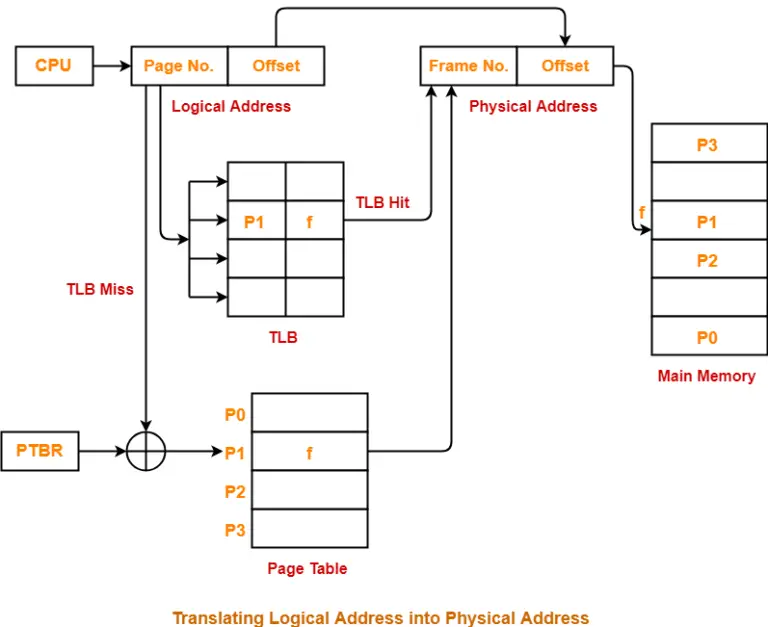
Let's watch a video that walks through this hit/miss process.
Page Tables and MMU: How Virtual Memory Actually Works Behind the Scenes (Animation)
The 'Page Tables and MMU' video also explains the role of the MMU and TLB in this process. The next segment animates the hit and miss scenarios.
Continue with the same video: 04:43 - 06:13: Introduces the MMU as the hardware that performs the translation and the performance problem of page table lookups. 06:13 - 08:07: Explains what the TLB is, its contents (including the important ASID), and its role in accelerating translation. 08:07 - 10:20: Walks through the step-by-step process of a TLB hit vs. a TLB miss. This is the core concept.
Performance Analysis: The Cost of a Miss
As an engineer preparing for interviews at companies like Qualcomm or NVIDIA, you must be able to analyze the performance implications. The cost of a TLB miss is significant because it requires at least one extra main memory access, which is orders of magnitude slower than a cache hit.
To reinforce this, let's look at a concrete example.
Virtual Memory: 11 TLB Example
This video from David Black-Schaffer provides a more direct, lecture-style walkthrough of TLB hits, misses, and page faults.
Watch these short clips to see the concepts in action: 00:35 - 01:26: A TLB miss that requires a page table lookup in main memory. 01:26 - 01:57: A subsequent TLB hit for an address on the same page, demonstrating spatial locality. 03:20 - 04:26: A page fault. This is the worst-case scenario where the page isn't even in RAM and must be loaded from disk, incurring a massive performance penalty.
Interview-Critical Topics
Beyond the basic mechanism, senior-level interviews will probe deeper into the nuances and edge cases.
Paging: Faster Translations (TLBs)
The OSTEP textbook chapter 'Paging: Faster Translations (TLBs)' is a fantastic, in-depth resource that covers these advanced topics. It's an excellent reference to solidify your understanding for an interview.
Focus on the following key sections: Read Section 19.2, 'Example: Accessing An Array'. This demonstrates how spatial and temporal locality lead to high TLB hit rates. Read the first paragraph of the TIP on page 5 about caching and locality. This connects TLB behavior to the general principles of caching we've already discussed. Read Section 19.5, 'TLB Issue: Context Switches'. This explains why flushing the TLB is inefficient and introduces the Address Space Identifier (ASID) as the hardware solution. This is a very common interview question. Read Section 19.8, 'Summary'. Pay attention to the concept of TLB coverage and the use of large pages as a solution for programs with large working sets.
To summarize these crucial points:
- Locality is Key: Programs with good spatial locality (accessing data sequentially) and temporal locality (re-accessing the same data) will have high TLB hit rates.
- Context Switches & ASIDs: Naively flushing the TLB on every context switch would destroy performance. Instead, modern CPUs use Address Space Identifiers (ASIDs) to tag TLB entries, allowing translations for multiple processes to coexist. The OS tells the MMU the ASID of the currently running process.
- TLB Coverage & Large Pages: A standard TLB might have 64-128 entries. With 4KB pages, this covers only a small amount of memory (e.g., 128 * 4KB = 512KB). If an application's working set exceeds this, it will "thrash" the TLB, causing constant misses. The solution is for the OS to use large pages (e.g., 2MB or 1GB on ARM/x86) for large data structures, dramatically increasing the memory range covered by a single TLB entry.
Conclusion
We've covered the entire journey from a virtual address generated by a program to a physical address used to access RAM. Understanding this process is non-negotiable for anyone working on systems with a modern OS or hypervisor.
Key Takeaways:
- Virtual Memory provides process isolation, memory protection, and flexibility, enabled by the MMU.
- Paging is the mechanism, using page tables to map virtual pages to physical frames.
- The TLB is a critical hardware cache for page table entries that makes address translation fast in the common case (a TLB hit).
- A TLB miss is a performance penalty, requiring a slow page table walk in main memory.
- A page fault is a major event where the OS must load data from disk, incurring a massive delay.
- ASIDs are used to avoid costly TLB flushes on context switches.
- Large Pages are a strategy to improve TLB coverage for applications with large memory footprints.
Preview of the Next Lesson:
We have now examined the key components of the memory hierarchy: caches and the MMU. In the next lesson, we will shift our focus from the memory system to the heart of the processor itself. We will explore CPU Core Concepts, starting with the instruction pipeline, the hazards that can stall it, and the branch prediction techniques used to keep it running at full speed.