Hello. Preventive migraine treatment is meant to make future attacks less frequent or less disruptive; it does not have to eliminate migraine to be worthwhile. This lesson focuses on interpreting a follow-up: comparing migraine days with a baseline, checking whether everyday life has improved, and weighing that benefit against adverse effects. Just as important, you will see why an early review and an adequate clinician-agreed trial can lead to different conclusions.
What counts as improvement?
A count of migraine days gives you a starting point. If someone had ten migraine days per month before treatment and five afterward, that is a substantial change. But the count cannot tell you whether attacks still prevent them from carrying out ordinary activities, whether acute treatment now works better, or whether the preventive itself causes troublesome symptoms.
The American Migraine Foundation makes a useful distinction between improvement and having no further headaches. Read its discussion of treatment goals before examining the follow-up below.
What to Do When Migraine Treatment Fails? | American Migraine Fdn.
Read the American Migraine Foundation's discussion of what a successful preventive treatment can look like. Its emphasis on functioning helps put a percentage reduction in context.
Under the subsection "What if a treatment doesn’t work?", read the opening paragraph. It begins with the idea of "redefining success" and ends just before the subsection "How can I learn from a Failed Treatment?" Notice that the suggested goals include both fewer or less intense headaches and less interference with daily life.
A reduction of around 50% in headache or migraine days is a useful benchmark, not an all-or-nothing rule. A smaller reduction may still matter if attacks become much less disabling. Conversely, an impressive reduction in migraine days may be hard to live with if the medicine causes significant fatigue or another adverse effect. The follow-up needs to describe both sides.
It also helps to keep the measure consistent. Migraine days are days with migraine symptoms; headache days may include other headaches too. If a diary records both, compare each measure with its own pretreatment baseline rather than switching between them.
Give the treatment time, but not a free pass
Preventive medicines often begin at a low dose and increase gradually. An early visit can be valuable for checking tolerability and whether the plan is practical, even when it is too soon to decide whether the medicine prevents migraine. The Migraine Trust outlines the usual monitoring approach for preventive medication.
Preventive medicines for migraine - The Migraine Trust
Read The Migraine Trust's monitoring guidance for the relationship between dose changes, emerging benefit, adverse effects, and the timing of an assessment.
In "Monitoring your preventive migraine medicine", read the monitoring guidance. Start with the paragraph about reducing attacks and using a headache diary; continue through the paragraphs on starting at a low dose and allowing time for an effect. Stop before "How long to take your preventive". Focus on why a small change in the first few weeks is not, by itself, proof of failure.
For many oral preventives, a roughly three-month trial is a common basis for judging benefit, provided the medicine is tolerable and the dose plan has been followed. That is not a rule to endure serious or unacceptable adverse effects for three months. Nor is it a universal clock for every preventive: the appropriate dose, observation period, and review schedule depend on the treatment and the plan agreed with the clinician.
At a follow-up, it is therefore useful to establish not only how long someone has taken a medicine, but also at what dose and for how long at that dose. Four weeks spent gradually increasing a dose give different evidence from several weeks at a stable, tolerated dose.
Interpreting a sample follow-up
Consider this fictional record. Before starting an oral preventive, the person averaged 10 migraine days per month across three months. On about six days per month, migraine substantially limited usual activities. The clinician and patient agreed to increase the dose during the first month if tolerated and review progress at approximately three months.
| Period | Migraine days | Days migraine substantially limited activities | Reported adverse effects |
|---|---|---|---|
| Pretreatment monthly average | 10 | 6 | None attributed to treatment |
| Month 1 | 9 | 5 | Mild daytime tiredness |
| Month 2 | 7 | 4 | Afternoon fatigue affecting concentration |
| Month 3 | 5 | 2 | Afternoon fatigue still affecting concentration |
At the month-one review, the change from ten to nine migraine days is small. Because the dose has been increasing and benefit can take time to emerge, it would be premature to call the preventive ineffective on that result alone. The tiredness still deserves attention: an early review is partly an opportunity to report adverse effects and decide with the clinician whether the dose plan remains suitable.
At month three, the reduction from ten to five migraine days is:
Days substantially limited by migraine have also fallen from six to two. Those observations support a meaningful preventive benefit. But the table does not establish that overall functioning has improved to the same extent. Persistent fatigue is affecting concentration, even on some days without migraine. A fair interpretation is: migraine burden has improved substantially, while treatment tolerability remains a problem to discuss.
There is still some uncertainty. The pretreatment figure is an average across three months, whereas five migraine days is one month’s result. Continuing to track the pattern can show whether the improvement holds. The follow-up should also establish when fatigue began, whether it changed with dose increases, and how much it interferes with life; its appearance during treatment does not, on its own, prove the medicine caused it.
The clinician and patient can then weigh the trade-off. They might discuss whether to continue and monitor, adjust the dose, or consider another preventive. The numbers inform that decision; they do not make it automatically. Dose changes or stopping a prescribed preventive should be discussed with the prescribing clinician rather than undertaken solely from a diary result.
A practical way to read any follow-up
When you see a preventive-treatment record, read it in three passes:
- Compare like with like. Use the same measure and time unit before and after treatment—for example, migraine days per month—and note whether the baseline is an average or a single month.
- Look beyond attack counts. Check days of disrupted activity, missed commitments, attack severity or duration, and whether acute treatment is helping. Specify whether a limitation is due to migraine or a possible treatment effect.
- Place the result on the treatment timeline. Note the start date, dose changes, time at a stable dose, and adverse effects. Decide whether the agreed trial has been adequate and tolerable enough to assess.
This avoids two opposite mistakes: declaring failure after a few early weeks with little change, and declaring success from a percentage reduction while overlooking how the person actually feels and functions.
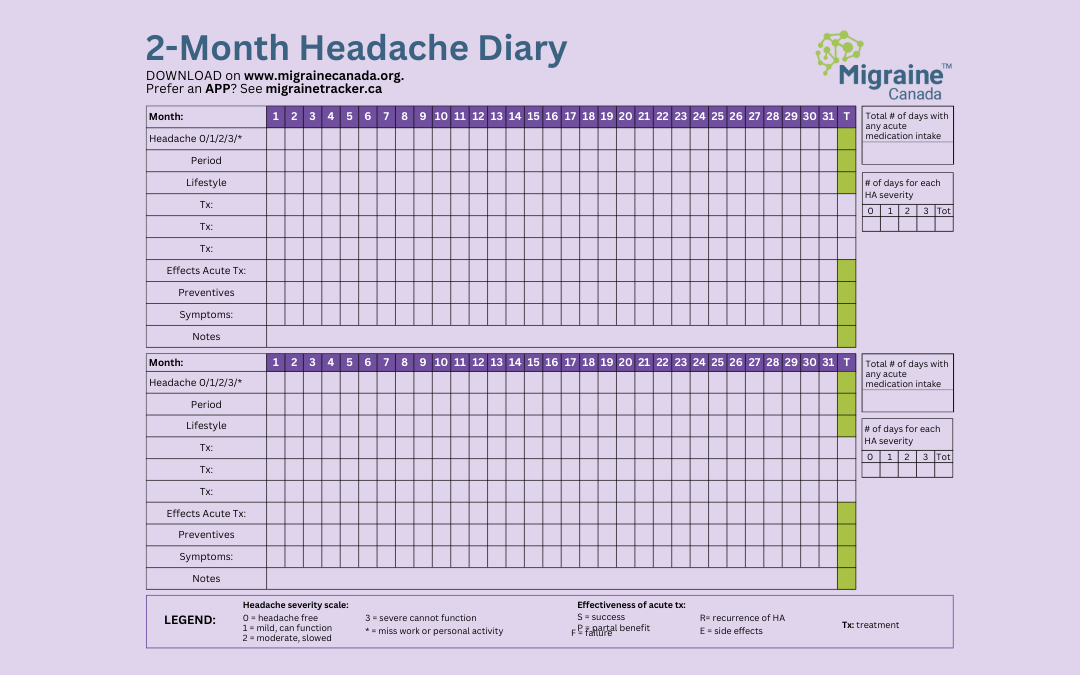
A diary helps make these comparisons more reliable. The blank two-month template below shows how daily symptoms and treatment entries can be gathered into monthly totals; it is not the completed record used in the fictional example.
Key takeaways
A preventive follow-up is an assessment of benefit, everyday functioning, adverse effects, and timing together. A 50% reduction is a helpful benchmark, but neither it nor an early lack of improvement should be interpreted in isolation. An adequate trial is agreed with the clinician and must also be tolerable; troublesome effects warrant discussion without waiting for an arbitrary deadline.
The next lesson turns to recording the underlying information: making a headache-diary entry that a clinician can use to assess symptoms, treatment use, and response.