The previous lesson compared three oral migraine preventives and showed why medical history and adverse effects matter when choosing among them. This lesson turns to two other approaches: CGRP-targeted preventive medicines and onabotulinumtoxinA injections. Both aim to reduce future migraine burden, but they differ in what they target, how they are given, and who may be eligible. A further complication is that clinical recommendations and rules for obtaining treatment are not always the same.
First, distinguish migraine frequency from treatment eligibility
A headache day is a day on which headache occurs. A migraine day is a day with migraine features; it also counts as a headache day. Keeping those counts separate matters particularly for chronic migraine, which generally means headache on at least 15 days per month for more than three months, with at least eight days per month having migraine features.
For example, a month with eight migraine-feature days and nine other headache days contains 17 headache days in total—not 25. If that pattern persists for more than three months, it may meet the frequency pattern for chronic migraine, subject to clinical assessment. Eight migraine-feature days plus six other headache days would total 14 headache days and would not meet that threshold.
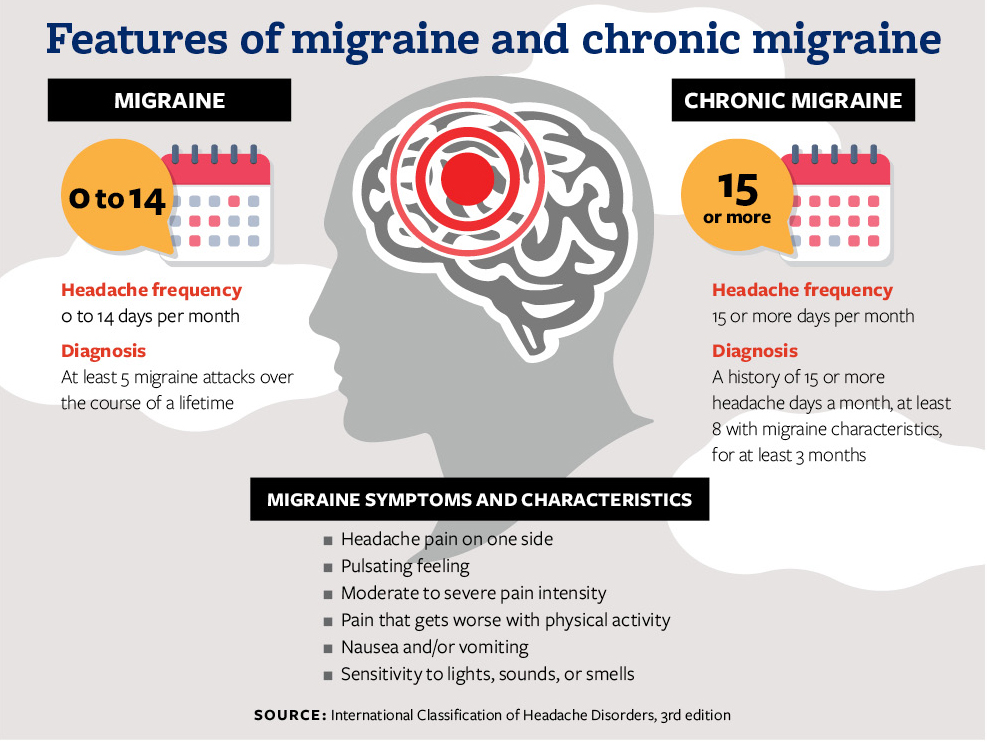
The distinction is not a judgment about how disruptive an attack is. Someone with fewer than 15 headache days may have substantial disability and need prevention. But the chronic-migraine classification is particularly important for onabotulinumtoxinA eligibility.
CGRP-targeted medicines: several forms of migraine prevention
CGRP, short for calcitonin gene-related peptide, participates in migraine pain signalling. Medicines that act on this pathway include two different kinds of preventive treatment:
- CGRP monoclonal antibodies are long-acting medicines that target CGRP or its receptor. Erenumab, fremanezumab and galcanezumab are given by injection under the skin, commonly at home on a monthly schedule, although some schedules differ. Eptinezumab is given by intravenous infusion, generally every three months.
- Preventive gepants are oral medicines that act on the CGRP pathway. Atogepant is taken daily; rimegepant has a preventive schedule involving a tablet every other day where approved.
This is a useful distinction from the earlier lesson on acute gepants: being a gepant does not, by itself, tell you whether a particular prescription is for an attack or for prevention. The medicine, its approval in the relevant location, and its prescribed schedule determine its role. Likewise, an injection is not necessarily onabotulinumtoxinA: several CGRP preventives are injections too.
Which Targeted Treatment Should You Try for Migraine Prevention? | American Migraine Foundation
Read the American Migraine Foundation’s overview to see which CGRP-targeted medicines it identifies as preventives and how their delivery differs.
In “Anti-CGRP Targeted Therapies,” read the CGRP overview. Begin with the paragraph introducing the approved medicines and stop after the sentence comparing rimegepant’s and atogepant’s schedules, immediately before “OnabotulinumtoxinA.” Focus on the distinction between antibodies given by injection or infusion and preventive gepants taken orally. The list also contains gepants used for acute treatment; do not treat the entire list as a list of preventives.
“Targeted” describes the medicine’s approach, not a guarantee that it will work for a particular person or have no adverse effects. Injection-site reactions are relevant to the self-injected antibodies; constipation or nausea may matter with some CGRP-targeted options. A clinician also checks the particular medicine, other medicines being taken, and pregnancy plans. The practical advantage of an at-home injection or tablet may matter to one person, while another may prefer a less frequent appointment-based infusion.
OnabotulinumtoxinA: a different treatment, for chronic migraine
OnabotulinumtoxinA is a botulinum toxin preparation used to prevent migraine. It is not a medicine to take when an attack starts, and it is not classified as a CGRP-targeted antibody or gepant. It can reduce the release of pain-related substances from sensory nerves, including CGRP, but its treatment method and eligibility are distinct from those of CGRP-targeted medicines.
A trained healthcare professional administers it as a series of small injections at specified sites across the head and neck. The standard protocol involves 31 injection sites, with treatment generally repeated every 12 weeks when appropriate. This is different from a single at-home CGRP antibody injection. It also means that travel to a suitable clinic and tolerating multiple injections are part of the decision.
The central eligibility distinction is that onabotulinumtoxinA is used for chronic migraine, rather than simply for any migraine that warrants prevention. CGRP-targeted preventives may be considered for people with fewer than 15 headache days per month as well as for people with chronic migraine, depending on the individual medicine and local rules. Thus, a person can have enough migraine burden to discuss prevention—or even a CGRP-targeted preventive—without meeting the chronic-migraine criterion for onabotulinumtoxinA.
Local discomfort, bruising, neck discomfort and temporary eyelid drooping are possible effects of onabotulinumtoxinA. These differ from the considerations for an oral preventive taken each day or an antibody self-injected periodically. None of these treatment schedules replaces an agreed plan for relieving individual attacks when they occur.
Clinical suitability and access are separate checks
There are two questions in a real treatment discussion. First, might this treatment be clinically suitable? Headache and migraine-day counts, disability, previous treatments, other health conditions, adverse effects and personal preferences all matter. Second, can it be obtained under the applicable local rules? A treatment may be clinically reasonable yet require a specialist assessment, documented previous preventive trials, or insurer or health-system authorization.
The Migraine Trust provides one concrete example of access criteria. Read it as an example tied to the health system it describes, not as a worldwide rule.
Migraine preventive treatments: CGRP monoclonal antibodies and Botox - The Migraine Trust
The Migraine Trust explains delivery and the criteria it describes for accessing CGRP monoclonal antibodies and onabotulinumtoxinA through specialist care.
Read three connected passages. Under “CGRP monoclonal antibodies (CGRP mAbs),” read antibody delivery, from the list of antibodies through the statement about migraine-day frequency. Under “Botulinum toxin-A (Botox),” read injection eligibility, from the description of clinic injections through the chronic-migraine criterion and treatment interval. Finally, under “When should you consider these?”, find the criteria list beginning “You need to have tried three previous preventive medicines”; read the access criteria from the paragraph introducing that list through its final point about continuing a headache diary. Notice which statements concern the migraine diagnosis and which concern access within the health system described.
In that account, CGRP monoclonal antibodies can be offered at four or more migraine days per month, while onabotulinumtoxinA is restricted to chronic migraine. It also describes requirements involving previous preventive medicines and a headache diary. Those details are valuable for understanding why a specialist might ask what has already been tried and how many days have migraine features. They should not be assumed to apply unchanged everywhere—or to every CGRP-targeted medicine.
The American Migraine Foundation describes a different recommendations-and-coverage picture: it reports that American Headache Society guidance considers CGRP-targeted treatments first-line options for episodic migraine, and both CGRP-targeted treatments and onabotulinumtoxinA first-line options for chronic migraine. Yet coverage may still require trials of older preventives. “Can be considered first-line” is not the same statement as “will be covered without prior treatment.”
Which Targeted Treatment Should You Try for Migraine Prevention? | American Migraine Foundation
Return to the American Migraine Foundation article to contrast clinical recommendations with the practical requirements of delivery and coverage.
Read the onabotulinumtoxinA passage under “OnabotulinumtoxinA,” through its sentence about the injection sites and 12-week interval. Then, under “Choosing the Right Preventive Treatment,” read the recommendations in “Effectiveness.” Finish under “Logistics and Coverage” with delivery logistics and the coverage point. Focus on why a clinically appropriate option might still require an appointment, referral, or coverage review.
The comparison can now be kept concise:
| CGRP-targeted preventives | OnabotulinumtoxinA | |
|---|---|---|
| Treatment role | Prevent future migraine; selected medicines may be options below the chronic-migraine threshold or in chronic migraine | Prevent future migraine in chronic migraine |
| Delivery | Antibody injection or infusion, or an oral preventive gepant; schedule depends on medicine | Multiple head-and-neck injections by a trained professional, generally every 12 weeks |
| Eligibility discussion | Migraine burden, medicine-specific suitability, and local approval or coverage criteria | Chronic-migraine diagnosis, individual suitability, and local access criteria |
| Practical considerations | Home treatment is possible with some options; others require infusion visits | Requires repeated clinic visits and multiple injections |
A headache diary helps make the eligibility discussion more precise: it distinguishes all headache days from the subset with migraine features and records what has already been tried. The next lesson will use those records to judge whether a preventive is actually helping—not just whether it could be started.
Key takeaways
CGRP-targeted prevention includes injectable or infused monoclonal antibodies and oral preventive gepants; the term does not describe one delivery method. OnabotulinumtoxinA is a separate, clinic-administered preventive used for chronic migraine, which has a specific headache-day and migraine-day pattern. Clinical suitability and access are related but distinct: recommendations, prior-treatment requirements and coverage can vary by location and health system.
In the next lesson, the focus shifts from choosing a preventive to assessing its benefit over an adequate, clinician-agreed trial using migraine days, everyday functioning and adverse effects.