Hello. This module is about turning a headache history into information you and a clinician can use. In this lesson, you’ll learn to record one attack clearly: what happened, how long it lasted, what it prevented you from doing, what treatment you used, and whether that treatment helped. Later lessons will use diary entries to examine possible patterns and prepare for a visit.
A diary records more than pain
A note such as “bad migraine on Tuesday” preserves an impression, but it leaves out much of what matters for treatment decisions. A useful entry distinguishes the attack, its effect on everyday functioning, and what happened after treatment. It need not be elaborate; a short, consistent record is often more useful than a detailed account that is difficult to maintain.
Keeping a headache diary - The Migraine Trust
Read The Migraine Trust’s “Keeping a headache diary” for its explanation of why a diary helps and its practical list of details to record.
In “Why keep a headache diary?”, read the reasons for tracking. Then, under “Headache diary template,” read the list of basic fields, stopping before the template download links. Notice that duration, accompanying symptoms, medication, and possible triggers each answer a different question about an attack.
The starting point is date and timing. Record when the headache began and ended if you can; if you cannot, an estimate such as “began during the morning, eased by dinner” is still useful. Duration is the elapsed time, not the pain rating. For severity, choose a consistent method—for example, mild/moderate/severe or a rating out of 10—and note the worst point if intensity changed.
Next, record symptoms alongside the pain: nausea or vomiting, sensitivity to light or sound, dizziness, and any temporary visual, sensory, or speech symptoms you noticed. A brief description is better than trying to decide from the diary alone whether every symptom was part of migraine.
Finally, record disability in ordinary terms. “Could not work for three hours” or “managed work but needed to lie down afterward” tells a clinician something a pain score cannot. Two attacks rated equally painful may have very different effects on daily life.
A complete worked entry
The Migraine Patient Toolkit offers a diary layout with separate places for attack timing, severity, function, medication, and relief. Those separate fields are worth preserving even if you use a notebook or phone rather than its form.
Migraine Patient Toolkit: A Guide for Your Care
Look at the “HEADACHE DIARY” in the Migraine Patient Toolkit, focusing on how its columns separate the attack’s impact from the treatment result.
On the printed page marked “06,” find “HEADACHE DIARY” and inspect the column labels for start and end times, severity, function, medications, treatments, and relief. Below the diary sheet, read the explanation, ending before the “NOTES” examples. The exact rating scales matter less here than recording function and relief as different observations.
Here is a fictional entry. Its medication details illustrate record-keeping, not a suggested dose or treatment plan.
| Field | Entry |
|---|---|
| Date and duration | 12 April; headache began around 07:00 and ended around 17:00—approximately 10 hours |
| Pain and symptoms | Peak pain 7/10; nausea and light sensitivity |
| Effect on daily life | Unable to do usual tasks during the morning; resumed light tasks around 15:30; cancelled an errand |
| Possible contributing circumstances | Slept about five hours the previous night; breakfast was delayed |
| Acute medication | Acetaminophen (paracetamol) 500 mg by mouth at 08:00; another 500 mg at 12:00 |
| Response and unwanted effects | Pain still 7/10 at 10:00; about 3/10 by 15:00; headache ended around 17:00. No unwanted medication effect noticed |
Notice what the entry does not claim. Short sleep and a delayed meal occurred near the attack, but one entry cannot establish that either caused it. Likewise, improvement after medication is worth recording, but the timing alone does not prove how much of the improvement was due to the medicine. The diary supplies observations for a better discussion, not a verdict.
Recording the response at a recognizable time makes the entry more informative than simply writing “medicine helped.” If nausea or vomiting made it hard to swallow or keep down a medicine, record that too: how a treatment was taken can matter when discussing its effectiveness.
Fitting the information into a practical diary
The two-month grid below is one way to see headache and medication patterns across days. Its compact format is useful for spotting frequency; its Notes space is important for details that a small daily box cannot hold.
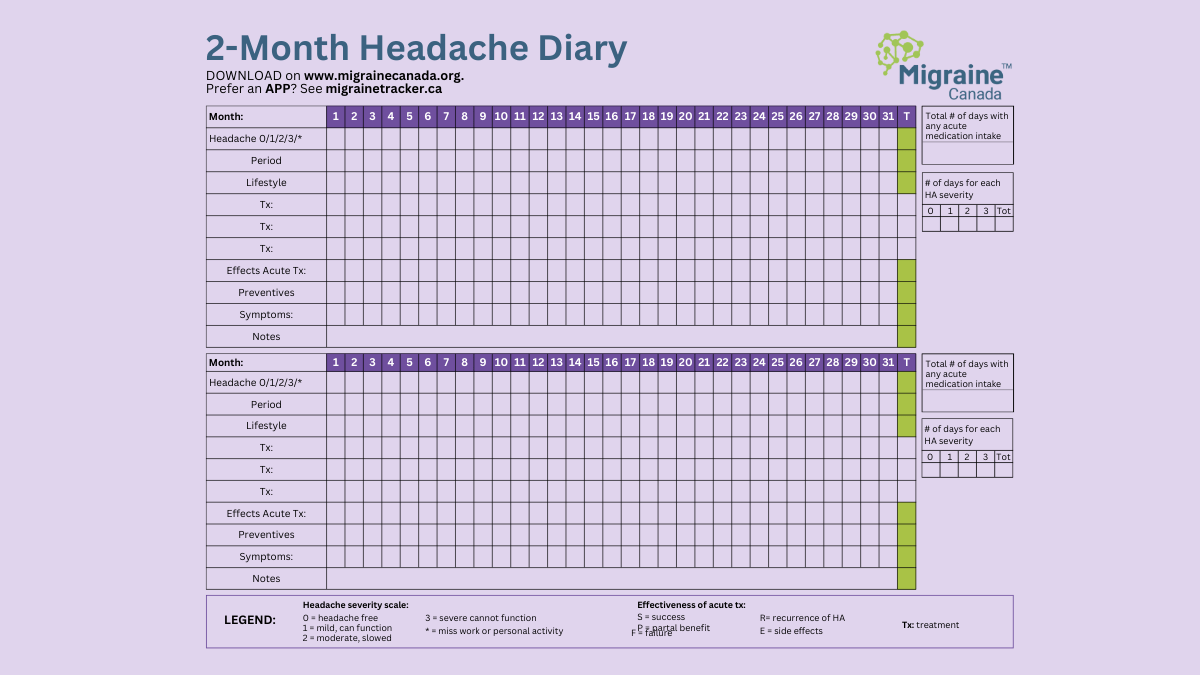
For a day like the worked entry, mark the headache severity in that date’s column, put the medication in a treatment row, and use the effects row to indicate whether it helped. Add the start and end times, functional impact, and response times in Notes or an attached note. If nothing happened on a date, a consistent “no headache” mark helps distinguish a headache-free day from a forgotten entry.
Count medication-use days by calendar date, not by number of doses. In the worked entry, two doses of acetaminophen on 12 April make one day of acetaminophen use. Record both doses in the entry, but count the date once in a monthly medication-use total. If more than one acute medicine is taken on the same date, record each medicine; the date still counts only once when counting any acute-medication days. Keep regular preventive medicines distinct from medicines taken for immediate relief.
A short note made soon after an attack is enough. Approximate times, an honest “not sure,” and a concrete description of what you could do are more valuable than details reconstructed with false precision weeks later. A diary also does not replace urgent assessment when a headache has warning signs.
Key takeaways
A useful headache-diary entry captures symptoms, timing and duration, severity, disability, possible contributing circumstances, every acute-medication dose, and the treatment response. Record possible triggers as observations rather than proven causes, and distinguish doses from medication-use days. The next lesson will use a series of entries to consider one manageable routine change without mistaking every apparent association for a trigger.