Welcome back. In the previous lesson, you recorded what happened during an attack without treating nearby events as proven causes. Now you’ll use several entries to look for a pattern and choose one manageable routine change. The aim is not to solve migraine from a diary alone; it is to bring a clearer observation to a clinician.
A pattern is a clue, not a verdict
A factor recorded near a migraine may have contributed to it, may have coincided with it, or may even have followed the start of the attack. The Migraine Trust describes a threshold model: several circumstances can combine to make an attack more likely, while no single circumstance reliably causes one every time. It is a way to think about patterns, not a measurable threshold you must calculate.
Migraine attack triggers - The Migraine Trust
Read The Migraine Trust’s explanation of combined factors and of early migraine symptoms that can be mistaken for triggers.
Under “About migraine triggers” and “Migraine threshold theory,” read combined factors. Then, under “Migraine triggers and warning signs,” read warning signs. Notice why the order in which a symptom, a behavior, and the headache occur matters.
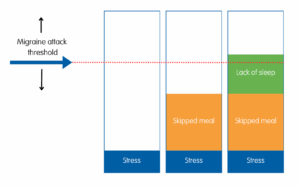
Timing is especially important with prodrome, the early phase of an attack. A craving might lead someone to eat chocolate shortly before headache pain starts. Without the timing, the diary might make chocolate look like the cause, although the craving could already have been part of the attack. Similarly, a person may miss breakfast because nausea or headache began early. Recording what happened first helps prevent a plausible-looking but backward explanation.
Read the diary before choosing what to change
Here is a fictional ten-day continuation of the 12 April entry from the previous lesson. “No headache” means the day was recorded, not left blank. The table summarizes routine and symptoms; the fuller diary still holds disability, medication-use days, and treatment response.
| Date | Previous night’s sleep | Breakfast | Headache and relevant note |
|---|---|---|---|
| 12 April | About 5 hours | 11:30 | Migraine began around 07:00; nausea made eating difficult |
| 13 April | About 8 hours | 08:00 | No headache |
| 14 April | About 7 hours | 11:00 | No headache |
| 15 April | About 7 hours | 08:00 | No headache |
| 16 April | About 6 hours | 11:30 | Craved chocolate at 13:00, ate it at 13:15; migraine began around 15:00 |
| 17 April | About 8 hours | 08:00 | No headache |
| 18 April | About 8 hours | 11:00 | No headache |
| 19 April | About 7 hours | 08:00 | Ate chocolate at 13:00; no headache |
| 20 April | About 8 hours | 11:00 | High-stress day; migraine began around 16:00 |
| 21 April | About 7 hours | 08:00 | No headache |
Read the sequence rather than counting every late breakfast alike. On 12 April, the migraine started before breakfast was delayed; that delay cannot explain the attack’s onset. On 16 and 20 April, breakfast was late before the headache. But breakfast was also late on 14 and 18 April, with no headache. The diary offers a reason to examine meal timing, not evidence that late breakfast always triggers migraine.
Other explanations remain possible. Short sleep preceded the attacks on 12 and 16 April, but not the one on 20 April. Stress was noted on the 20th. Chocolate was eaten before the attack on the 16th, yet the craving might have been an early symptom, and chocolate was also eaten on the 19th without an attack. Ten days cannot separate these influences confidently. A useful diary includes days without attacks, because they reveal whether a suspected factor also occurs without the outcome.
Turn one clue into a manageable change
The most useful next step is usually a modest change that fits ordinary life, rather than trying to eliminate every suspected trigger. The Migraine Trust emphasizes regular routines, including sleep and meals, while cautioning that trigger avoidance can become burdensome and may not prevent every attack.
Migraine attack triggers - The Migraine Trust
Return to The Migraine Trust’s page for its practical guidance on common factors and realistic adjustments.
Under “Common migraine triggers,” begin at sleep and meals. Under “Identifying and managing triggers,” continue through the “Regular routine,” “Avoiding triggers,” and “Lifestyle adjustments” subsections, from routine guidance. Focus on the difference between a sustainable adjustment and an effort to control every possible trigger.
For this fictional diary, one reasonable proposal is to make breakfast more regular: prepare an easy option the night before and, on days when it is feasible, eat by about 09:00 for the next three to four weeks. This choice does not require believing that breakfast caused or would have prevented any recorded attack. It addresses a repeated, changeable pattern without imposing a list of forbidden foods. If an attack has already begun and nausea makes eating difficult, the plan should not become a rule to force a meal.
Keep recording headache start times, symptoms and disability, as well as meal times and other circumstances such as sleep and stress. At the end, compare attack frequency and effect on daily life, not just whether breakfast was on time. A quieter period might be encouraging, but it would not prove the change worked: attacks fluctuate, and other factors may have changed too. An unchanged diary is useful information as well. Continue documenting acute-medicine use and response, and do not replace or delay clinician-agreed treatment with a routine experiment.
The same reasoning could support a different single choice in another diary: a steadier sleep schedule, keeping water available during the day, manageable activity, or a brief stress-management routine. The best candidate is both plausible from the recorded pattern and realistic to maintain. The goal is to learn from observations, not to make every attack feel like a failure to avoid a trigger.
Key takeaways
Look for repeated patterns across headache and headache-free days, check whether a suspected factor occurred before the attack, and remember that early symptoms can masquerade as triggers. Choose one feasible change, track it alongside headache burden, and treat the result as information rather than proof of cause. Next, you’ll bring these diary findings together with treatment history and health considerations in a concise summary for a clinician visit.