Welcome to the final lesson in our module on Advanced Writing. In our previous sessions, we have built a powerful toolkit for constructing sophisticated sentences using relative clauses and conditionals. You now have the grammatical resources to express complex ideas with precision. This lesson is where we put it all together.
The learning outcome for today is to self-edit a full writing task (1 & 2) to improve cohesion, vocabulary, and grammatical range. Think of this as the quality assurance (QA) phase of your writing process. Just as you would review code for logic, efficiency, and syntax errors, we will systematically review your essays to elevate them to a Band 7 standard. This is a crucial skill, as a polished, error-free essay will always score higher than a rough first draft.
1. The Editor's Framework: The Four Pillars of IELTS Writing
Before you can effectively edit, you need to know what you're looking for. The IELTS examiners use four specific criteria to assess your writing. These same criteria will form our editing checklist.
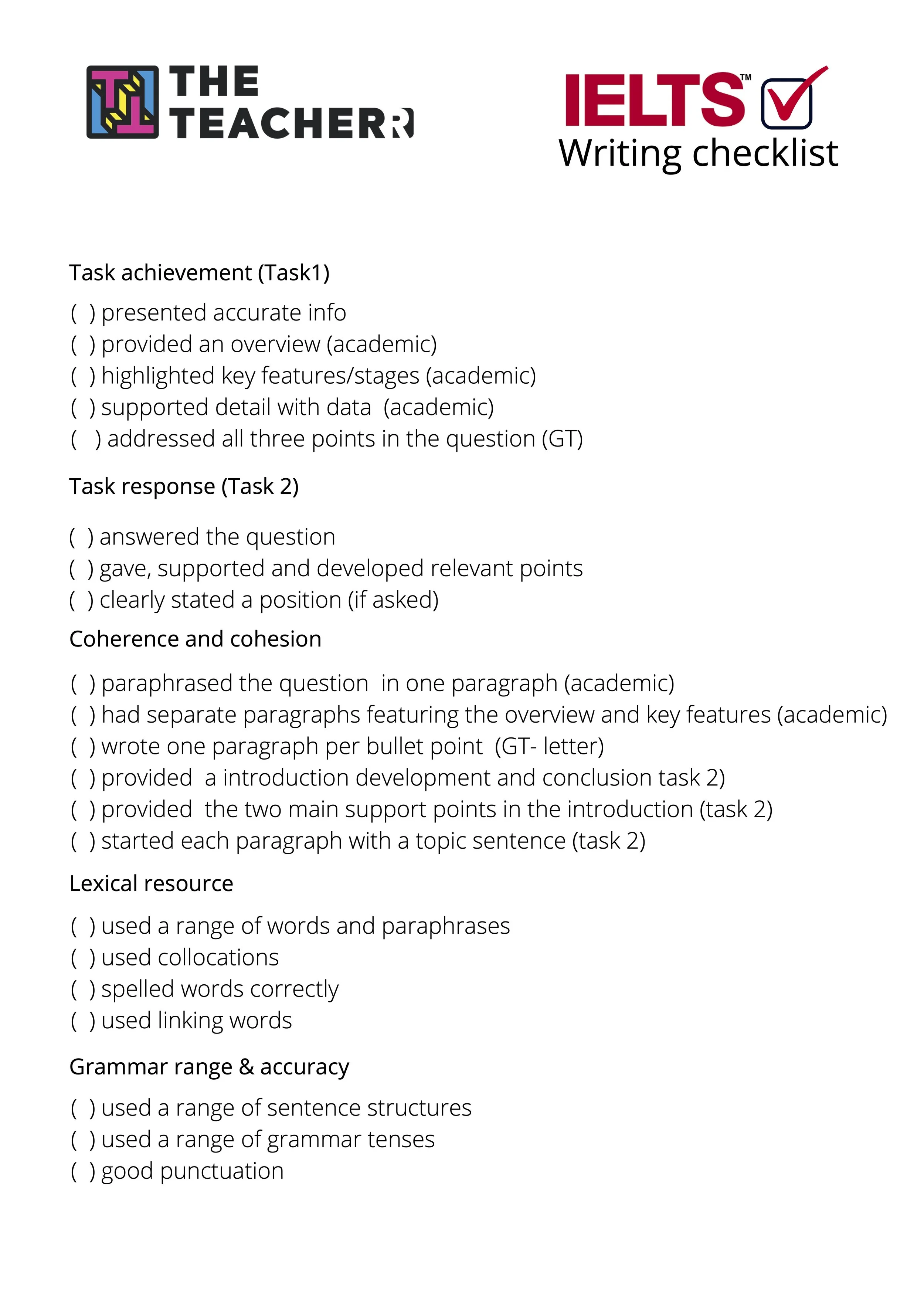
A strong response must perform well across all four areas. Let's briefly define what each one means in the context of self-editing. The following guide provides an excellent, detailed breakdown.
[PDF] A Complete Guide to IELTS Writing
This guide clearly explains the marking criteria, giving you a solid foundation for what to look for when you review your own work.
Please read two short sections: First, in the 'Task 1' chapter, read the explanation of the four marking criteria. Focus on the paragraph that starts here. This breakdown applies to both Task 1 and Task 2. Next, navigate to the 'Task 2' chapter and read the 'Overview' section. Pay attention to how the criteria are adapted for Task 2, especially regarding "Task Achievement." You can find this starting from this part.
Your goal during self-editing is to act as the examiner, critically evaluating your own writing against these four pillars.
2. A Systematic Approach: The Three-Pass Proofread
Simply re-reading your essay and hoping to catch errors is ineffective. A much better method, similar to a structured testing protocol, is to review your work in multiple, focused passes. Each pass has a specific goal.
This video from IELTS Energy TV introduces a highly effective three-step proofreading strategy.
How to Proofread your Own IELTS Writing Essays
This video breaks down the overwhelming task of proofreading into three manageable steps, ensuring you check for the most important issues systematically.
Watch the video from the start of the explanation to understand the full process. The three passes are: Overall Structure: Checking for the high-level organization—overview in Task 1, thesis and topic sentences in Task 2. Vocabulary: Scanning for spelling errors and, crucially, for overused words that can be replaced with synonyms or paraphrasing. Grammar: Focusing on your common error patterns, like verb tenses and singular/plural nouns.
Adopting this structured approach will make your editing more efficient and far more effective. You'll move from just correcting typos to making substantial improvements to your score.
3. Case Study: Transforming a Band 6 to a Band 8
Let's see this process in action. It's one thing to understand the theory, but another to see how it transforms an actual essay. The following video provides an expert walkthrough, showing how a typical Band 6 Task 1 response can be elevated to a Band 8 by applying these editing principles.
IELTS Writing Task 1- Convert Band 6 to Band 8
This video from IELTS Advantage is an excellent demonstration of the editing process. It diagnoses the problems in a sample essay and applies targeted fixes to improve its score dramatically.
As you watch, focus on the difference between the Band 6 and Band 8 versions. First, watch the analysis of the Band 6 overview. Notice the problems with inaccuracy and bringing in outside knowledge. Next, observe how the overview is rewritten to be accurate and effective. Pay close attention to the explanation from this point. Note that a good overview contains no specific data points (numbers/percentages). Then, see how the detail paragraphs are logically grouped. The explanation from this section shows how to organize information based on trends in the data itself. Finally, observe the 'sniper approach' to writing detail paragraphs, as explained from here. The key is selecting the most significant data and reporting it accurately with approximations (e.g., 'just over 20%') instead of guessing exact figures.
This case study demonstrates that achieving a high band isn't about using impossibly complex language, but about clarity, accuracy, and logical organization—all things that can be refined through careful editing.
4. Your Self-Editing Challenge
Now it is your turn to apply this framework. Your task is to take the full Task 1 and Task 2 essays you wrote in previous lessons and perform a full three-pass edit on them.
Find your essay responses from:
- Module 5, Lesson 5 (A complete Task 1 response)
- Module 6, Lesson 6 (A complete Task 2 essay)
Use a different color pen or the 'track changes' feature in a word processor to mark your edits.

Follow the three-pass process systematically for each essay.
Pass 1: Structure & Task Response/Achievement
- Task 1: Does your first paragraph paraphrase the question? Do you have a clear overview that identifies 2-3 main trends/features? Have you described the key features with supporting data in the body paragraphs?
- Task 2: Does your introduction paraphrase the prompt and state your thesis? Does each body paragraph have a clear topic sentence? Does each paragraph develop a single main idea with explanation and an example? Does your conclusion summarize your points and restate your position? Have you answered all parts of the question?
Pass 2: Cohesion & Lexical Resource
- Cohesion: Check your linking words. Are they varied and used correctly? Can you improve flow using referencing (e.g.,
this trend,these issues)? - Vocabulary: Hunt for repeated words. Can you replace them with synonyms or rephrase the sentence? (e.g.,
people->individuals,citizens,residents). Are there any spelling mistakes? - Formality: Is the language academic? Replace informal phrases (like
more and more,a lot of) with more formal alternatives (an increasing number of,a significant amount of).
Pass 3: Grammatical Range & Accuracy
- Tenses: Check every verb. Are you using the correct tense (past for past dates, present for general truths, future for predictions)?
- Subject-Verb Agreement: Do your verbs agree with your subjects (e.g.,
The government implements...,The statistics show...)? - Articles & Nouns: Check your use of
a,an, andthe. Are your plural and singular nouns correct? Pay attention to uncountable nouns (e.g.,information,advice,research—no 's'). - Punctuation: Are commas, full stops, and other punctuation used correctly?
For a list of common errors to watch out for, refer to the "MOST COMMON MISTAKES" sections in the guide we looked at earlier.
[PDF] IELTS Writing Task 1 + 2: The Ultimate Guide with Practice to Get a ...
This guide contains excellent checklists of common errors. Use them as a reference during your 'Pass 3' grammar check.
Quickly review these two sections: Task 1 Common Mistakes Task 2 Common Mistakes
Take about 20 minutes for this exercise. The goal is not just to find mistakes, but to actively improve your original text.
Conclusion
In this lesson, you've learned to transition from writer to editor, a crucial step in achieving a Band 7. By systematically reviewing your work against the official IELTS criteria, you can identify weaknesses and make targeted improvements.
Key Takeaways:
- Edit with Purpose: Use the four official marking criteria (Task Achievement, Coherence & Cohesion, Lexical Resource, Grammar) as your guide.
- Use a System: The three-pass proofreading method (Structure -> Vocabulary -> Grammar) ensures you check for different types of errors effectively.
- Small Changes, Big Impact: As the case study showed, correcting small errors in accuracy, vocabulary, and grammar can significantly lift your band score.
- Practice is Key: The more you practice self-editing, the better you will become at spotting your own common errors and avoiding them in the first place.
This concludes our module on advanced writing. You now possess a comprehensive set of skills for planning, structuring, writing, and refining high-quality IELTS essays. In our next module, we will shift our focus to the Speaking test, starting with strategies for improving fluency and coherence.