Welcome to our new module, where we pivot from the structured world of academic writing to the dynamic, real-time challenge of the IELTS Speaking test. In our last lessons, you honed your skills in editing and refining written text, a process that allows for careful deliberation. Now, we will focus on developing the spontaneity and fluency needed for a high-scoring conversation.
Today's lesson targets a crucial first impression: delivering extended, fluent responses to Part 1 questions on familiar topics. This part of the test is a warm-up, but it's also where the examiner first assesses your ability to communicate. Mastering this section is the first step toward overcoming the "thinking delay" you've mentioned and building the confidence you need for the entire speaking test.
1. The Foundation of Fluency: Why Short Answers Fall Short
In IELTS Speaking Part 1, the examiner asks you a series of questions about familiar topics like your work, studies, hometown, or hobbies. The entire section lasts about four to five minutes. While the questions are simple, the goal is not just to provide correct information, but to demonstrate your command of English.
A common mistake is to give minimal, one-sentence answers. This gives the examiner very little language to assess, making it difficult to award a high score for fluency, vocabulary, or grammar. To score a Band 7 or higher, you need to show you can speak at length and develop your ideas.
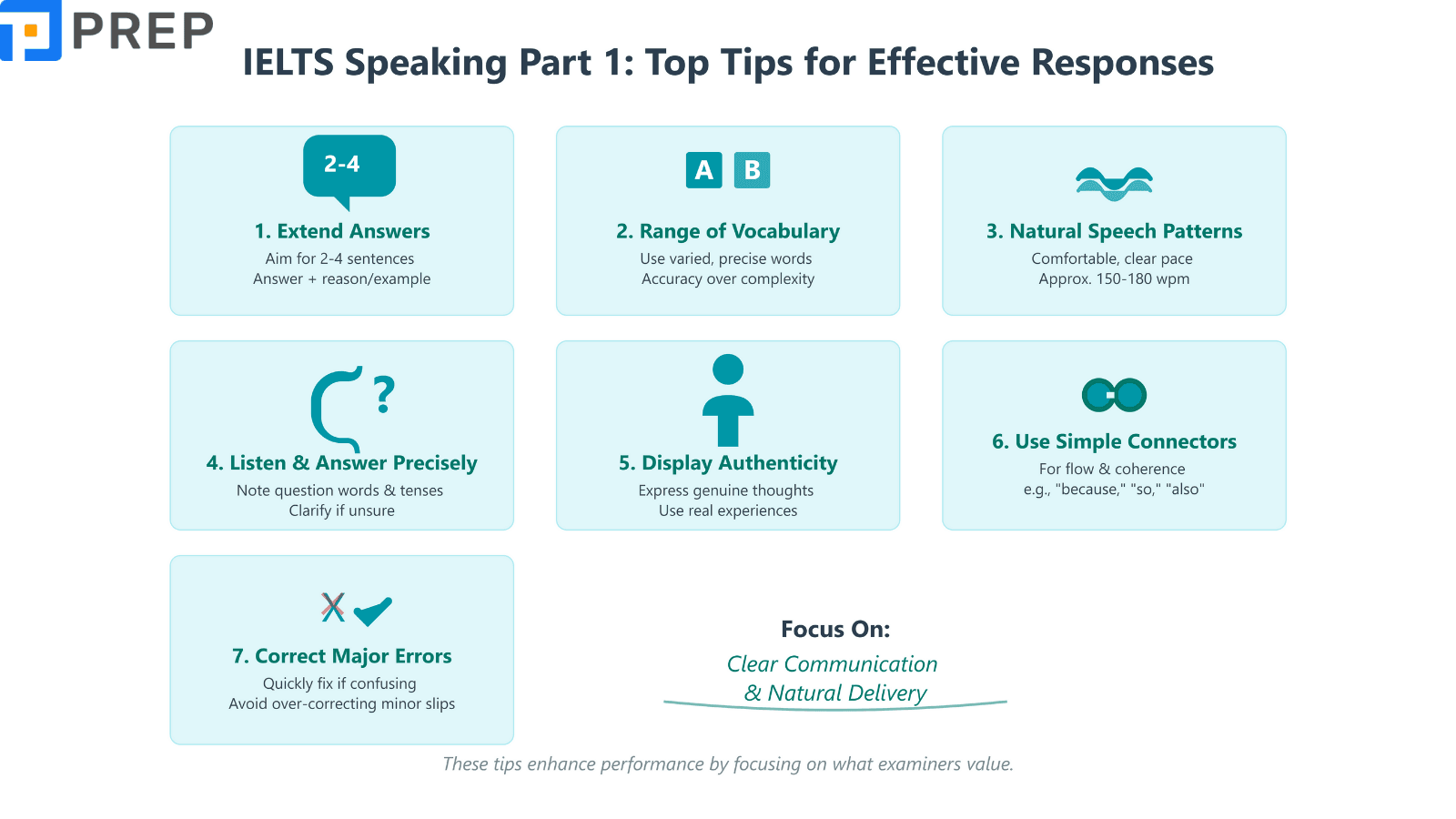
Giving a short answer signals that you can't say more. Our goal is to show the examiner that you can comfortably elaborate on any topic.
2. A Structure for Spontaneity: The A.R.E. Framework
How do you extend your answers without rambling? The key is to have a simple, reliable structure in mind. Think of it as a mental template that organizes your thoughts quickly. A highly effective method for Part 1 is the A.R.E. Framework.
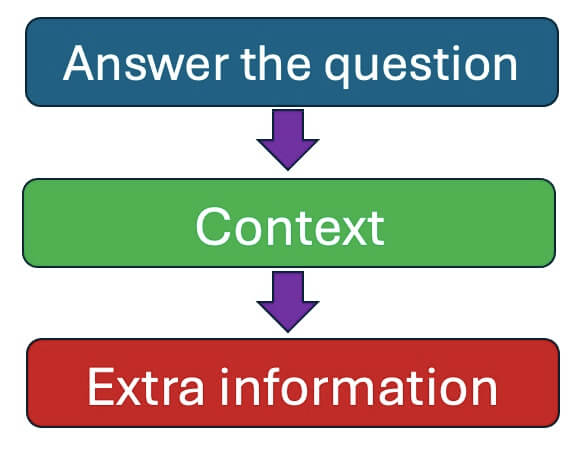
The A.R.E. Framework formalizes this structure:
- Answer: Give a direct answer to the question.
- Reason: Explain why you have that answer or opinion.
- Example: Provide a specific example or extra detail to support your reason.
This framework transforms a simple "yes" or "no" into a well-developed, coherent response that showcases your language skills.
How to Expand Your IELTS Speaking Answers and Break Through to Band 9 — SpeakPrac
This article from SpeakPrac clearly explains the A.R.E. framework and demonstrates its power with a clear example.
Please read the section titled Part 1: The A.R.E. Framework™. Start from the heading here and focus on how the simple answer is transformed into a Band 9 response.
Using this structure ensures your answers are detailed enough for a high score but concise enough to stay on topic, which is crucial for the "Fluency and Coherence" marking criterion.
3. Overcoming "Thinking Delay": The Idea Bank Strategy
A great structure is helpful, but you still need content. The "thinking delay" you experience often comes from searching for ideas, not just words. To solve this, we'll adopt a strategy that should resonate with your background in system development: creating a reusable "component library" of ideas. In the context of IELTS, this is called an idea bank.
The principle is simple: do your thinking before the test. Instead of trying to come up with new, perfect ideas for every single question, you prepare a few versatile examples for common topics that you can adapt and reuse. This drastically reduces the cognitive load during the exam, allowing you to focus on speaking fluently.
This video from Adam's English Lessons on engVid brilliantly explains this strategy, which he calls the "Lasagna Method."
IELTS Speaking: Improve your fluency with the LASAGNA METHOD
This video provides a powerful, practical technique for preparing content in advance to boost your fluency and reduce hesitation.
Watch these two key segments: First, watch the section that explains how to create an idea bank. The explanation starts at this point. Notice the core advice: pick one specific, versatile example (like lasagna for food) and prepare to talk about it from multiple angles. Next, watch how to build a vocabulary list around your chosen example. This is covered from here. This step ensures you not only have ideas but also the high-level language to express them.
By preparing a few rich, specific examples for topics like hobbies, travel, food, or work, you'll always have something ready to say, allowing you to deploy the A.R.E. framework smoothly and confidently.
4. Practice Session: Applying the Frameworks
Now it's time for our practice-first approach. Your task is to combine the A.R.E. framework with the idea bank strategy.
Step 1: Start Your Idea Bank (10 minutes)
Choose 3-4 common Part 1 topics from the list below and create a specific, versatile example for each. Jot down a few keywords, interesting details, and some good vocabulary.
- Work/Job: (e.g., A specific challenging project, your team collaboration, a technical problem you solved)
- Hometown: (e.g., A particular historical building, a local festival, a favorite park)
- Hobbies: (e.g., A specific skill you're learning, a recent book you read, a sport you follow)
- Food: (e.g., A favorite dish to cook or eat, a memorable restaurant experience)
Step 2: Answer Aloud (15 minutes)
Below are some typical Part 1 questions. For each one, answer out loud using the A.R.E. framework and drawing from your idea bank. If you can, record yourself on your phone and listen back. Don't write full sentences—just speak.
- Do you work or are you a student? (Follow-up: Do you like your job?)
- Where is your hometown? (Follow-up: What do you like about it?)
- What do you usually do in your free time?
- Do you enjoy cooking?
- Do you enjoy travelling?
- What do you usually do on weekends?
To see what high-scoring answers sound like, you can refer to the following resource. It contains dozens of sample questions with Band 7-8 answers.
IELTS Speaking Part 1 Questions and Answers (Band 7+ Examples with Audio)
This guide provides excellent models for structuring your answers. Reading a few examples will help solidify the A.R.E. structure in your mind.
Browse through the answers under the topics of Personal Life and Daily Life. Notice how nearly every good answer provides a direct response, a reason, and often an example or extra detail.
Conclusion
In this lesson, we laid the critical groundwork for success in IELTS Speaking Part 1. You've learned not just why you need to extend your answers, but also how to do it systematically and confidently.
Key Takeaways:
- Extend Your Answers: Aim for 2-4 sentences to demonstrate your language ability.
- Use the A.R.E. Framework: Structure your responses with a direct Answer, a Reason, and an Example. This provides coherence and depth.
- Build an Idea Bank: Prepare versatile ideas and vocabulary for common topics before the test to reduce thinking time and boost fluency.
- Practice Speaking: The key to making these strategies automatic is consistent oral practice.
By combining a clear structure (A.R.E.) with prepared content (your idea bank), you have a powerful system to deliver fluent, extended, and high-scoring answers in Part 1.
In our next lesson, we will move to Speaking Part 2. You'll learn how to use your one minute of preparation time to structure a coherent two-minute monologue, building on the organizational skills we've started developing today.