Welcome to the next lesson in our advanced writing module. In our previous session, we focused on using referencing and substitution to create a smooth and cohesive flow between your sentences. You learned to avoid repetition by using words like it, they, and summary nouns like this trend.
Today, we'll build on that by learning how to pack more detail and precision within your sentences. The learning outcome for this lesson is to construct complex sentences using relative clauses to add detail and precision. This skill is crucial for elevating your "Grammatical Range and Accuracy" score towards a Band 7 and beyond.
Think of it this way: in systems design, you might have a basic data object. To make it useful, you add specific attributes and properties that describe it in detail. A relative clause does the same for a noun in a sentence—it adds a descriptive property that makes your writing more informative and sophisticated, moving you away from simple, disconnected statements.
1. What is a Relative Clause?
At its core, a relative clause is a part of a sentence that adds more information about a noun. It usually starts with a relative pronoun like who, which, that, whose, or a relative adverb like where or when.
Let's look at a simple illustration of this concept.
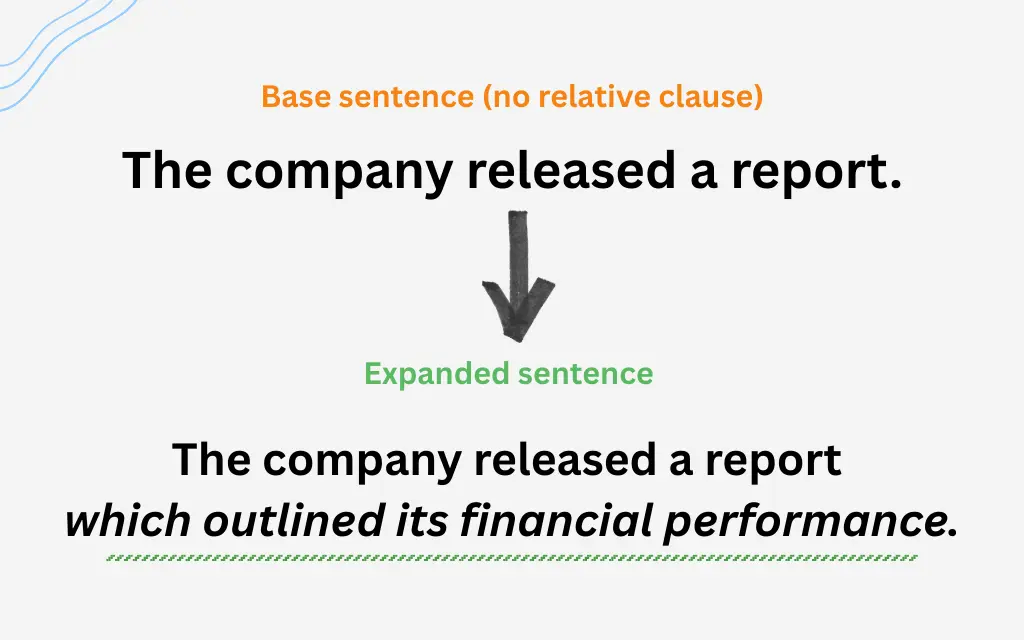
As you can see, instead of writing two simple sentences ("The company released a report. The report outlined its financial performance."), we can combine them into one more fluid and complex sentence. This is the essence of what we'll be practicing today.
2. Identifying and Using Relative Clauses: A Diagnostic
Before we dive into the theory, let's follow your preferred practice-first approach. The following diagnostic test will help you assess your current understanding of relative clauses and pinpoint areas for focus.
Relative Clauses for IELTS: Diagnostic Test, Grammar ...
This resource from IELTSMaterial.com provides a short diagnostic test to check your foundational knowledge. Don't worry about getting everything right; the goal is to identify areas to work on.
Please navigate to the section Diagnostic Test. Complete both exercises: Exercise 1: Choose the correct relative pronoun. Exercise 2: Find and correct the mistakes in the sentences. Once you've tried them, check your work against the Answer Key provided just below the exercises. Note any questions that were challenging.
3. Defining vs. Non-Defining Clauses: The Crucial Difference
Your performance on the diagnostic likely highlighted that the rules around relative clauses can be nuanced. The most important distinction to master is between defining and non-defining relative clauses. This distinction affects punctuation (commas) and the very meaning of the sentence.
- Defining clauses provide essential information to identify the noun. Without this clause, we wouldn't know who or what is being talked about. They do not use commas.
- Example: "The developer who wrote the plugin has left the company." (We need this clause to know which developer).
- Non-defining clauses provide extra, non-essential information. The sentence still makes sense without this clause. They must be separated by commas.
- Example: "The lead developer, who is an expert in C#, is mentoring the junior staff." (We already know who the lead developer is; the clause just adds extra detail).
This short video explains the comma rule with excellent clarity.
Start Writing Complex IELTS Sentences | Band 9 Grammar
This video from Fastrack IELTS provides a clear and concise explanation of how to use relative clauses and, most importantly, the punctuation rules that distinguish defining and non-defining clauses.
Please watch from the beginning of the segment on relative clauses. Pay close attention to the examples given ("The boy who wears the red t-shirt...") as they make the comma rule very easy to understand.
To solidify this, take a look at the following quick-reference chart. It neatly summarizes the uses of the main relative pronouns.
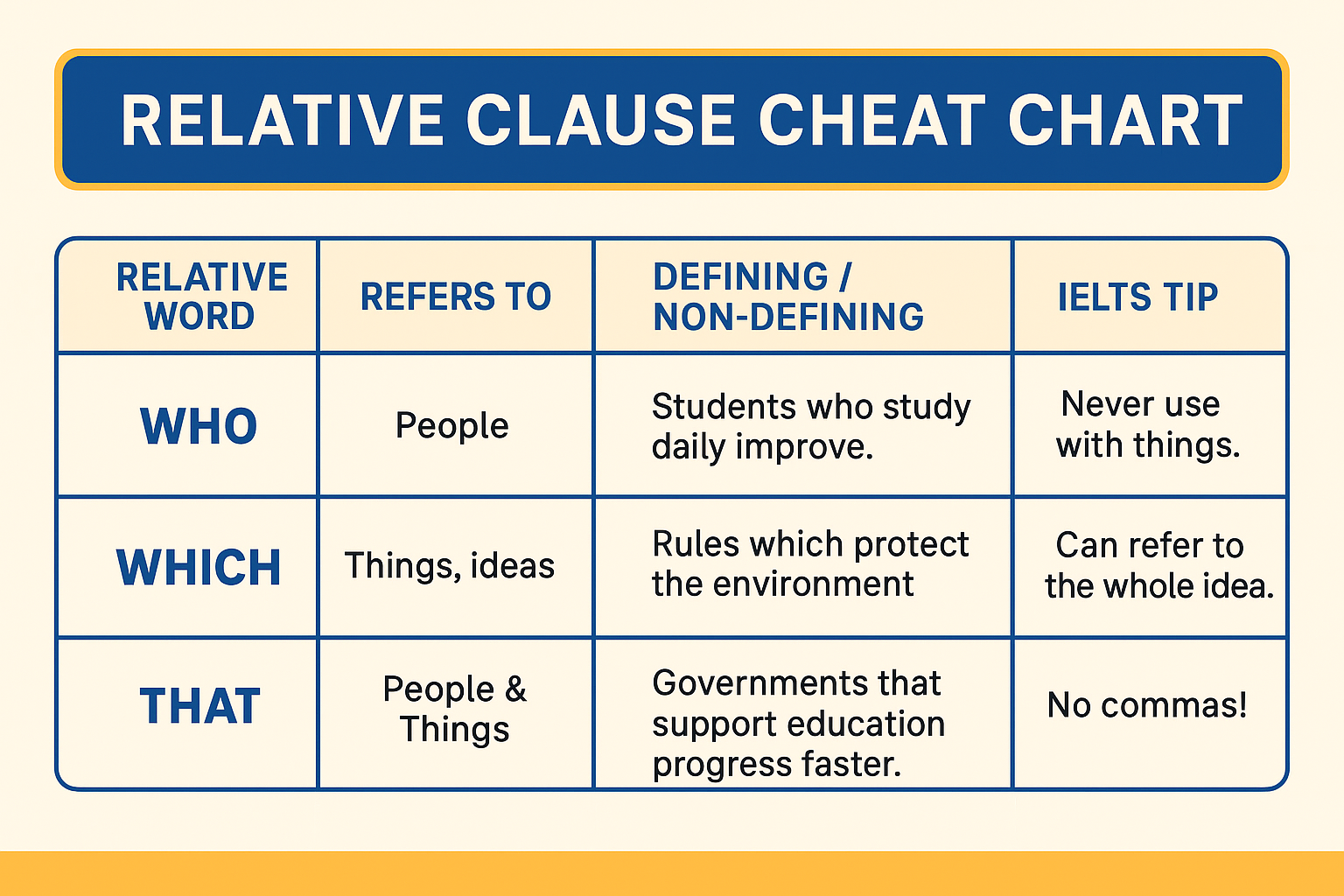
Notice the "IELTS TIP" for that: "No commas!". This is because that is only used in defining relative clauses.
4. Practice: Building Complex Sentences
Now that you have a clearer understanding of the rules, let's put them into practice by actively constructing sentences. These exercises will help you move from theory to application.
IELTS Writing Mini-Lesson: Relative Clauses with Quick Exercises | BabyCode Blog
This blog post from BabyCode Blog has a series of targeted exercises that are perfect for building this skill incrementally.
Complete the following three exercises. Try to write down your answers before checking the solutions provided in the resource. Exercise 1: This focuses on choosing the correct pronoun for essential clauses. Exercise 2: This tests your ability to add extra information with the correct comma usage. Exercise 5: This is the key challenge. It requires you to combine two simple sentences into one complex sentence, directly practicing the skill needed for your essays.
5. Application in IELTS Writing Task 1
Relative clauses are particularly useful in Writing Task 1, where you need to describe charts and diagrams with precision. You can use them to add specific data points or details without starting a new sentence.
For example, instead of:
"The consumption of sodium was highest at dinner. It was 43%."
You can write:
"The consumption of sodium was highest at dinner, where it reached 43%."
This next video demonstrates exactly how to apply these structures to a Task 1 response.
How to Write Complex Sentences in IELTS Academic Writing Task 1
This Fastrack IELTS video focuses specifically on using complex sentences, including relative clauses, to achieve a high score in Task 1.
Watch the following segments to see these structures in action: Making the introduction complex: See how which is used to add information about the ingredients. Enhancing the overview: Notice the phrase "...the meal in which the lowest average percentages are revealed." This is a very sophisticated structure. Adding detail to body paragraphs: Observe how where is used to pinpoint data related to a specific meal time.
6. Final Integration and Self-Editing
To bring everything together, your final task is to construct a coherent paragraph using a variety of relative clauses. This will simulate how you would use this skill in the actual exam. It is also crucial to be aware of common mistakes so you can avoid them in your writing.
IELTS Writing Mini-Lesson: Relative Clauses with Quick Exercises | BabyCode Blog
We will return to the BabyCode Blog resource for a final challenge and a review of common errors.
First, review the Top 5 Errors. The most common mistakes are using the wrong pronoun (e.g., which for people) and incorrect punctuation. Then, attempt Exercise 15. Write a short paragraph on the topic of technology in education, trying to naturally incorporate defining, non-defining, and other relative clause structures. Compare your paragraph to the sample provided to see how they integrated the different types.
Conclusion
In this lesson, you've added another powerful tool for demonstrating grammatical range to your IELTS writing toolkit. By mastering relative clauses, you can combine ideas efficiently, add precise detail, and construct the kind of sophisticated sentences that examiners reward with high scores.
Key Takeaways:
- Relative clauses add information about a noun using pronouns like
who,which,that, andwhose. - The most critical rule is the distinction between defining clauses (essential information, no commas) and non-defining clauses (extra information, with commas).
- Using
thatis only for defining clauses. Usingwhichcan refer to a single thing or a whole idea expressed in the main clause. - Varying your sentence structures with different types of relative clauses is a direct way to meet the "Grammatical Range" requirement for a Band 7+.
In our next lesson, we will explore another type of complex sentence construction: using conditional structures (if, unless, etc.) to discuss hypothetical situations or results. This will further broaden your ability to express complex ideas in your writing and speaking.