In our previous lesson, we mapped out the complete architecture of the IELTS Academic test, familiarizing ourselves with the format and question types for each module. With that blueprint in hand, we can now define the performance metrics for our goal. Today's lesson focuses on a critical question: what does it actually take to achieve a Band 7? We will analyze the official IELTS band descriptors to define the precise performance required in each skill, moving from understanding the system's structure to defining its success criteria.
Understanding the Overall Band 7
First, it's important to understand how your overall band score is calculated. Your final score is the average of the four individual module scores (Listening, Reading, Writing, and Speaking), rounded to the nearest half-band. This means you don't necessarily need to score a 7.0 in every single module to achieve an overall 7.0.
For a clear explanation of this, and to see some common score combinations that result in a Band 7, let's turn to a helpful guide.
How to Get Band 7 in IELTS: The Ultimate Guide for Academic & General Training
This article from LumeTest clearly explains the "math" behind the overall score and what a Band 7 represents in terms of language ability. It also provides a useful comparison between Band 6.5 and Band 7 behaviors.
Please read the first two main sections. Start with the quick answer and review the table showing different score combinations that lead to a Band 7. Then, continue to the section Understanding the IELTS Band 7 Criteria, paying close attention to the comparison table that highlights what needs to improve to move from a 6.5 to a 7.
As you've read, achieving an average of 6.75 across the four skills is the threshold for an overall 7.0. This allows you to leverage your strengths. For example, a high score in Listening or Reading can compensate for a slightly lower score in Writing or Speaking. However, always be mindful that many universities and immigration programs have minimum score requirements for each individual skill.
Performance in Listening and Reading (Receptive Skills)
The Listening and Reading tests are scored objectively based on the number of correct answers out of 40. For the Academic module, a Band 7 is typically awarded for a specific range of correct answers.
What’s does Band 7 mean, anyway? | IDP IELTS Canada
This article from IDP, one of the co-owners of IELTS, gives a straightforward explanation of the performance level expected for a Band 7 in each skill.
Focus on the sections titled Band 7 Reading and Band 7 Listening. Note the target score mentioned for both modules.
As the articles confirm, your target for a stable Band 7 is to consistently score 30-32 correct answers out of 40 in both the Listening and Academic Reading tests. This means you have a margin for error of about 8-10 questions. Your task is not to be perfect, but to be accurate and efficient enough under timed conditions to hit this threshold.
Performance in Writing (Productive Skills)
Unlike the receptive skills, Writing is assessed subjectively by certified examiners against four specific criteria. Understanding these criteria is the key to producing a Band 7 response. The jump from a Band 6 to a Band 7 involves clear, demonstrable improvements in each area.
The image below provides a high-level summary of the key differences.

Let's break these down:
- Task Response: A Band 6 response generally addresses the prompt, but some ideas may be underdeveloped or unclear. A Band 7 response, however, addresses all parts of the question fully, presenting a clear position throughout the essay with well-developed ideas.
- Coherence and Cohesion: A Band 6 essay has a "clear overall progression" but may have some faulty or mechanical connections. A Band 7 essay demonstrates "clear progression throughout," with logical paragraphing and appropriate use of cohesive devices that don't feel forced.
- Lexical Resource (Vocabulary): A Band 6 writer "lacks precise vocabulary." A Band 7 writer moves beyond simple words to use "some precise vocabulary" and less common lexical items effectively.
- Grammatical Range and Accuracy: A Band 6 essay has a "restricted range of complex grammatical structures." A Band 7 essay demonstrates a "variety of complex grammatical structures" and, crucially, "frequently produces error-free sentences."
To see these differences in action, the following video provides feedback from an ex-examiner on real essays, comparing a Band 6 performance to a Band 7+ performance for each criterion.
IELTS Writing Task 2: Band 6 vs. Band 7+ | Ex-examiner’s Feedback
In this video from Fastrack IELTS, an ex-examiner breaks down two essays to show you the practical difference between a Band 6 and a Band 7. This will make the criteria much more concrete.
Watch the following segments, which correspond to the four marking criteria. For each one, notice how the Band 7 essay demonstrates superior control and development compared to the Band 6 essay. Task Response Coherence and Cohesion Lexical Resource Grammatical Range & Accuracy
The key insight is that a Band 7 isn't about using overly complicated language; it's about clarity, structure, and control.
Performance in Speaking (Productive Skills)
The Speaking test is also assessed against four criteria, which are similar but not identical to the writing criteria. For you, a key goal is to reduce the "thinking delay" you experience. The Band 7 descriptors show that you can achieve this without needing to be perfect.
Here are the official public band descriptors for Speaking. Focus on the differences between Band 6 and Band 7.
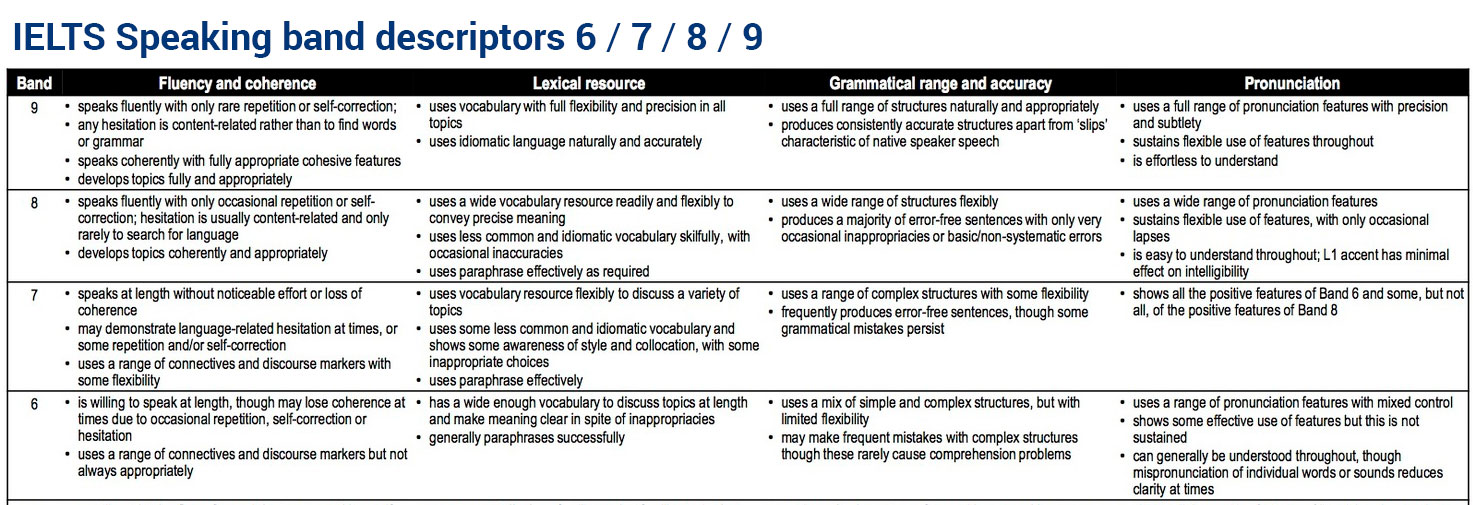
Let's analyze the requirements for a Band 7 speaker:
-
Fluency and Coherence:
- Speaks at length without noticeable effort or loss of coherence. This means your ideas flow logically.
- May demonstrate language-related hesitation at times, or some repetition and/or self-correction. This is a crucial point for you. A Band 7 speaker is not flawless. Some hesitation while searching for the right word is acceptable. The goal is to minimize long, fluency-breaking pauses.
- Uses a range of connectives and discourse markers with some flexibility.
-
Lexical Resource (Vocabulary):
- Uses vocabulary resource flexibly to discuss a variety of topics.
- Uses some less common and idiomatic vocabulary and shows some awareness of style and collocation, with some inappropriate choices. You don't need to be an encyclopedia of idioms. Using a few natural ones correctly is enough.
- Uses paraphrase effectively.
-
Grammatical Range and Accuracy:
- Uses a range of complex structures with some flexibility.
- Frequently produces error-free sentences, though some grammatical mistakes persist. Again, perfection is not the standard. The key is that error-free sentences are common, not rare.
-
Pronunciation:
- Shows all the positive features of Band 6 and some, but not all, of the positive features of Band 8. In simple terms, this means you are easy to understand throughout your speech, and your pronunciation rarely causes confusion for the listener. Your accent is not a factor; clarity is.
The following video provides an excellent overview of the speaking criteria and emphasizes a mindset that will be particularly useful for you.
Prepare for IELTS in 1 Hour: Step-by-Step Crash Course
This video from IELTS Advantage explains the marking criteria and offers a critical piece of advice for high-scoring candidates.
First, watch the breakdown of the four marking criteria from this section. Then, pay close attention to the principle explained in Fluency beats perfection. This mindset shift—prioritizing smooth communication over flawless accuracy—is one of the most effective ways to reduce hesitation and meet the Band 7 standard for fluency.
Conclusion
Today we've defined the specific performance targets for a Band 7. We've translated an abstract score into a concrete set of KPIs for each of the four skills. This gives us a clear definition of "done" for our preparation.
Key Takeaways:
- Overall Score: An average of 6.75 across the four skills gets you a Band 7, but be aware of individual minimums required by your target institution.
- Listening/Reading: Your goal is consistency. Aim to correctly answer 30-32 questions out of 40 in practice tests.
- Writing: To hit Band 7, you must fully address the prompt, organize your ideas logically, use precise vocabulary, and produce a variety of complex sentences with frequent accuracy.
- Speaking: The key to a Band 7 is speaking at length with reasonable fluency. Some hesitation is acceptable, as are occasional grammatical errors. The focus is on effective communication, not perfection.
In our next lesson, we will use this knowledge of the test structure and the Band 7 requirements to build your personalized 30-day study plan. This will be our project roadmap, breaking down the path to your target score into manageable daily tasks.