Welcome to the third and final lesson of our "IELTS Academic Kickstart & Strategy" module. In our first lesson, we deconstructed the architecture of the IELTS Academic test. In the second, we defined the specific performance criteria required to achieve a Band 7. We've established the 'what' and the 'why'; today, we build the 'how'.
This lesson is about project management for your IELTS preparation. Drawing on your experience in managing complex projects and leading teams, we will develop a structured, actionable 30-day study plan. This plan will serve as our roadmap, breaking down your Band 7 goal into manageable daily tasks that fit within your 1-2 hour commitment. By the end of this lesson, you will have a personalized schedule that guides your practice for the rest of this course.
The Principles of a Personalized Study Plan
An effective study plan is more than just a calendar of tasks; it's a strategic framework. For a condensed, 30-day preparation cycle, consistency and smart allocation of time are paramount. The goal is not to cram but to build skills and confidence systematically.
Before we draft the plan itself, let's establish the core principles. The following video offers a great perspective on how to approach this, emphasizing personalization and the importance of tracking progress.
How I prepare IELTS for FREE (with AI and free sources) + FREE score tracker and study plan
This video by Jane Lim discusses how to build a learning map for IELTS. It aligns perfectly with a structured, goal-oriented approach.
Please watch the following segments: First, watch the section on creating a learning map to understand the high-level strategy. Next, focus on the process of creating a study plan, where she discusses adjusting the plan based on your level, availability, and goal. This is the core of what we are doing today. Finally, observe the section on tracking your score, a practice that will be crucial for monitoring your development.
As the video highlights, your plan must be tailored to your specific circumstances. We know your goal (Band 7), your availability (1-2 hours daily), and your timeframe (30 days). The key takeaway is the principle of frequent, consistent practice over infrequent, long sessions. This active recall will be far more effective for cementing new skills.
Building Your 30-Day "Sprint Plan"
We will structure your 30-day preparation into four weekly "sprints," each with a primary focus that aligns with the modules of this course. This provides a clear progression, moving from foundational skills to full test simulation.
Here is a proposed weekly breakdown:
-
Week 1: Foundation & Core Receptive Skills (Listening & Reading)
- Focus: Apply fundamental strategies for Listening (Module 2) and Reading (Module 3). Your goal is to get comfortable with the main question types (e.g., Multiple Choice, True/False/Not Given, Form Completion).
- Practice: Daily, timed practice of individual Listening and Reading sections. Complete at least one full practice Writing Task 1 and Task 2 to establish a baseline. Practice one or two Speaking Part 2 cue cards.
-
Week 2: Structuring Productive Skills (Writing & Speaking)
- Focus: Deconstruct and practice the structures for Writing Task 1 (Module 5) and Task 2 (Module 6). Learn how to plan, write introductions, develop body paragraphs, and conclude effectively. For Speaking (Module 8), focus on structuring your Part 2 talk and organizing your Part 3 answers.
- Practice: Write 2-3 Task 1 and 2-3 Task 2 essays under timed conditions. Record yourself delivering 3-4 full Speaking mock tests (Parts 1, 2, and 3). Continue with daily Listening or Reading practice to maintain speed.
-
Week 3: Refining Language & Cohesion
- Focus: Target key areas of Grammar & Vocabulary (Module 4) and Advanced Writing techniques (Module 7). This includes working on the Academic Word List, using cohesive devices, and constructing complex sentences.
- Practice: Self-edit your previous writing for grammatical errors and vocabulary range. Do targeted exercises on sentence structure and linking words. Complete timed sections (e.g., a full 60-minute Reading test or a 60-minute Writing section).
-
Week 4: Integration & Full Simulation
- Focus: Simulate exam conditions to build stamina and refine your timing strategy (Modules 10 & 11).
- Practice: Complete at least two full, timed mock tests (Listening, Reading, and Writing back-to-back). Conduct a full mock Speaking test. The majority of your time this week should be spent on error analysis: understanding why you made mistakes and how to avoid them.
The following resources provide excellent examples of how this weekly structure can be broken down into daily tasks. You don't need to follow them exactly, but use them as a template to build your own schedule.
[PDF] Free eBook: Prepare for IELTS in 30 Days
This eBook from IDP offers a strategic, week-by-week guide to preparation. It provides a great overview of what to focus on at each stage.
Skim through the entire guide to absorb the overall philosophy. Pay particular attention to the weekly structure: Revisiting the Basics (Week 1 Focus) Preparation Strategies for Success (Week 2 Focus) Refining Advanced Language Skills (Week 3 Focus) Review, Reflect, and Relax (Week 4 Focus) Finally, look at the template study planner at the end of the document. Notice how it blends different skills each day.
Daily Execution and Progress Tracking
With a 1-2 hour daily window, you need a balanced and focused approach. A "practice-first" methodology means every session should involve active engagement with test materials.
Here’s a sample 90-minute daily schedule you can adapt:
- 15 minutes: Warm-up & Vocabulary
- Review 10-15 words from the Academic Word List. Try to use them in sentences.
- Briefly review a grammar point you struggled with previously.
- 45 minutes: Main Skill Focus
- Day A: Complete one Academic Reading passage with questions (20 mins), then review answers and analyze errors (25 mins).
- Day B: Complete one Writing Task (20 mins for Task 1, 40 mins for Task 2), then spend the remaining time reviewing the prompt and your structure.
- 30 minutes: Secondary Skill Focus
- Day A: Complete two Listening sections and review the transcripts for any words or phrases you missed.
- Day B: Practice one Speaking Part 2 cue card (1 min prep, 2 mins speaking), then practice related Part 3 questions for 10-15 minutes. Record yourself.
The final, and perhaps most critical, element of your plan is tracking. Your background in delivering projects highlights the importance of monitoring KPIs. Your IELTS preparation is no different. A study log allows you to track metrics, identify patterns of error, and objectively see your progress.
The image below shows a sample study plan that incorporates tracking.
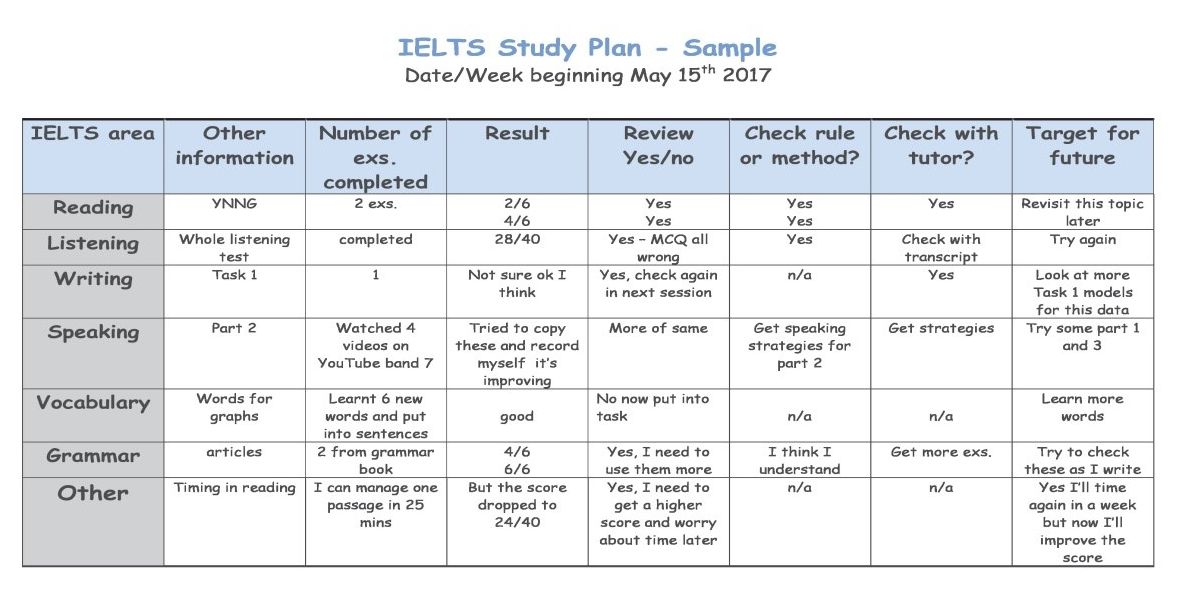
Your own log could be a simple spreadsheet with columns for:
- Date
- Skill Practiced (e.g., Reading Passage 1, Test 5)
- Time Taken
- Score (e.g., 9/13)
- Errors Made (e.g., "Misunderstood 'Yes/No/Not Given'," "Vocabulary for trends")
- Action Item (e.g., "Review lesson on Y/N/NG," "Learn 5 verbs for describing graphs")
This data-driven approach transforms study from a passive activity into an active process of continuous improvement.
Conclusion
In this lesson, we have designed the project plan for your successful IELTS campaign. You now have a framework to guide your daily efforts effectively and efficiently.
Key Takeaways:
- Structure Your Study: Use a four-week "sprint" model, with each week focusing on a different stage of preparation, from foundational skills to full test simulation.
- Balance Your Practice: Your daily 1-2 hour sessions should incorporate a mix of skills, with a main focus area and a secondary one to ensure balanced development.
- Track Everything: Maintain a study log to monitor your scores, timing, and error types. This data is essential for identifying weaknesses and making your practice more targeted.
- Be Flexible: This plan is a roadmap, not a rigid script. Adjust it based on your progress and the areas that require more attention.
With our plan in place, we are ready to begin execution. In our next lesson, we will dive into Module 2 and start our first practical sprint, focusing on core listening skills. We'll begin by applying prediction and signposting strategies to master Section 1 of the Listening test.