Welcome to your personalized IELTS course. This first lesson is designed to give you a clear, architectural overview of the entire IELTS Academic test. Your goal is a Band 7, and your preference is for a practice-first approach. Think of this initial session as the crucial planning phase of a project: before diving into development sprints, you need to understand the complete system requirements, components, and constraints. By the end of this lesson, you will be able to deconstruct the format, timing, and question types for each of the four test modules.
A Blueprint of the IELTS Academic Test
The IELTS exam is divided into four modules, always taken in this order on test day: Listening, Reading, Writing, and Speaking. The Speaking test might occur on the same day or up to a week before or after the other three sections.
Let's start with a high-level visual summary of the test structure.

As you can see, the total test time is around 2 hours and 45 minutes. Now, we will systematically break down each module to understand its specific format and the types of questions you will encounter. This foundational knowledge will make your practice sessions far more targeted and effective.
The Listening Module (Approximately 30 minutes + 10 minutes transfer time)
The Listening test is identical for both Academic and General Training candidates. It is designed to assess your ability to understand a range of spoken materials, including conversations and monologues.
Format and Timing:
- 40 questions distributed across 4 sections.
- The sections become progressively more difficult.
- You hear each recording only once.
- After the final recording, you have 10 minutes to transfer your answers to an answer sheet.
The contexts of the four sections are quite predictable:
- Section 1: A conversation between two speakers in an everyday social context (e.g., booking a service, making an inquiry).
- Section 2: A monologue set in an everyday social context (e.g., a welcome talk for new students, a radio announcement).
- Section 3: A conversation between up to four people in an educational or training context (e.g., a university tutor and a student discussing an assignment).
- Section 4: A monologue on an academic subject (e.g., a university lecture).
Question Types:
The Listening module features a wide variety of question types. Being able to recognize and anticipate them is a key skill. The following resource provides sample tasks for many of these question types.
[PDF] Free eBook: Prepare for IELTS in 30 Days
To understand the practical application of the format, let's walk through the various question types you'll face. This document from IELTS.org contains official examples.
Please browse through this document, paying close attention to the title of each sample task. You don't need to complete the tasks now; the goal is to familiarize yourself with the variety of questions. Notice the different ways information is requested: Form Completion Multiple Choice Short-answer Questions Sentence Completion Matching Plan, map, or diagram Labelling Note Completion
As you can see, the tasks range from filling in specific details like names and numbers to labeling diagrams and following complex academic arguments.
The Reading Module (60 minutes)
The Academic Reading module tests a wide range of reading skills, including reading for gist, main ideas, detail, and understanding logical arguments.
Format and Timing:
- 40 questions based on 3 long academic texts.
- You have a total of 60 minutes to read the passages and answer all questions. There is no extra time to transfer answers.
- The texts are authentic, taken from books, journals, magazines, and newspapers. They are written for a non-specialist audience but are academic in nature.
Question Types:
Similar to the Listening test, the Reading module has many different question formats. Your ability to quickly identify the question type and apply the correct strategy is vital for managing the strict 60-minute time limit.
[PDF] Free eBook: Prepare for IELTS in 30 Days
Now, let's deconstruct the Reading question types. This document contains official samples for the Academic Reading test.
Again, focus on the title of each sample task to build a mental checklist of what to expect. This is like understanding the different functions or methods you might need to call in a large software library. Browse through the examples for: Matching Features Table Completion True/False/Not Given Matching Headings Summary Completion And others like Multiple Choice, Sentence Completion, and Diagram Label Completion.
Your background in systems design will be an asset here. Each question type has its own logic. For example, "True/False/Not Given" questions require a strict, logical evaluation of information present in the text, not unlike debugging a conditional statement.
The Writing Module (60 minutes)
The Academic Writing module assesses your ability to produce two very different pieces of writing in a formal, academic style.
Format and Timing:
- 2 tasks to be completed in 60 minutes.
- Task 1: You should spend about 20 minutes and write at least 150 words.
- Task 2: You should spend about 40 minutes and write at least 250 words. Task 2 contributes twice as much as Task 1 to your final writing score.
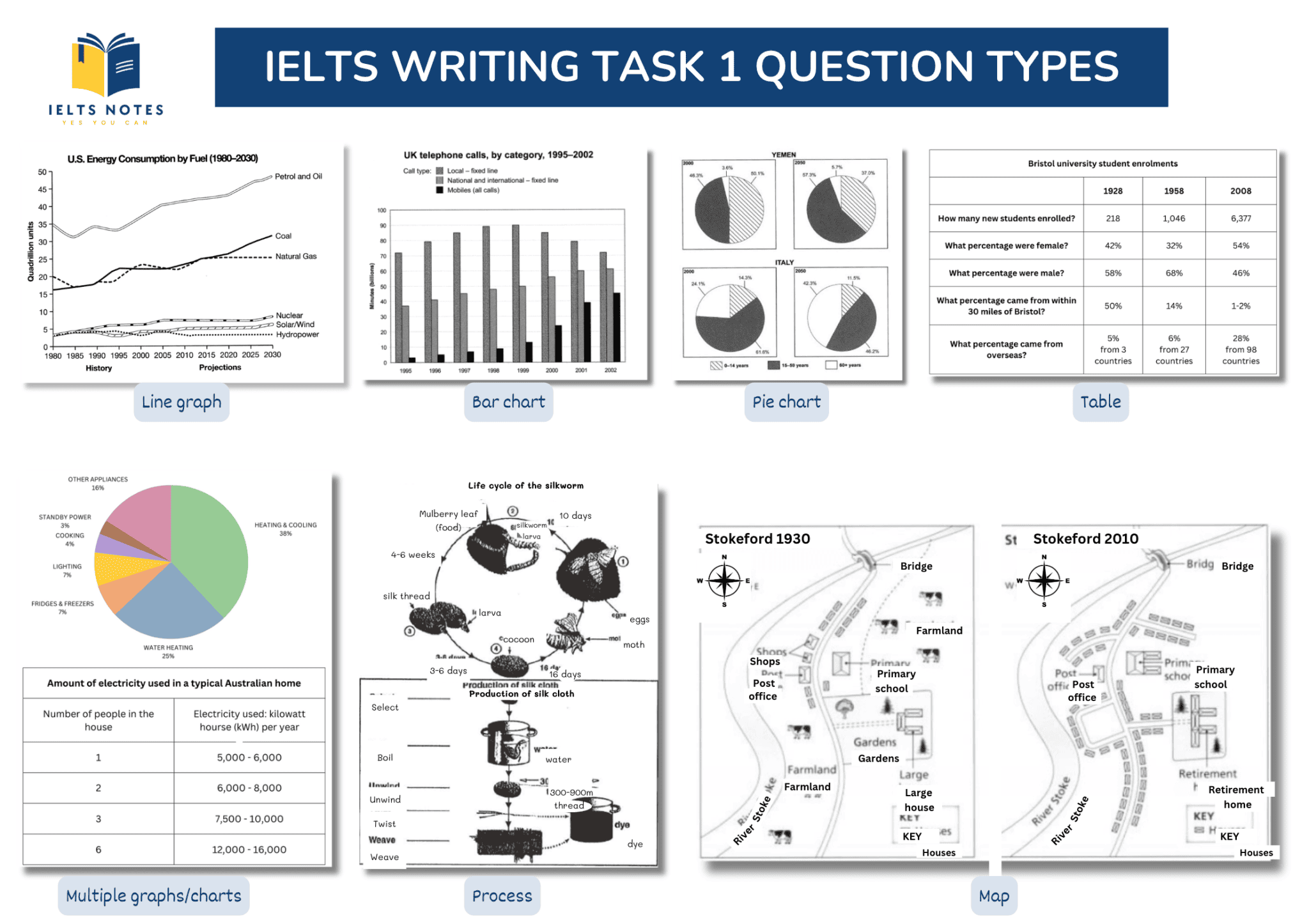
Task 1: Describing Visual Information
You will be presented with a graph, table, chart, map, or process diagram. Your task is to describe and summarize the information, selecting and reporting the main features and making comparisons where relevant. You should not give your opinion.
Task 2: Essay Writing
You will be given a point of view, argument, or problem. Your task is to write an essay in response. The topics are of general interest and you do not need specialist knowledge to answer them. The key is to present a well-structured, well-supported argument.
There are several common types of Task 2 essays, which we will practice in detail later in the course. These include:
- Opinion Essay: (Agree or Disagree)
- Discussion Essay: (Discuss both views)
- Problem and Solution Essay
- Advantages and Disadvantages Essay
- Two-Part Question Essay
For a brief overview of the writing module, you can review the following resource.
[PDF] Free eBook: Prepare for IELTS in 30 Days
This section from the "Prepare for IELTS in 30 Days" guide provides a concise summary of the writing test's structure and, importantly, introduces the four marking criteria.
Focus on the descriptions of the two tasks. Then, briefly read through the four assessment criteria: Task Achievement/Response, Coherence and Cohesion, Lexical Resource, and Grammatical Range and Accuracy. These are the metrics by which your 'system' (your writing) will be evaluated.
The Speaking Module (11-14 minutes)
The Speaking test is a face-to-face interview with a certified examiner. It is recorded. This module assesses your use of spoken English, not your knowledge of specific topics.
Format and Timing:
- A one-on-one interview divided into 3 parts.
Part 1: Introduction and Interview (4-5 minutes)
The examiner will ask you general questions about yourself and a range of familiar topics, such as your home, family, work, studies, and interests. This part is like a warm-up conversation.
Part 2: Individual Long Turn (3-4 minutes)
The examiner gives you a task card which asks you to talk about a particular topic.
- You have 1 minute to prepare and make notes.
- You then need to speak on the topic for 1 to 2 minutes.
This part tests your ability to speak at length on a topic, organizing your ideas coherently. It's similar to giving a short, structured update in a scrum meeting.
Part 3: Two-way Discussion (4-5 minutes)
The examiner will ask you further questions connected to the topic from Part 2. These questions are more abstract and give you an opportunity to discuss more complex issues and ideas. This is analogous to a follow-up discussion where you might have to justify a technical decision or explore the broader implications of a project.
To see how these parts are structured, take a look at the sample tasks.
[PDF] Free eBook: Prepare for IELTS in 30 Days
This document provides official examples of the prompts and questions for each part of the Speaking test.
First, quickly look through the Part 1 questions to see how they relate to familiar topics. Then, examine the Part 2 Cue Card format. Finally, review the Part 3 questions to understand their more abstract nature. After reviewing the samples, read the section on the basics (Part 1.5) for a summary of each part.
Conclusion
In this lesson, we have deconstructed the IELTS Academic test, mapping out the format, timing, and question types for all four modules. You now have the "system architecture" diagram for the exam. This structure is the foundation upon which all our targeted practice will be built. You know what to expect in Listening, Reading, Writing, and Speaking.
Key Takeaways:
- The IELTS test is a standardized exam with four distinct modules: Listening, Reading, Writing, and Speaking.
- Each module has a specific format, strict timing, and a variety of question types.
- Listening: 4 sections, 40 questions, one hearing only.
- Reading: 3 academic passages, 40 questions, 60 minutes total.
- Writing: 2 tasks (describing a visual and writing an essay) in 60 minutes.
- Speaking: A 3-part live interview assessing conversational and abstract discussion skills.
In our next lesson, we will analyze the official IELTS Band Descriptors. This will define the performance expectations for your target Band 7 score, giving us a clear set of success criteria for the "development sprints" ahead.