Welcome to our next lesson. In our previous session, you practiced delivering a structured, detailed two-minute monologue for Speaking Part 2. We focused on the Topic Diamond™ framework to ensure your talk was coherent and comprehensive.
Today, we transition from the monologue of Part 2 to the dynamic, abstract discussion of Part 3. The learning outcome for this lesson is to use a range of discourse markers (e.g., 'As for...', 'On the other hand...') to organize extended answers in Part 3.
Think of discourse markers as the logical connectors in your speech. In your work as a systems consultant, you use specific syntax and structures to make code readable and logic flow clearly. Discourse markers serve the same purpose in conversation: they signal to the listener how your ideas are connected, making your arguments easier to follow. Mastering them is key to achieving a high score in Fluency and Coherence and will directly help reduce the "thinking delay" you've mentioned by giving you ready-made phrases to structure your thoughts.
1. What Are Discourse Markers and Why Are They Crucial for Part 3?
Discourse markers, also known as signposting language or connectors, are words and phrases we use to organize our speech. They show the relationship between different parts of what we're saying.
Part 3 questions are very different from Part 1 and 2. They require you to:
- Express and justify opinions.
- Compare and contrast ideas.
- Speculate about the future or hypothetical situations.
- Analyze causes and effects.
Without clear signposts, your answers can sound like a disconnected stream of thoughts. With them, you guide the examiner through your reasoning, demonstrating a high level of linguistic control.
This image provides a useful overview of the different functions discourse markers can have.
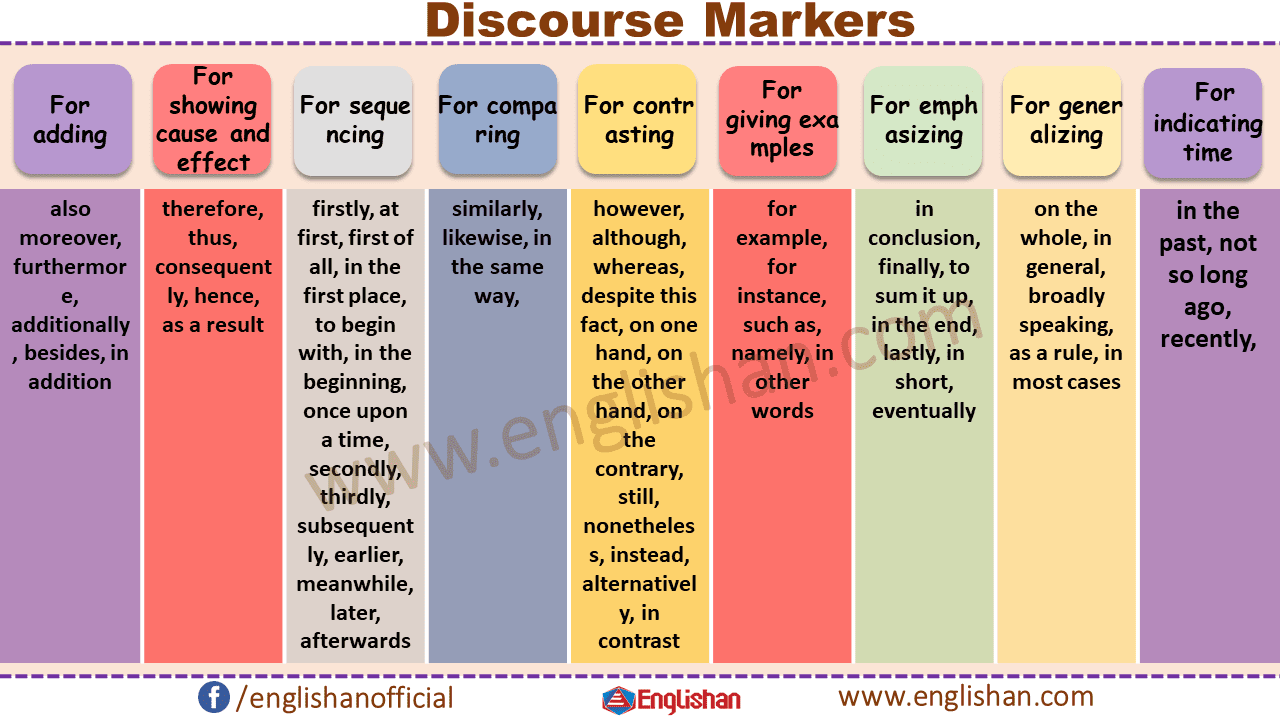
To understand why these are so vital for your score, please watch this short introduction from the English Speaking Success channel.
IELTS Speaking - Better Connectors, Better Fluency
This video explains how a wide range of connectors is a specific requirement for a Band 7+ score in Fluency and Coherence.
Watch from the beginning to the explanation of why a wide range is necessary. The presenter highlights that coherence—connecting your ideas logically—makes up a significant part of your score.
2. Building Your Discourse Marker Toolkit
To use discourse markers effectively, you need to have a variety of them ready for different types of questions. We'll organize them by their function, which is the most practical approach for the IELTS test.
This document from the British Council provides excellent examples of signposting language in action.
[PDF] Signposting Language – Speaking Part 3 - British Council IELTS
This resource breaks down how different phrases are used to perform specific functions in Part 3, like agreeing, speculating, or explaining.
First, read through the four candidate answers on Worksheet 1 (Answer A, Answer B, Answer C, and Answer D). Notice how they use phrases to introduce opinions, compare, and speculate. Next, study the table on Worksheet 2 (the table). This is your core toolkit. It categorizes phrases for comparing, discussing the past/present, speculating, giving reasons, and agreeing/disagreeing. Keep this table in mind as we go through the functions.
The table you just reviewed is a fantastic starting point. Now, let's expand on it with more sophisticated options from a guide by IELTS Advantage. These will help you push your lexical resource score higher.
100 Essential Words and Phrases for Band 7-9 Success
This guide offers a treasure trove of high-level phrases, perfect for elevating your Part 3 responses.
Skim through the lists in this guide to familiarize yourself with the variety of options available. Pay special attention to these sections: Advanced Linking & Cohesion: Look at the phrases for adding, contrasting, and showing results. Explaining & Clarifying: Note the phrases for rephrasing and elaborating. These are great for adding depth. Comparing & Contrasting: The phrases for showing similarities and differences are essential for many Part 3 questions. Giving Examples & Evidence: This is crucial. Review the phrases for introducing examples and showing patterns. Concluding & Summarizing: Useful for wrapping up a long answer. See the phrases under this section. Finally, read the Detailed Analysis section (16 phrases analysis) to see exactly how high-scoring candidates use these in real tests. Also, briefly review the Common Mistakes to Avoid.
3. Structuring Your Answers with the A-R-E-A Method
Having a toolkit of phrases is one thing; using them naturally under pressure is another. To help with this, we'll use a simple, memorable structure: the A-R-E-A method. This provides a logical path for your answers, making it easier to integrate discourse markers and develop your points coherently.
- A - Answer: Start with a direct answer to the question.
- R - Reason: Explain the reason behind your answer.
- E - Example: Provide a specific, non-personal example to support your point.
- A - Alternative: Briefly acknowledge a different perspective or consequence.
Let's see it in action with a typical Part 3 question.
Question: Why do some people prefer to work from home these days?
- (A) Answer: "Well, I believe the primary motivation is the desire for greater flexibility and work-life balance."
- (R) Reason: "This is mainly because commuting can be time-consuming and costly, and a home environment allows people to manage personal tasks alongside their professional ones."
- (E) Example: "For instance, many professionals in the tech industry find they can be just as productive, if not more so, without the daily commute. They can use that saved time for family, hobbies, or further professional development. You can see this in the policies of many large tech companies that now offer permanent remote or hybrid options."
- (A) Alternative: "Having said that, some people still prefer the office environment for the social interaction and clearer separation between work and home life. Ultimately, though, I think the trend is moving firmly towards remote work."
This structure provides a complete, well-supported, and balanced answer, which is exactly what examiners are looking for.
4. Practice and Application
Now it's your turn. Your preference is for practice, so let's apply this immediately. Below are some Part 3 questions that follow a recent Part 2 topic on skills and work.
Your Task:
- Choose one of the questions below.
- Plan a response using the A-R-E-A framework.
- Consciously select discourse markers from the resources we've reviewed.
- Record yourself delivering the answer. Aim for a response of about 45-60 seconds.
- Listen back and analyze: Did you follow the structure? Did you use signposting language correctly and naturally?
Practice Questions:
- What are the most important skills a person needs to learn to be successful in the workplace today?
- Do you think soft skills are more important than hard skills? Why or why not?
- How do you think artificial intelligence will change the skills that are required for jobs in the future?
A Tip for Handling "Thinking Delay"
Part 3 is fast-paced. If you need a moment to think, don't just stay silent. Use specific filler phrases to buy yourself time. This video offers excellent strategies for this.
How to Start Speaking in IELTS Part 3
This video from English Speaking Success provides practical tips on how to create thinking time naturally.
Watch the segment on gaining thinking time, from this timestamp. The presenter explains three key strategies: repeating the question, using time fillers like "That's an interesting question...", and asking for clarification.
Using these phrases signals to the examiner that you are engaged and processing the question, rather than struggling for words.
Conclusion
In this lesson, we've focused on one of the most important skills for a high score in IELTS Speaking: using discourse markers to build coherent, well-structured answers in Part 3.
Key Takeaways:
- Discourse markers are essential for coherence: They guide the listener through your logic and are a specific requirement for Band 7+.
- Organize your toolkit by function: Learn phrases for giving opinions, comparing, contrasting, speculating, and providing examples.
- Use the A-R-E-A method: Structure your answers with a direct Answer, Reason, Example, and mention of an Alternative view.
- Buy thinking time strategically: Use phrases like "That's a good question..." to reduce pauses and maintain fluency.
In our next lesson, we will continue to build on this foundation. We'll focus on how to express and justify opinions on abstract topics in Part 3 with clear reasoning. You now have the structural tools; next, we will refine the substance of your arguments.