Hello! In our last lesson, we built the structural framework for your Speaking Part 3 answers using discourse markers and the A-R-E-A method. This gave you the tools to connect your ideas coherently.
Today, we'll build on that foundation to focus on the substance of your arguments. The learning outcome is to express and justify opinions on abstract topics in Part 3 with clear reasoning. This is the core of what examiners are looking for in a Band 7+ performance. It's not just about stating an opinion, but about defending it with logic, evidence, and nuance. In your work, you justify complex technical solutions to stakeholders; this skill is analogous, requiring you to build a clear, logical case for your viewpoint.
1. What is "Clear Reasoning" in IELTS Part 3?
In Parts 1 and 2, your answers are mostly descriptive and personal. Part 3, however, demands a shift to abstract, analytical thinking. The examiner isn't interested in your personal feelings, but in your ability to discuss broader societal issues. A simple opinion isn't enough; you need to demonstrate what are sometimes called "Higher Order Thinking Skills" (HOTS).
IELTS Speaking Part 3: How to Get a High Score
This article from Keith Speaking Academy introduces the concept of Higher Order Thinking Skills (HOTS) and why they are essential for Part 3.
Read the introduction and the first two sections, "Getting a high score..." and "A sample IELTS speaking part 3 answer". Pay close attention to the list of skills—analyzing, evaluating, reasoning, speculating—as these are the mental muscles you need to exercise in your responses.
The difference between a well-reasoned answer and a simple one is what separates a Band 6 from a Band 7 or higher. To see this in practice, we'll look at a resource that provides side-by-side comparisons.
IELTS Speaking Part 3: Topics, Questions & Band 7+ Sample Answers (2026)
This guide from IELTSKaro brilliantly illustrates the structural and logical differences between mid-band and high-band answers.
First, study the section called "The Opinion Structure Formula". This expands on the A-R-E-A method we learned, adding crucial steps for nuance and reinforcement. Then, carefully analyze the three comparison examples. For each question, notice how the Band 7-8 answer provides specific reasoning, uses more abstract vocabulary, and—most importantly—acknowledges complexity.
As you saw, the high-scoring answers don't just state an opinion; they explore why it's a valid perspective and often consider its limitations.
2. The Anatomy of a Justified Opinion
To consistently produce well-reasoned answers, you need a reliable structure. A simple and effective model is Opinion - Reason - Example. This ensures you not only state your view but also back it up.
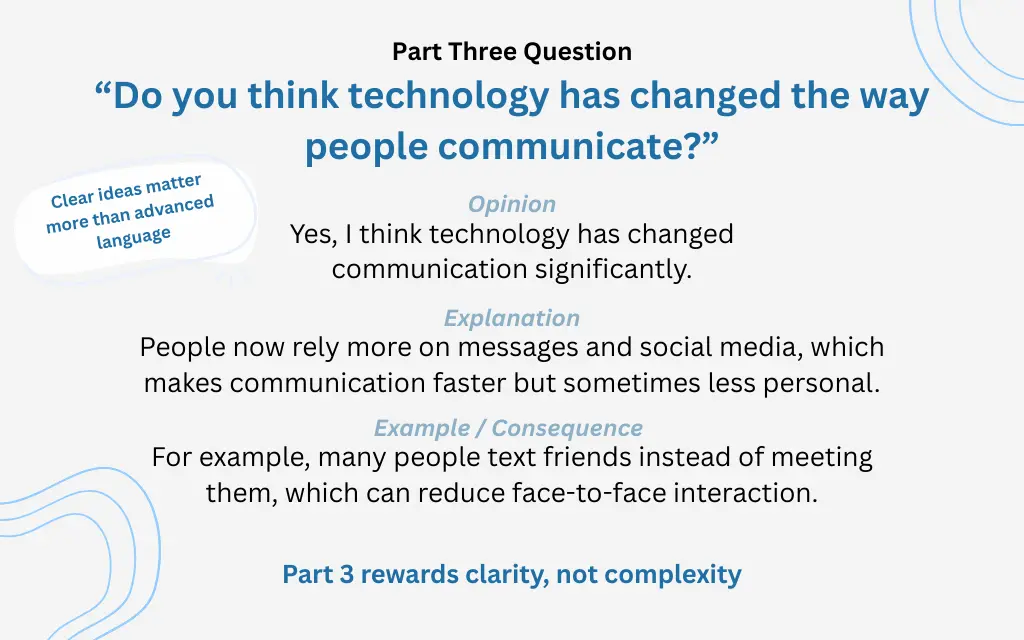
A critical element here is the type of example you provide. For the abstract discussion in Part 3, personal anecdotes are less effective than general examples.
How to Start Speaking in IELTS Part 3
This video from English Speaking Success, which we looked at briefly before, has an excellent section on how to develop your answers using the O-R-E method and the right kind of examples.
Watch the segment from this timestamp. The speaker explains the "O.R.E." (Opinion, Reason, Example) method and makes a vital point about using general or global examples rather than personal stories like "my granddad..." This is key to sounding analytical and objective.
To summarize the key points:
- Opinion: State your main point directly.
- Reason: Explain why you think this. Use phrases like "This is because..." or "The main reason is..."
- Example: Provide a general example. This could be a societal trend, something you've read about, a common business practice, or a government policy. It should not be about your personal life.
For example, if asked "Why do some people prefer working in an office to working from home?":
- Opinion: I believe for some, the preference for an office environment stems from a need for clear boundaries between their professional and personal lives.
- Reason: This is largely because the physical separation of the workplace helps them to mentally "switch off" after hours, which can be difficult when their living room is also their office.
- Example: For instance, many junior employees or those in collaborative roles, like in marketing or design, find that the spontaneous interactions and mentorship opportunities in an office are crucial for their career development, something that is much harder to replicate in a fully remote setup.
This answer is justified with a logical reason and a non-personal, relevant example.
3. Adding Nuance: The Key to a Band 7+ Score
The most effective way to demonstrate advanced reasoning is to show that you can see more than one side of an issue. This is where the "Concession" or "Alternative" part of your answer comes in. After presenting your main argument (Opinion-Reason-Example), you briefly acknowledge a counter-argument before concluding.
This technique is highlighted in the "5 Strategies That Separate Band 6 From Band 7+" from the IELTSKaro guide.
IELTS Speaking Part 3: Topics, Questions & Band 7+ Sample Answers (2026)
This section of the guide provides actionable strategies for high-level performance.
Read through the five strategies, starting from Strategy 1. Pay special attention to Strategy 2: Embrace Complexity and Strategy 5: Disagree With the Examiner Politely. Also, read the FAQ answers for "What if I don't have an opinion?" and "Should I agree with the examiner?". This shows that acknowledging complexity isn't a weakness; it's a sign of a sophisticated speaker.
Adding a concession using phrases like "Having said that...", "On the other hand...", or "Of course, one could argue that..." transforms your answer from a simple statement into a well-rounded mini-argument.
Let's upgrade our previous example:
- Opinion, Reason, Example: (As before)
- Concession: "That said, the autonomy and flexibility of remote work are undeniably powerful motivators for experienced professionals who can manage their own time effectively."
- Conclusion/Reinforcement: "Ultimately, though, I think the ideal work environment often depends on an individual's career stage and personality."
This full structure—Position, Reason, Example, Concession, Reinforcement—is your blueprint for a comprehensive, well-justified Band 7+ answer.
4. Practice and Application
Now it's time to put this into practice. Below are some Part 3 questions on topics related to your professional field. This should help you generate ideas more easily.
Your Task:
- Choose one of the questions below.
- Take one minute to plan your answer using the Position-Reason-Example-Concession-Reinforcement structure.
- Record yourself delivering the answer. Aim for a response of about 45-60 seconds.
- Listen back and critically assess your response.
- Did I state a clear position?
- Was my reasoning logical?
- Was my example general and not personal?
- Did I include a concession to show nuance?
- Was my language clear and appropriate for an abstract topic?
Practice Questions (from the "Technology and Society" and "Work and Education" sets):
- Do you think social media has had a positive or negative effect on society?
- How might artificial intelligence change the job market in the next 20 years?
- Do you think job satisfaction is more important than salary?
- Is it better to specialise in one field or to have a broad range of skills?
Using filler phrases like "That's an interesting question..." or "Let me think about that for a moment..." is perfectly fine. It buys you a few seconds to structure your thoughts and shows you are engaging with the question, which helps reduce the "thinking delay" you're working on.
Conclusion
Today, we've moved from the structure of an answer to its logical substance. You've learned how to justify your opinions not just by stating them, but by building a reasoned argument.
Key Takeaways:
- Go Beyond the Obvious: Part 3 requires analytical thinking (HOTS), not just personal descriptions.
- Justify with O-R-E: Every opinion should be supported by a Reason and a general Example.
- Embrace Complexity: Acknowledging the other side of an argument with a Concession is a hallmark of a Band 7+ response.
- Use the Full Formula: Aim for the Position-Reason-Example-Concession-Reinforcement structure for a comprehensive, well-developed answer.
In our next lesson, we will begin a new module focusing on Lexical Resource and Pronunciation. The first topic will be "Use topic-specific vocabulary and natural collocations when discussing common IELTS themes." You now have the logical framework for your arguments; next, we will work on enriching the language you use to express them with greater precision and impact.