In our last lesson, we developed the essential skills of skimming and scanning to quickly navigate IELTS reading passages. We framed this as a three-speed process: a quick skim for the gist, a targeted scan for keywords, and a careful read for confirmation. Today, we'll focus heavily on that third speed—careful, precise reading—as we tackle one of the most common and challenging question types: True/False/Not Given and Yes/No/Not Given.
Your background in computer science and system development will be a significant asset here. These questions operate on a strict, binary-like logic. A statement is either demonstrably true based on the text, demonstrably false, or the information is simply not available to make a judgment. Think of it like evaluating a logical condition in code: a statement in the text either makes the question TRUE, explicitly makes it FALSE, or the necessary information isn't present, making it NOT GIVEN. Your task is to become a rigorous 'compiler' for these statements, based solely on the provided text.
1. Understanding the Core Logic
At its heart, this question type tests your ability to distinguish between what is stated, what is contradicted, and what is not mentioned at all. Let's establish the ground rules.
- TRUE: The statement agrees with or confirms the information in the passage. It will often be a paraphrase, not a word-for-word copy.
- FALSE: The statement contradicts or is the opposite of the information in the passage. There must be a direct conflict.
- NOT GIVEN: You cannot find the information in the passage. It's not about whether the statement is true in the real world; it's about whether the text gives you the evidence to decide.
This flowchart provides a simple decision-making process:

True/False vs. Yes/No
There is a subtle but important difference between the two variations of this question type.
- True/False/Not Given (TFNG) questions are about factual information presented in the passage.
- Yes/No/Not Given (YNNG) questions are about the writer's views, opinions, or claims.
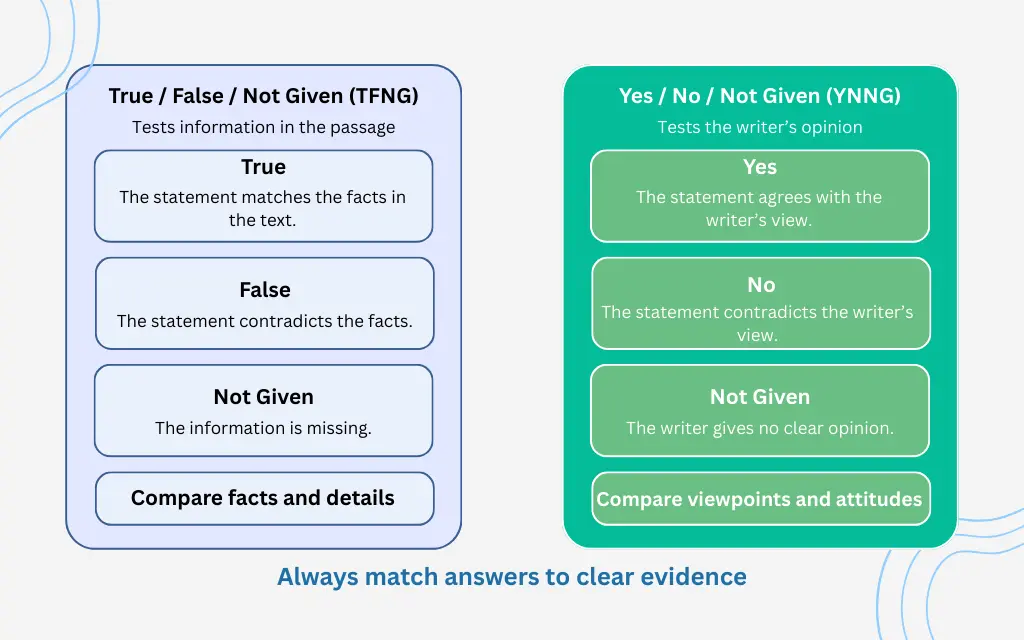
Despite this difference, the logical process you'll use to answer them is identical. You are always looking for clear evidence in the text.
2. The 'False' vs. 'Not Given' Distinction
The most common difficulty is distinguishing between 'False' and 'Not Given'. The key is to remember that 'False' requires a direct contradiction. If the passage says "the car was red," the statement "the car was blue" is False. However, the statement "the car was a convertible" is Not Given. The text doesn't provide that detail.
The following resource from IELTS Buddy explains this distinction very clearly. Pay special attention to the sample question about ants building cities, as it perfectly illustrates the 'Not Given' trap.
IELTS Reading True False Not Given Exercises
This article breaks down the definitions of True, False, and Not Given, with a specific focus on why 'Not Given' is so tricky for many candidates.
Please read the introductory sections and the detailed explanation of 'Not Given'. Start by reading the definitions under Understanding the Statements. Next, read the section Understanding 'Not Given' Questions. The example provided here about ants is crucial. The text says their achievements "outstrip" humans', but it says nothing about the speed of building. This is a classic 'Not Given' scenario where the topic is mentioned, but not the specific detail in the question.
The core principle to internalize is that you must not make any assumptions or use your own general knowledge. Your entire decision must rest on the words printed in the passage.
3. Guided Practice: Applying the Logic
In line with your preference for a practice-first approach, let's apply these concepts directly. We'll start with a guided walkthrough of a practice text, and then analyze how an expert breaks down more complex questions.
Practice Set 1: "The Quest for Beauty"
The same IELTS Buddy page you just reviewed contains an excellent practice exercise. I recommend you work through it question by question. For each one, read the statement, locate the relevant information in the paragraph, decide on your answer (True, False, or Not Given), and then click the 'show / hide answer' button to check your reasoning against the explanation.
IELTS Reading True False Not Given Exercises
This exercise allows you to apply the T/F/NG logic to a real passage, with immediate feedback and explanations for each question.
Navigate to the section titled The Quest for Beauty. Attempt each of the 10 questions. Pay close attention to the explanations for: Question 4: A perfect example of 'Not Given'. The text says the pills are a "cash cow," but doesn't compare their profitability to other pills. Question 6: A classic 'False'. The statement and text contain a direct contradiction in one key detail ('after marriage' vs. 'prior to their wedding day'). Question 7: A good example of 'True' based on paraphrasing ('lacks the social stigma' means society 'does not view it as negatively').
Practice Set 2: Expert Walkthrough
Now, let's watch how an expert applies this same logical rigor to questions of increasing difficulty. This video from Fastrack IELTS is excellent because the tutor externalizes their thought process, showing you how to dissect each statement and compare it to the text.
Band 9 IELTS Reading TRUE - FALSE - NOT GIVEN | Strategy & Practice
This video provides a masterclass in solving T/F/NG questions, moving from simpler Section 1 style questions to complex Section 3 examples.
Watch the following segments to see the strategy in action. Core Strategy: Begin at the tips section, where the tutor emphasizes that "the devil is in the detail" and a 'False' answer requires a "strong contradiction." A 'False' Example: Watch the walkthrough from the first practice question. Notice how the statement says "different groups of polar bears," but the text says they compared "polar bears with brown bears." This is a clear contradiction. A 'True' Example: Continue with the next question from the polar bear passage. The tutor shows how "could also be used by people one day" is a direct paraphrase of "could potentially benefit." A Difficult 'False' Example: Now, observe the more complex Section 3 question about the "job prospects experiment" from this segment. The statement says students "could choose" one of two perspectives. After careful reading, the tutor finds the phrase "assigned to the distant observer group," which directly contradicts the idea of choice. A Difficult 'Not Given' Example: Finally, analyze the "couples' experiments" question from this part. The statement claims the length of the relationship impacted the results. The text mentions that the couples were in "long-term" relationships, but it provides no information about short-term couples or any comparative results. The information is simply not there.
This systematic process of locating keywords, carefully comparing the meaning, and looking for direct contradictions or exact paraphrases is the key to achieving a high score on these questions.
Conclusion
Today, we've broken down the logical framework for True/False/Not Given and Yes/No/Not Given questions. By approaching them with the same precision you would use for evaluating code, you can avoid common traps and answer with confidence.
Key Takeaways:
- Base your answer only on the text. Your general knowledge is irrelevant.
- TRUE/YES means the statement is a correct paraphrase of what the text says.
- FALSE/NO means the statement directly contradicts what the text says.
- NOT GIVEN means the information required to verify or contradict the statement is absent from the text.
- Pay extremely close attention to qualifying words like some, all, many, occasionally, always, as they can completely change the meaning of a sentence.
In our next lesson, we will move on to another set of common questions: Matching Headings, Information, and Features. These questions require a broader understanding of paragraph structure and main ideas, and will call upon the skimming skills we developed in the previous lesson.