Hello! Welcome to our next lesson in the IELTS Academic Reading module.
In our previous session, we honed our skills in tackling True/False/Not Given questions by applying strict, binary-like logic. You learned to act as a rigorous 'compiler', evaluating statements based solely on the evidence provided in the text. Today, we shift our focus from validating specific details to understanding the broader structure of a text. We'll be tackling three related but distinct question types: Matching Headings, Matching Information, and Matching Features.
This lesson will equip you with systematic strategies to efficiently map main ideas, specific details, and key features to their correct locations within a passage. Think of it as a structural analysis task: for Matching Headings, you're identifying the primary purpose of each 'code block' (paragraph); for Matching Information and Features, you're performing a targeted information retrieval, much like querying a database for specific records. Your background in navigating complex systems will be very useful here.
1. Matching Headings: Identifying the Main Idea
The first and most common of these tasks is Matching Headings. You'll be given a list of headings (summaries) and asked to assign the most appropriate one to each paragraph of the text.
The key challenge is to identify the main idea or 'gist' of a paragraph without getting lost in the supporting details and examples. There will always be more headings than paragraphs, so you need to be precise.
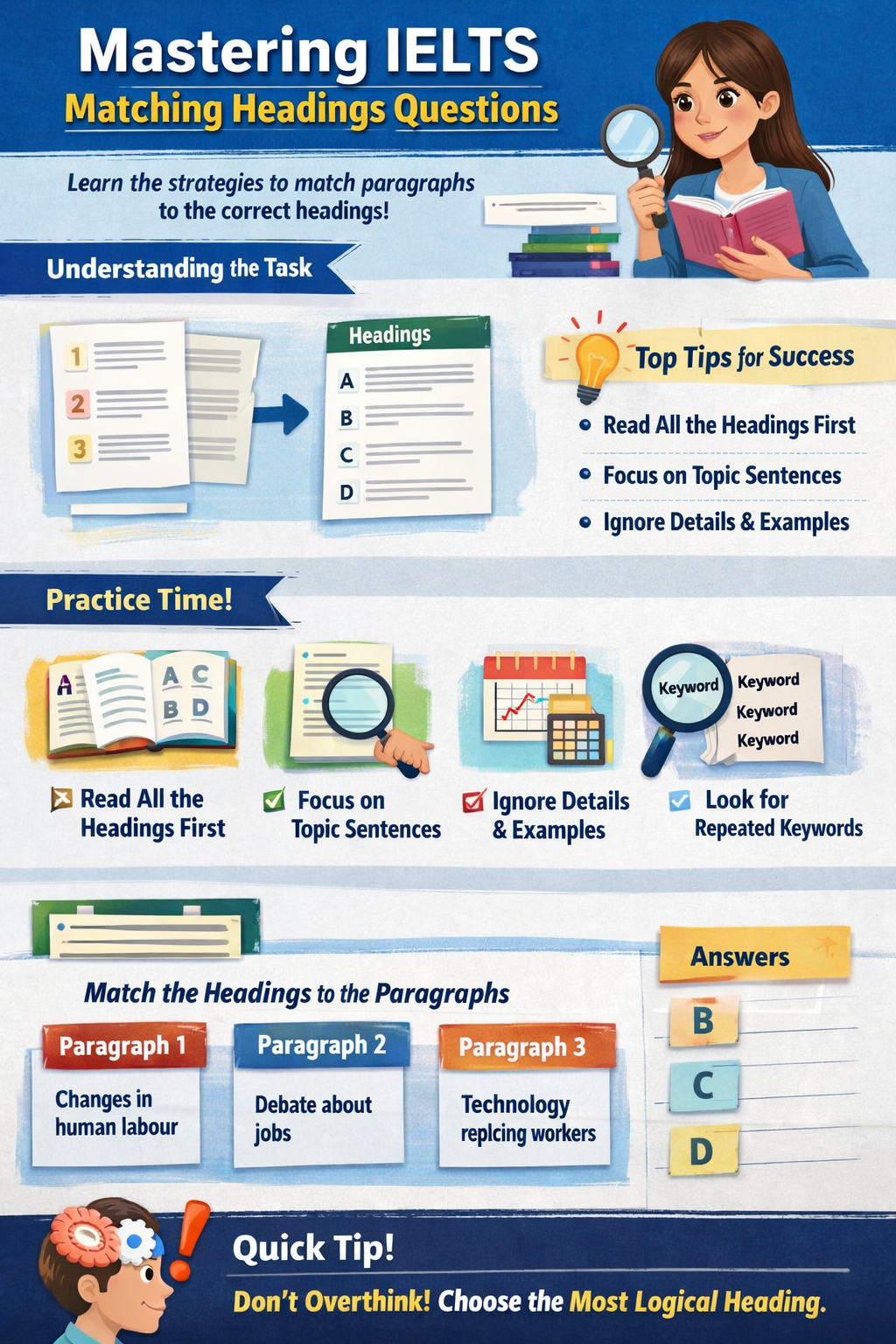
The core strategy involves a systematic process of elimination and matching. Instead of reading the entire passage first, you work paragraph by paragraph. A fantastic resource from the British Council walks through this exact process.
This PDF from the British Council provides a complete guide and practice session for Matching Headings questions. It includes a reading passage about the musician Miles Davis and breaks down the strategy into clear, actionable steps.
Please work through this resource as follows: On page 3, read the description under the heading <span data-type="resource_reading_textrange" data-resource-subitem-id="3e98d313" data-range-start="Matching Headings questions" data-range-end="from supporting ones">Matching Headings questions to understand the task format. 2. On page 4, review the concepts of topic sentences in Exercise 4 and identifying keywords in Exercise 5. This is crucial. A topic sentence, which is often the first sentence, usually states the main idea of the paragraph. 3. On page 10, study the step-by-step procedure in Exercise 7, under Strategy for dealing with Matching Headings. This is the systematic approach you should adopt. 4. Finally, put the strategy into practice. Read the full text about Miles Davis on pages 7-8 and attempt to match the headings from the list on page 9 to paragraphs A-F. You can check your work against the explanations provided on pages 5-6 for paragraphs A, B, and D to ensure you are on the right track.
As you work through the exercise, notice how the most effective strategy isn't to read deeply from start to finish. Instead, it's a cycle:
- Read headings to know what you're looking for.
- Read a paragraph, focusing on the first and last sentences.
- Match the paragraph to a heading.
- Cross off the used heading and repeat.
2. Matching Information and Matching Features
While Matching Headings is about the main idea, two other question types—Matching Information and Matching Features—are about locating specific details. They look similar but require slightly different approaches.
- Matching Information: You match a statement (e.g., "an explanation of how a problem can arise") to the paragraph (A, B, C...) that contains this information.
- Matching Features: You match a list of items (e.g., research findings) to a list of named features (e.g., scientists, companies, places).
The following video from Fastrack IELTS provides an excellent, clear strategy for tackling both types. The instructor, Asiya, does a brilliant job of differentiating them and offers time-saving tricks.
IELTS Reading Matching Features & Information
This video breaks down the strategies for both Matching Information and Matching Features, using examples from an official Cambridge IELTS practice test.
Please watch the video, paying close attention to these key segments: Matching Information Strategy: From this section, Asiya explains why this isn't about the main idea. Her strategy is crucial: read the questions first, highlight keywords, and then read the passage section by section, checking back against your list of questions after each one. Matching Information Practice: Follow her worked example from this segment. Notice how one paragraph (Section C) can contain the answers to two different questions. Matching Features Strategy: Watch from this point. The key insight here is that while the questions are not in order, the features (the list of names, in this case) are usually found in the text in the order they are listed. This allows you to scan for names, which are easy to spot. Matching Features Practice: Observe the application of this scanning strategy from this walkthrough. The method is: scan for a name, stop, read the surrounding text carefully, and match it to a statement.
To get more hands-on practice, especially with Matching Features, let's turn to another resource.
Matching Features IELTS Reading Questions: Tips and Practise
This article from IELTS Buddy provides a concise summary of the strategy and a self-contained practice exercise.
First, quickly review the list of tips. They reinforce the method you saw in the video. Next, read the passage about the Santorini 'seismic crisis' and answer the 5 Matching Features questions that follow. Check your answers and, more importantly, read the detailed Answers Discussion to understand the reasoning and see how distractors are used to trick you. For instance, notice the explanation for Question 4 and the subtle difference between the two people who were "staying put".
Conclusion
In this lesson, we've added three powerful question-tackling strategies to your toolkit. You've learned to distinguish between finding a main idea and locating a specific detail, applying a different, optimized procedure for each task.
Key Takeaways:
- Matching Headings: This is a "main idea" task. Read the headings, then work through the text paragraph by paragraph, focusing on topic sentences. It’s about the summary, not the details.
- Matching Information: This is a "specific detail" task. Read the questions first, and then check for answers after reading each paragraph. A single paragraph can contain multiple answers.
- Matching Features: This is a scanning-heavy task. Use the list of features (e.g., names) as your guide. Scan the text for these keywords, which are often in order, then read the surrounding sentences carefully to find the match.
In our next lesson, we will focus on completion tasks (Summary, Sentence, and Note Completion). These questions require you to pull exact words or short phrases from the text to fill in gaps, testing both your scanning skills and your understanding of grammar and context.