Welcome to the first lesson of our module on Core Reading Skills. In the previous module, we developed a systematic approach to the IELTS Listening test, culminating in a full practice test and a deep dive into error analysis. That analytical mindset—breaking down a problem to find its root cause—will be just as valuable as we transition to the Academic Reading test.
The challenge in IELTS Reading is not just comprehension, but time. You have 60 minutes to answer 40 questions across three long academic passages. This works out to just 20 minutes per passage. Today's lesson is designed to equip you with the two most fundamental techniques for succeeding under this pressure: skimming and scanning. Mastering these skills is the key to locating information efficiently without reading every single word.
1. The Core Principle: Reading is a Targeted Search
In your work as a consultant and developer, you don't start a complex project by reading every line of existing code from top to bottom. You identify a requirement, locate the relevant modules or functions, and then focus your attention there. The IELTS Reading test demands a similar approach. Reading every word of the 2,500+ words of text is a trap; the test measures your ability to locate and understand specific information quickly.
The two primary techniques for this are skimming and scanning.
- Skimming is reading quickly to understand the general topic, structure, and main ideas of a text. It answers the question, "What is this passage about?"
- Scanning is searching for specific keywords, names, dates, or numbers. It's not reading; it's hunting. It answers the question, "Where is the information I need?"
This image provides a great visual for how to skim a text. Notice how you read the introduction and conclusion more carefully, but only glance at the first sentence of the body paragraphs to get their main idea.
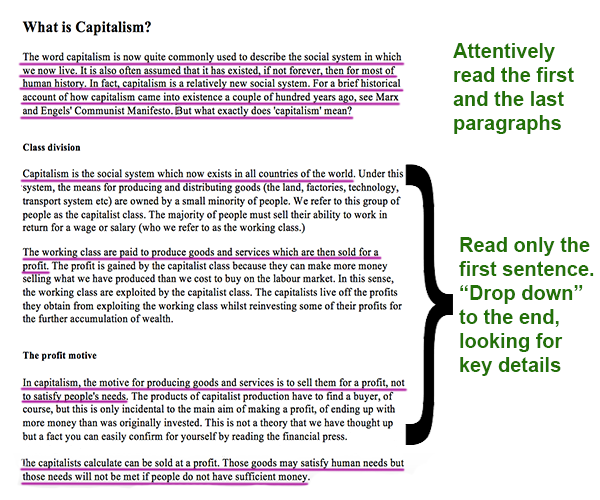
To solidify these definitions, please review the following resource from the British Council.
A Guide to Skimming vs. Scanning for IELTS Reading
This article clearly defines skimming and scanning and explains why they are essential for managing time in the IELTS Reading test.
Read the first few sections to get a clear understanding of each technique. Read the definitions under What is skimming? and What is scanning? Review the summary of their differences in the section What’s the difference. Finally, read the section Why are they important? to understand their direct benefits for your score.
2. A Three-Speed Framework for Reading
Thinking of reading as having different "speeds" or "modes" can be very effective. It's like having different search algorithms for different tasks. The following video introduces a powerful three-speed model: Speed Reading, Search Reading, and Careful Reading. These correspond directly to skimming, scanning, and detailed analysis.
Time Management in IELTS Reading: BEST STRATEGY
This video from E2 IELTS breaks down the reading process into a practical, step-by-step strategy. Pay close attention to the car analogy, as it's a memorable way to understand the different reading speeds.
Watch the following segments to learn the three-speed framework. Speed Reading (Skimming): First, watch the segment on Speed Reading. This is your initial, 90-second pass over a passage to map its structure and get the gist. Think of it as a quick "schema load" to understand the overall architecture of the text. Search Reading (Scanning): Next, watch the explanation of Search Reading. This is where you actively hunt for keywords from the question. Crucially, this section highlights that you'll often be looking for synonyms and paraphrases, not just the exact words. Careful Reading: Finally, understand the last stage by watching the segment on Careful Reading. This is the "debugging" phase—once you've located the right line of code (or sentence), you slow down to analyze it precisely. Putting it all together: To see how these three speeds combine into a coherent strategy, watch the summary of the ultimate IELTS Reading process.
This structured process—Speed Read, Read Question, Search Read, Careful Read, Answer—is an algorithm for efficiency. By applying it consistently, you avoid wasting time on irrelevant parts of the text and focus your cognitive energy where it matters most.
3. Guided Practice: Applying the Techniques
Now, let's put this theory into practice. The most effective way to learn is by doing. The following video walks through an entire IELTS Reading passage, demonstrating exactly how to apply these techniques to answer questions in under 20 minutes.
I suggest you approach this interactively. For each question, pause the video after the tutor reads the question, try to find the answer yourself using the skimming/scanning techniques, and then resume the video to see how the expert does it.
IELTS Reading Practice Test 2026 with Answers IN UNDER 20 MINUTES
This video from IELTS with Juva provides a masterclass in applying skimming and scanning under time pressure. It is a perfect example of your preferred "practice-first" approach.
Follow along as the tutor works through a full reading passage. The Core Strategy: Watch the introduction from the beginning, where the tutor explains the fundamental rule: read the questions first. Scanning for Keywords: Observe how the tutor tackles Question 2. She identifies "Victoria and Albert Museum" as a keyword and immediately scans the text to find that exact phrase, ignoring everything else. This is a perfect demonstration of scanning. Skimming for Gist: For Question 3, which asks about the writer's view, watch how the tutor skims paragraph D. She isn't looking for a single word but is reading quickly to understand the main argument of that specific paragraph before checking the options. Handling Detail Questions: For the sentence completion task (Questions 5-7), notice how the tutor scans for very specific types of information: a price ('one shilling'), a unique noun ('velocipeds'), and a description ('giant greenhouse'). This shows how scanning helps you pinpoint precise details required for fill-in-the-blank questions. Mapping Information: Finally, for the "Which paragraph contains..." questions (8-13), observe how the process becomes faster. Because the tutor is already familiar with the text's general layout from answering the previous questions, she can more quickly navigate to the right paragraph for each piece of information.
Working through this practice video gives you a clear, repeatable workflow for any IELTS Reading passage.
Conclusion
In this lesson, we've established the foundational skills for the IELTS Reading test. You've learned that success isn't about reading faster, but about reading smarter. By treating the text as a database to be queried rather than a novel to be read, you can conquer the 20-minute time limit for each passage.
Key Takeaways:
- Read the Questions First: Always start with the questions to know what information you are looking for.
- Skim for Gist: Use a quick (~90-second) pass to understand the passage's overall topic and paragraph structure.
- Scan for Keywords: Hunt for specific names, dates, numbers, and unique nouns from the questions to locate the relevant section of the text. Remember to look for synonyms and paraphrases.
- Read Carefully for Confirmation: Once you've located the potential answer, slow down and read the surrounding sentences carefully to confirm your choice.
In our next lesson, we will apply these skills to one of the most challenging question types in the IELTS Reading test: True/False/Not Given and Yes/No/Not Given questions. These questions require a strict application of logic and an precise understanding of what the text states, which builds directly on the scanning and careful reading skills you've developed today.