Hello. Last time, you distinguished plasma breakeven from ignition and saw why a long-running plasma need not have a long energy confinement time. Those distinctions are useful now: fusion headlines often report a real achievement, but the headline number may measure only one part of a power system.
In this session, you will read three kinds of result: NIF’s target gain, JET’s fusion-energy yield, and a long magnetic-confinement discharge. The goal is to identify what each experiment demonstrated—and what additional evidence would be needed to claim net electrical output. Allow about 30 minutes.
First, find the boundary around the claim
A gain figure compares an output with a particular input. Before interpreting it, ask where the measurement boundary is drawn. For example, laser energy delivered to a target excludes much of the electricity used to run the laser facility. Energy used to heat a magnetic plasma excludes other plant systems.
A power plant faces a wider test:
Both terms must be measured over a meaningful operating period. Fusion energy released in an experiment is not yet electricity generated: a plant would have to capture that energy as heat, convert some of it to electricity, and run all its equipment. Keep that boundary in mind as the experiments change scale and duration.
NIF: more fusion energy than laser energy delivered to the target
The National Ignition Facility (NIF) uses a short laser pulse to compress a tiny deuterium–tritium (D–T) fuel capsule. Its December 5, 2022, experiment reported 3.15 megajoules (MJ) of fusion energy after 2.05 MJ of laser energy was delivered to the target. Read the laboratory’s account for both the achievement and its stated limitation.
Read Lawrence Livermore National Laboratory’s account to see precisely what NIF calls “target gain,” then how the researchers distinguish it from practical net energy gain.
In the opening discussion of the December 5 experiment, read the target-gain result. Farther down, after the paragraph beginning “And on Oct. 30,” read from “They also acknowledged” through the paragraph ending with “shot rate, target robustness, higher fuel compression levels and cost”: the practical qualification. Focus on which energy input is—and is not—in the reported ratio.
Using the reported numbers, NIF’s target gain was approximately
This is an important result: the target released more fusion energy than the laser delivered to it. NIF uses “ignition” for this target-gain milestone. Do not silently substitute a different meaning of ignition, such as a magnetic plasma sustaining its temperature indefinitely without external heating. NIF’s compressed fuel is finite; its burn ends.

The laboratory also says its laser facility typically consumes roughly 100 times the laser energy delivered to the target. That is why a target gain above one does not establish facility-level energy gain, much less net electricity. The image makes the narrower boundary tangible: the gain comparison starts with laser energy at the target, not electricity at the facility’s power supply.
A short explanation from a NIF scientist adds one more distinction: ignition of a capsule is not continuous operation.
How the NIF Did It: Fusion Ignition with NIF Laser Scientist
Watch the capsule-operation explanation in StarTalk’s “How the NIF Did It: Fusion Ignition with NIF Laser Scientist.” It separates a successful single shot from a repeating energy source.
Watch the finite fuel: the speaker describes replacing and firing targets repeatedly and gives a proposed power-plant shot rate. Treat that rate as a requirement for a future design, not something this NIF experiment achieved.
JET: a large D–T energy yield over several seconds
JET tested D–T fuel in a magnetically confined plasma rather than a laser-compressed capsule. Its reported 2023 record was 69 MJ of fusion energy during a 5.2-second discharge. The result answers a different question from NIF’s: how much fusion energy could this magnetic experiment produce over its pulse?
Energy record JET | Max-Planck-Institut für Plasmaphysik
Read the Max Planck Institute for Plasma Physics account for JET’s reported yield, pulse duration, and explicit statement about its energy balance.
In the opening account beneath the February 2024 date and experiment photograph, read the record description. Near the end of the article, below the discussion of earlier JET campaigns, read the paragraph beginning “The JET record did not achieve a positive energy balance”; its first sentence states the energy-balance limit. Notice that the article does not present 69 MJ as net electricity.
Dividing energy by duration gives an average fusion power during that discharge of about
That conversion is useful, but it does not produce a gain figure: a gain needs a specified input for comparison. The source states that more heating energy went into JET’s plasma than fusion energy was generated. JET’s record therefore demonstrated substantial D–T fusion yield sustained for several seconds, not plasma energy breakeven. It also did not demonstrate electrical generation.
A long pulse: endurance is a different metric again
Now consider the WEST tokamak trace below. Unlike the two results above, its most conspicuous feature is time: several plotted operating signals persist beyond 1,000 seconds. The graph includes plasma current and loop voltage, applied heating power, radiated power, and indicators of plasma conditions.
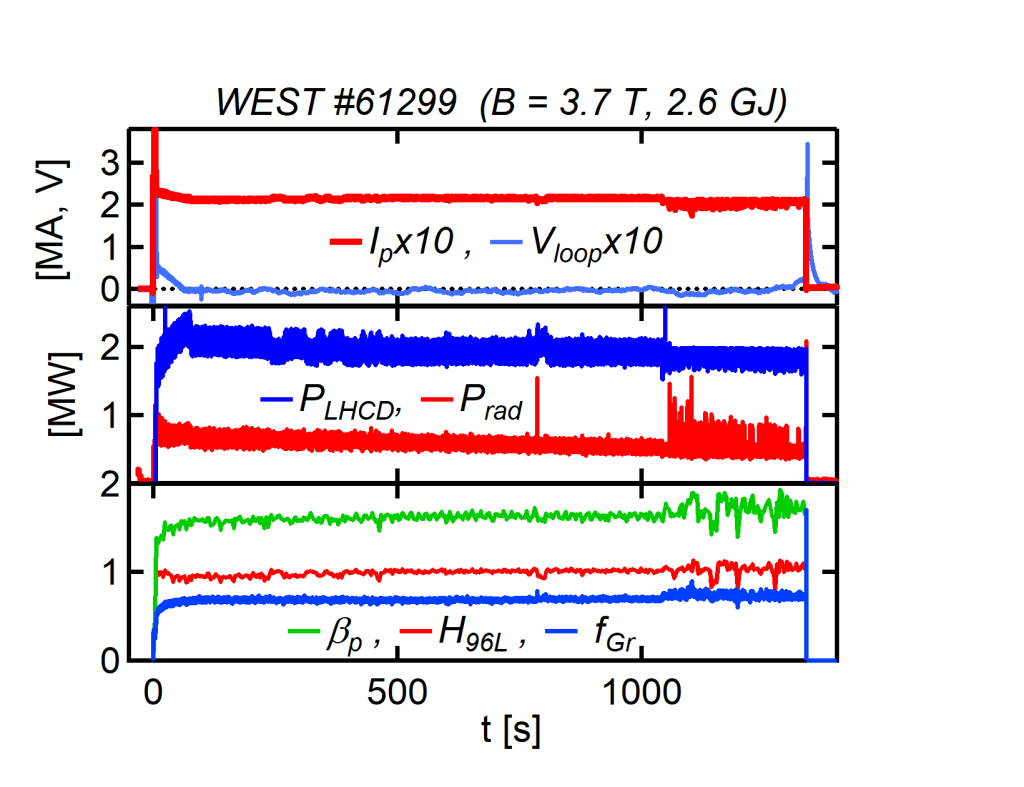
This is evidence of long-duration plasma operation with continued control and heating. It is not evidence that the plasma retained its heat for more than 1,000 seconds without replacement. Recall that energy confinement time, , measures stored thermal energy relative to its loss rate; it is not the length of the discharge. The plotted heating power is a reminder that energy continues to be supplied.
Nor should the graph’s “2.6 GJ” annotation be read as fusion output: the graphic does not identify it as such or give the inputs needed for a fusion-gain calculation. It does not establish a D–T fusion yield or net electricity. A long pulse matters because future plants must operate reliably for far longer than a striking short experiment—but duration alone is not an energy-balance result.
| Result | What the headline number establishes | What it does not establish |
|---|---|---|
| NIF: target gain about 1.5 | Fusion yield exceeded laser energy delivered to the target | Facility-level gain or net electricity |
| JET: 69 MJ in 5.2 s | Substantial D–T fusion energy over a magnetic-plasma discharge | Plasma breakeven or net electricity |
| WEST: over 1,000 s | Extended, heated magnetic-plasma operation | A comparable D–T yield, ignition, or net electricity |
Takeaway
The three results are significant because they answer different questions, not because one can stand in for the others. NIF demonstrated target gain; JET demonstrated a record D–T energy yield over several seconds; WEST’s traces demonstrate extended plasma operation. None, by itself, measures electricity delivered after running a complete generating plant.
When you encounter a fusion claim, identify the output, the input, the measurement boundary, and the duration before comparing it with another result. Next, you will use that discipline to compare the main approaches being developed toward fusion power and the bottleneck each must overcome.