Hello. In the previous lesson, you saw why NIF’s target gain, JET’s fusion yield, and a long-running magnetic plasma measure different achievements. Now the question is architectural: how might a device create fusion conditions repeatedly or continuously, and what is the hardest part of turning that approach into a power plant?
This lesson compares four leading families of approaches. The point is not to pick a winner from a headline, but to understand what each design is betting will work. Allow about 30 minutes.
Two ways to buy time for fusion
Recall that fusion requires sufficiently hot, dense fuel to remain together long enough for reactions to occur. The approaches here make different choices about density and confinement time.
A magnetic-confinement device holds a relatively diffuse plasma with magnetic fields and aims to maintain fusion conditions for long periods. A laser-driven inertial device compresses a tiny fuel capsule to enormous density; the fuel burns briefly before it flies apart. Magneto-inertial fusion lies between these strategies: it first magnetizes fuel, then compresses it in a pulse. Magnetization helps retain heat during the compression and burn.
These are ways of achieving fusion conditions, not complete power-plant designs. Each must eventually handle the energy released, its own operating demands, and repeated operation. Keep that distinction in view as we look at the machines.
Tokamaks: strong confinement in a comparatively simple torus
A tokamak confines plasma in a ring. External coils produce a field around the ring, while a substantial electrical current through the plasma helps produce the twisting magnetic field needed for confinement. This is a well-developed experimental route: JET, from the previous lesson, was a tokamak.
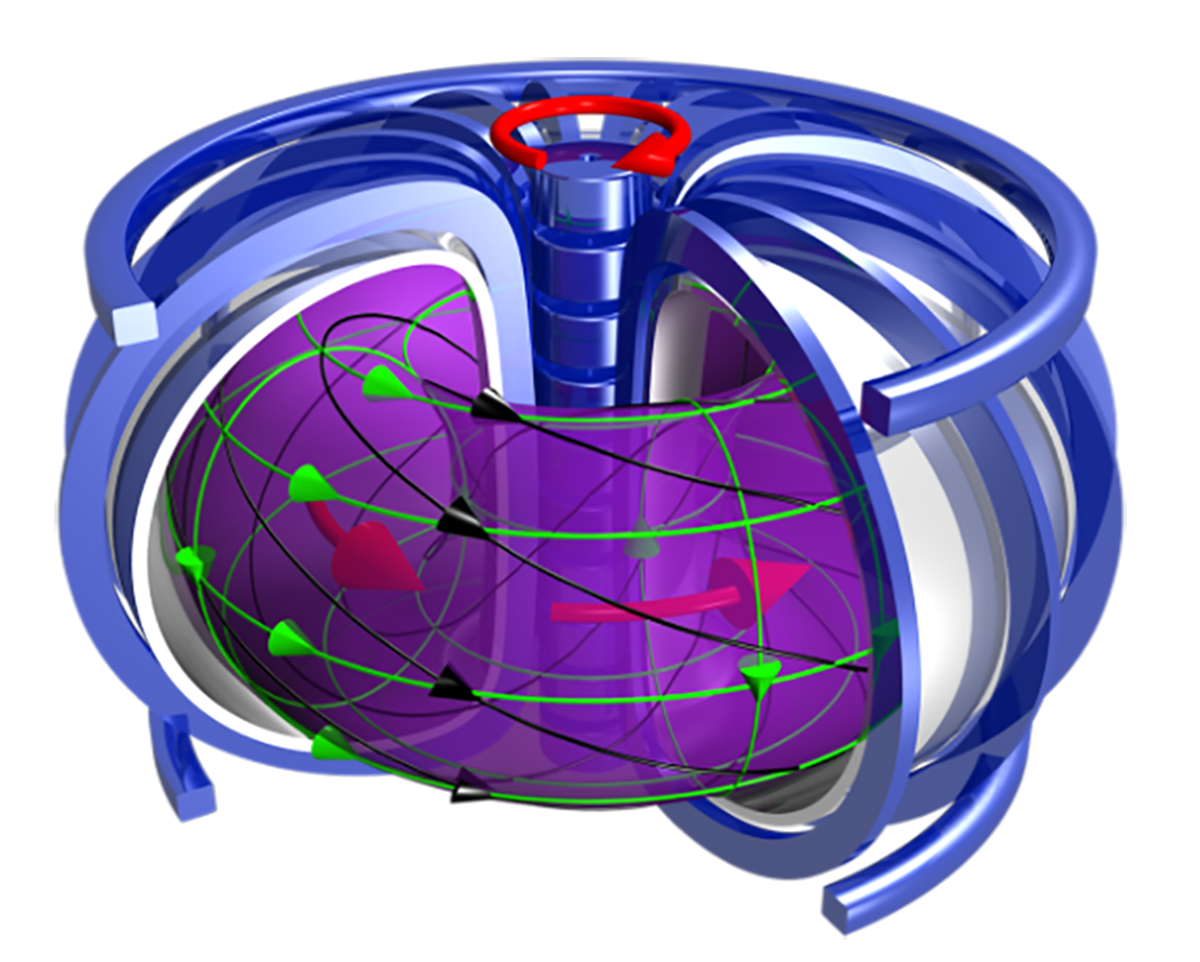
The tokamak’s central bet is that this comparatively regular magnetic geometry can deliver a high-performance plasma and be engineered into a useful power source. Its plasma current is also a complication. In the conventional transformer-driven arrangement, current cannot be maintained indefinitely; longer operation needs other current-drive methods or an operating cycle with interruptions. A rapid loss of plasma current—a disruption—can impose damaging heat and mechanical loads. Meanwhile, the heat that normally escapes the plasma must be directed to exhaust components without destroying them.
A high-field tokamak does not abandon that bet. It uses stronger magnets, potentially made with high-temperature superconductors, to seek comparable plasma performance in a smaller device. Watch the field-and-size comparison in this research talk; treat the proposed compact designs as design projections, not achieved fusion gains.
High-field Tokamaks: the fastest & surest path to a fusion energy power plant
Watch “High-field Tokamaks: the fastest & surest path to a fusion energy power plant” from Princeton Plasma Physics Laboratory for the case behind compact, high-field tokamaks.
Watch field and size, beginning with why both matter to tokamak performance and ending with the discussion of high-temperature superconductors. Focus on what a stronger field is meant to improve—and what the speaker has not claimed it eliminates.
Smaller is not automatically easier. Concentrating fusion power in a compact machine can make heat exhaust particularly demanding, while a high-current disruption remains a concern. The following paper’s discussion makes those trade-offs more explicit.
Overview of the SPARC tokamak - OSTI
Read the discussion of exhaust and disruptions in “Overview of the SPARC tokamak.” It identifies difficulties that remain even if the proposed high-field plasma performs as predicted.
In Section 5, “Investigation of SPARC physics,” on printed pp. 18–19, find the paragraph beginning “The high power density in SPARC V2.” Read exhaust and disruptions, stopping in the following paragraph after the discussion of disruption loads. Focus on the divertor—the component intended to receive escaping heat—and on why higher field does not remove the risk from high plasma current.
Tokamak bottleneck: it must combine good plasma confinement with controlled exhaust, survivable disruptions, and a practical operating cycle. The high-field variant adds the opportunity for compactness, but must demonstrate those functions under especially demanding power loads.
Stellarators: move the magnetic complexity outside the plasma
A stellarator also holds plasma in a torus, but its specially shaped external coils provide the necessary field twist. It does not require the large, transformer-driven plasma current on which a conventional tokamak relies. That makes steady operation more natural and removes the tokamak’s characteristic large-current disruption mechanism. It does not mean that every stellarator plasma is perfectly current-free or that continuous power generation has been demonstrated.
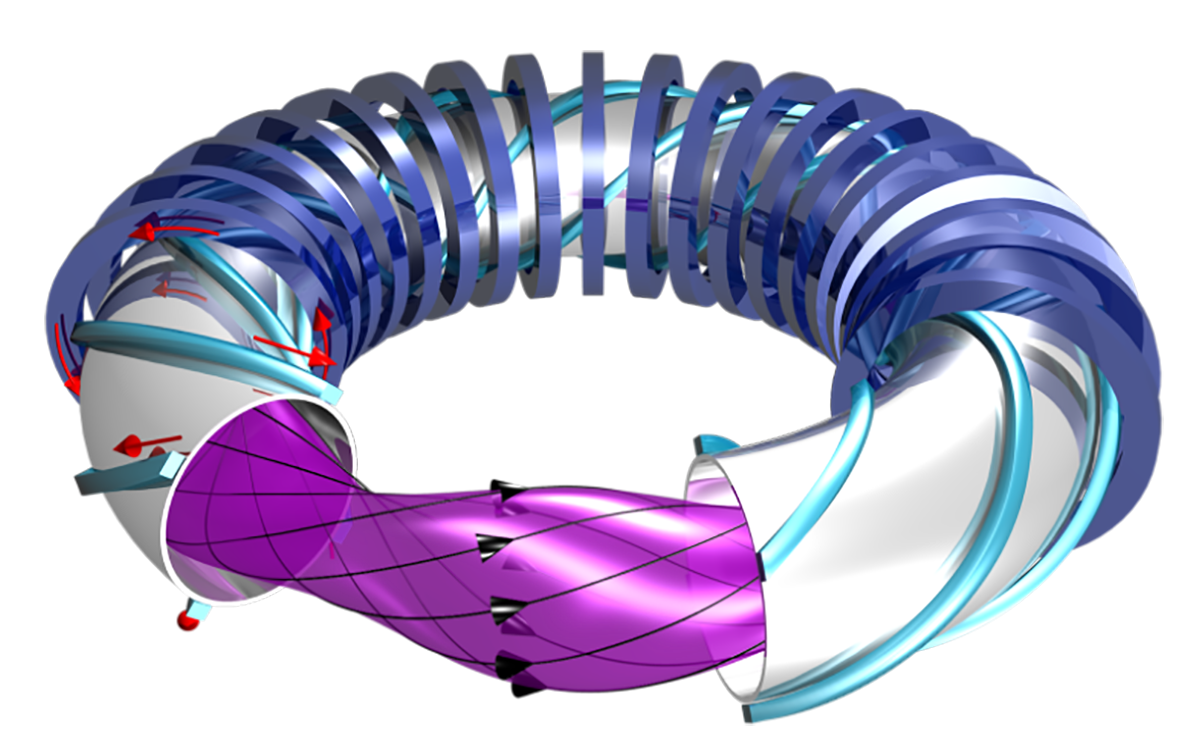
Watch how the change in field-making method changes the engineering problem.
Construction and Working Principles of a Stellarator
“Construction and Working Principles of a Stellarator,” from Energy Encyclopedia, gives a short visual introduction to the external-coil idea and its construction demands.
Watch external fields for the core operating concept. Then watch coil construction for the precision, vessel shape, and access constraints. Focus on what has been shifted from plasma control into device design; interpret the video’s description of having no internal current as not needing a large driven plasma current.
This is the stellarator’s bet: accept a difficult, three-dimensional machine in exchange for plasma operation that is easier to sustain without tokamak-style current disruptions. The principal unresolved issue is proving that an optimized, precisely manufactured configuration can confine a fusion-relevant plasma and remain practical to build, exhaust heat from, and maintain. Avoiding one kind of disruption does not dispose of those other requirements.
Two pulsed bets: laser-driven and magneto-inertial fusion
In laser-driven inertial fusion, powerful laser pulses compress a small capsule of fuel. Inertia keeps the compressed fuel together for the extremely short burn. You have already seen the decisive experimental result: NIF produced more fusion energy than the laser energy delivered to its target. Its power-plant bet is that capsules could be ignited reliably, economically, and many times in succession, using a sufficiently efficient driver while capturing the resulting energy.
The bottleneck is therefore broader than producing one successful shot. A generating system needs accurate, inexpensive targets; efficient delivery of energy to each target; a chamber that survives repeated shots; and a useful repetition rate. NIF’s target gain does not measure those capabilities. In a deliberately simplified example, if a driver delivered 10% of its electrical input to targets and heat conversion returned 40% of fusion energy as electricity, a target gain above would be needed merely to repay the driver’s electricity:
That calculation excludes every other plant load. It is not a required gain for all laser designs; it shows why the boundary around a gain figure matters.
Magneto-inertial fusion (MIF) is also pulsed, but aims to use magnetization to reduce heat loss while a driver compresses the fuel. Proposed drivers and targets vary, so MIF is a family, not one standard machine. Its central bet is that this combination can reach useful fusion conditions without needing either a long-lived tokamak plasma or the extreme compression strategy of laser-driven fusion.
Read the comparison below with that distinction in mind. In particular, note the authors’ caution about the maturity of compact and hybrid approaches.
Innovative approaches towards an economic fusion reactor
Read the discussion following Figure 1 in “Innovative approaches towards an economic fusion reactor” for a research-level comparison of established toroidal devices and less mature compact or hybrid concepts.
Immediately after Figure 1, start at the paragraph beginning “Anticipating the scientific and technological success of ITER.” Read the two routes, ending where the authors contrast engineering challenges with the confinement-physics challenge. Later, in the paragraph beginning “On the physics front,” find the sentence starting “The MIF in a pulsed mode.” Read the MIF assessment through the paragraph’s end. Treat suggested engineering advantages as possibilities, not demonstrated solutions.
For MIF, the foremost missing proof is repeatable, sufficiently strong fusion performance from the compressed, magnetized fuel. A driver that looks simpler on paper is valuable only if it produces the necessary conditions consistently. Repetitive operation and durable hardware would then have to follow. Proposed protective liquid walls might ease some component problems, but do not themselves establish a working fuel-and-energy system.
What is each approach asking us to believe?
| Approach | Central technical bet | Principal unresolved bottleneck |
|---|---|---|
| Tokamak | A well-developed, current-carrying magnetic plasma can reach useful performance. | Control exhaust and disruptions while sustaining a practical operating cycle. |
| High-field tokamak | Stronger superconducting magnets can deliver that performance in a smaller device. | Handle concentrated exhaust and disruption loads; verify projected compact-device performance. |
| Stellarator | Complex external coils can support well-confined, naturally steady operation without large driven plasma current. | Prove fusion-relevant performance in a buildable, maintainable three-dimensional machine. |
| Laser-driven inertial fusion | Repeated capsule implosions can turn demonstrated target physics into useful energy production. | Efficient, reliable, high-rate shots and a chamber that survives them. |
| Magneto-inertial fusion | Magnetized fuel plus pulsed compression can achieve fusion conditions with an attractive driver and device. | Demonstrate adequate, repeatable fusion performance before the plant advantages can be relied on. |
This comparison separates a physics demonstration from an engineering proposition. Tokamaks have extensive plasma-operating experience but difficult current and exhaust problems. Stellarators trade plasma-current dependence for intricate hardware. Laser-driven fusion has demonstrated target gain but not the repeated, efficient shots a plant needs. MIF offers several potentially appealing designs, but its central fusion-performance claim remains less established.
Takeaway
No approach wins merely by attaining a high temperature, a long pulse, or a gain measured at one boundary. Each makes a different trade between confinement physics, device complexity, and operation. When you hear that a design is “smaller,” “steady,” or “already at breakeven,” ask which bottleneck that fact actually resolves—and which it leaves untouched.
In the final lesson, you will widen the boundary again: from the fusion device to a proposed power plant and its possible contribution to low-carbon electricity.