Hello. Last time, you compared the technical bets behind tokamaks, stellarators, laser-driven fusion, and magneto-inertial fusion. You also saw why a successful plasma experiment is not yet a power station. This final lesson widens the boundary once more: what would a proposed fusion plant have to demonstrate before its output and deployment date become credible?
You will use a practical checklist, then apply it to a published high-field tokamak proposal. Allow about 30 minutes.
Judge the whole plant, not just its core
A useful assessment begins with two separate questions: Can this machine produce fusion power? and Can the entire facility deliver useful electricity reliably and affordably? The second requires fuel supply, components that survive operation, energy conversion, maintenance, and financing to work together.
The International Atomic Energy Agency (IAEA) offers indicative criteria for a successful plant. Read them as questions to investigate, not as a claim that today’s proposals have met them.
IAEA World Fusion Outlook 2025
Read the IAEA’s “Indicative criteria for a successful fusion plant” to see how much lies outside plasma performance.
On printed p. 17, read the table from its first operational-performance criterion through item 14, including the footnote defining an “environmental cycle.” In particular, follow the criteria from item 3 to the footnote. Notice the separate requirements for component replacement, fuel processing, remote maintenance, availability, and cost.
For a deuterium–tritium (D–T) proposal, use this six-part checklist:
| Question | Evidence to look for |
|---|---|
| Fuel: Can it breed and recover enough tritium? | A tested lithium blanket and an accounted-for fuel cycle, including losses and reserves. |
| Materials: What survives the neutron and heat exposure? | Irradiation results, component lifetimes, and a workable replacement plan. |
| Electricity: What reaches the grid? | Measured or credible estimates of captured heat, conversion efficiency, and all internal electrical loads. |
| Availability: How often does it deliver that output? | Sustained operation across maintenance cycles, including unplanned outages. |
| Economics: Could it be built and operated competitively? | Capital, financing, maintenance, replacement, and electricity-cost estimates with stated assumptions. |
| Climate contribution: How many plants, by when? | Evidence for manufacturing and deployment at scale, lifecycle emissions, and substantial delivered low-carbon energy. |
A proposal may have a strong answer to one row and an open question in another. “Not yet demonstrated” is more precise than either “impossible” or “solved.”
Fuel and hardware form one problem
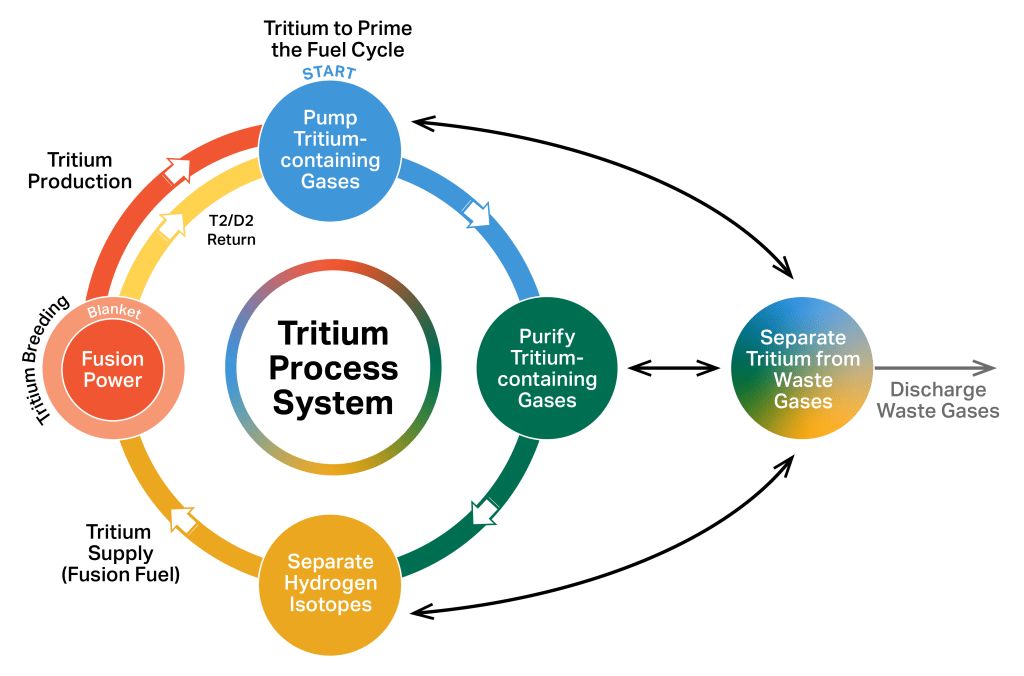
In D–T fusion, most of the reaction energy is carried by a fast neutron. A proposed plant surrounds the reaction region with a breeding blanket containing lithium. The blanket must absorb energy as heat and use neutrons to produce replacement tritium. Fuel-processing equipment must then recover that tritium and return it for use.

A central metric is the tritium breeding ratio:
A ratio above is necessary for a self-sufficient D–T plant, but a calculated ratio just above is not proof of self-sufficiency. Tritium can be lost, retained in equipment, or unavailable while being processed; some reserve may also be needed during shutdowns and to start other plants. Ask whether the integrated, recoverable supply covers those demands—not merely whether a blanket design breeds tritium in a simulation.
The same neutrons that enable breeding also damage nearby materials and can make components radioactive. Plasma-facing surfaces face intense heat as well. More protective material may help a wall survive, yet take up space or absorb neutrons needed for breeding. This is why a material choice, blanket design, and maintenance plan cannot be assessed independently.
An overview of shared technical challenges for magnetic and ...
Read this UKAEA paper for the common plant constraints that persist across different fusion approaches.
In “Drivers for plant design,” read “Cost of electricity (COE)” and “Availability” on printed pp. 4–5, from cost to reliability. In “Tritium self-sufficiency” on p. 6, read from breeding requirements. Then find “Tritium Cycle” on pp. 7–8 and read from the TBR explanation. Finally, under “Materials” on pp. 8–9, read from the irradiation discussion. Focus on how component life and replacement time affect the electricity a plant can sell.
Net electricity depends on uptime as well as gain
For most proposed D–T plants, captured fusion heat would drive a conventional heat engine and generator. That does not mean all fusion energy becomes electricity. The facility also consumes electricity for equipment such as cooling, pumping, heating, or drivers. A simplified accounting is:
Suppose, purely as an illustration, that a plant captures of thermal power, converts to electricity, and uses internally. It would deliver net while running. Neither fusion gain nor gross generator output alone tells you that figure.
The engineering challenges around heat capture and internal power use are described in this short segment:
The State of Fusion Energy w/ Gerrit Bruhaug
Watch “The State of Fusion Energy w/ Gerrit Bruhaug” from Decouple Media for a spoken overview of why producing fusion energy and delivering electricity are different engineering tasks.
Watch plant engineering. Attend to neutron and heat exposure, energy conversion, and parasitic loads; keep in mind that the particular solutions discussed are possibilities, not evidence that an integrated plant already works.
Output while running is still not annual output. If the illustrative plant delivered that power for of a year, it would supply about . Availability falls during planned component changes and unexpected failures. Remote replacement has to work in equipment exposed to radiation; the time taken matters economically. Thus “steady plasma” and “high plant availability” are different claims.
Put a published timeline under the checklist
Consider ARC, a proposed high-field tokamak power plant described in the IAEA outlook. The report presents an intended electrical plant in the early 2030s, preceded by a smaller tokamak, SPARC, intended to test the fusion-performance basis. Those are plans reported in the 2025 outlook, not demonstrated outputs or a verified completion date.
IAEA World Fusion Outlook 2025
Return to the IAEA outlook for a concrete proposal whose plasma milestone and plant milestone can be kept distinct.
In the plant-concepts section, find “United States of America” and “ARC (Commonwealth Fusion Systems)” near printed pp. 26–27. Read the ARC description. Identify what SPARC is expected to test and what ARC is expected to deliver; do not treat either expected result as an achieved one.
The claim has a coherent technical pathway: stronger magnets aim to make a tokamak smaller, and SPARC data are intended to inform ARC. But the outlook’s short description does not, by itself, establish tritium self-sufficiency, neutron-exposed component lifetimes, a measured net-electric balance, or reliable operation across replacement cycles. That is a limit on the evidence supplied here, not proof that no design work exists.
To assess the early-2030s date, look for milestones along the entire critical path:
- Core performance: independently interpretable D–T results, with the gain boundary stated.
- Integrated plant design: tested fuel recovery, blanket, heat-extraction, and component interfaces.
- Operation: net electricity demonstrated alongside maintenance and restart experience.
- Replication: a qualified supply chain, credible costs, and a schedule for building further plants.
A date for first operation, a date for first net electricity, and a date for dependable commercial output are three different dates. If an early milestone slips—or succeeds without testing the next system—the later date needs reassessment.
From one plant to a climate-relevant contribution
Fusion could be valuable as firm, low-carbon electricity alongside other low-carbon sources. But a single working plant would not by itself make a substantial difference to global emissions. The climate question concerns net electricity delivered over many years, how quickly plants can be reproduced, what their construction and fuel cycles emit, and what generation they actually displace.
The IAEA outlook includes a modelling study illustrating this distinction. Its numbers are conditional scenarios, not forecasts guaranteed by present experiments.
IAEA World Fusion Outlook 2025
Read the outlook’s adapted modelling discussion to see how assumed cost, availability, and deployment dates shape projected climate-scale output.
In “A global outlook for fusion energy deployment,” find “Key assumptions regarding fusion power generation” on printed pp. 65–66. Read the assumptions. Then, under “Results for global analysis” on pp. 67–69, read the base-case result and the cost comparison. Ask which assumed capabilities would first need to be demonstrated.
In that model, commercial availability in 2035, improving capacity factors, declining costs, and an absence of extra fusion-specific expansion constraints help produce substantial later-century generation. The sensitivity to cost is instructive: even after a plant works, expensive or unreliable output can limit deployment. Conversely, a successful prototype could be important without making fusion a major contributor to near-term emissions reductions.
Takeaway
When assessing a fusion announcement, state what has been measured, at what system boundary, then run the six-part checklist: tritium, materials, net electricity, availability, economics, and deployment at climate-relevant scale. Treat dates as conditional on evidence from the next required system, not as consequences of a single plasma milestone.
That completes this short course. The strongest position is neither to dismiss fusion’s potential nor to count proposed plants as delivered power: it is to update your assessment as integrated, independently interpretable plant evidence arrives.