Welcome back. In our last lesson, we mastered quantization, learning to use the sequencer's grid as a tool to control rhythmic feel, from robotic precision to humanized groove. We ended by foreshadowing the next step: moving beyond the simple, evenly divided grid to create more complex rhythmic textures.
This lesson marks the beginning of that journey as we delve into our "Advanced Rhythmic Structures" module. We will explore polyrhythms, which are a foundational element of rhythmic complexity in genres from jazz to breakbeat and West African drumming. Our goal is to not only understand what polyrhythms are but to be able to construct them from first principles, leveraging their inherent mathematical structure. By the end of this lesson, you will be able to construct patterns like "3 against 2" and explain the mathematical logic that governs them.
What is a Polyrhythm?
A polyrhythm is the simultaneous use of two or more rhythms whose subdivisions of the beat are in conflict. This conflict arises when the rhythms cannot be expressed as simple integer multiples of each other.
For instance, playing eighth notes (two notes per beat) against sixteenth notes (four notes per beat) is not a polyrhythm. The sixteenth note is simply a subdivision of the eighth note (4/2 = 2); they belong to the same rhythmic family and align neatly.
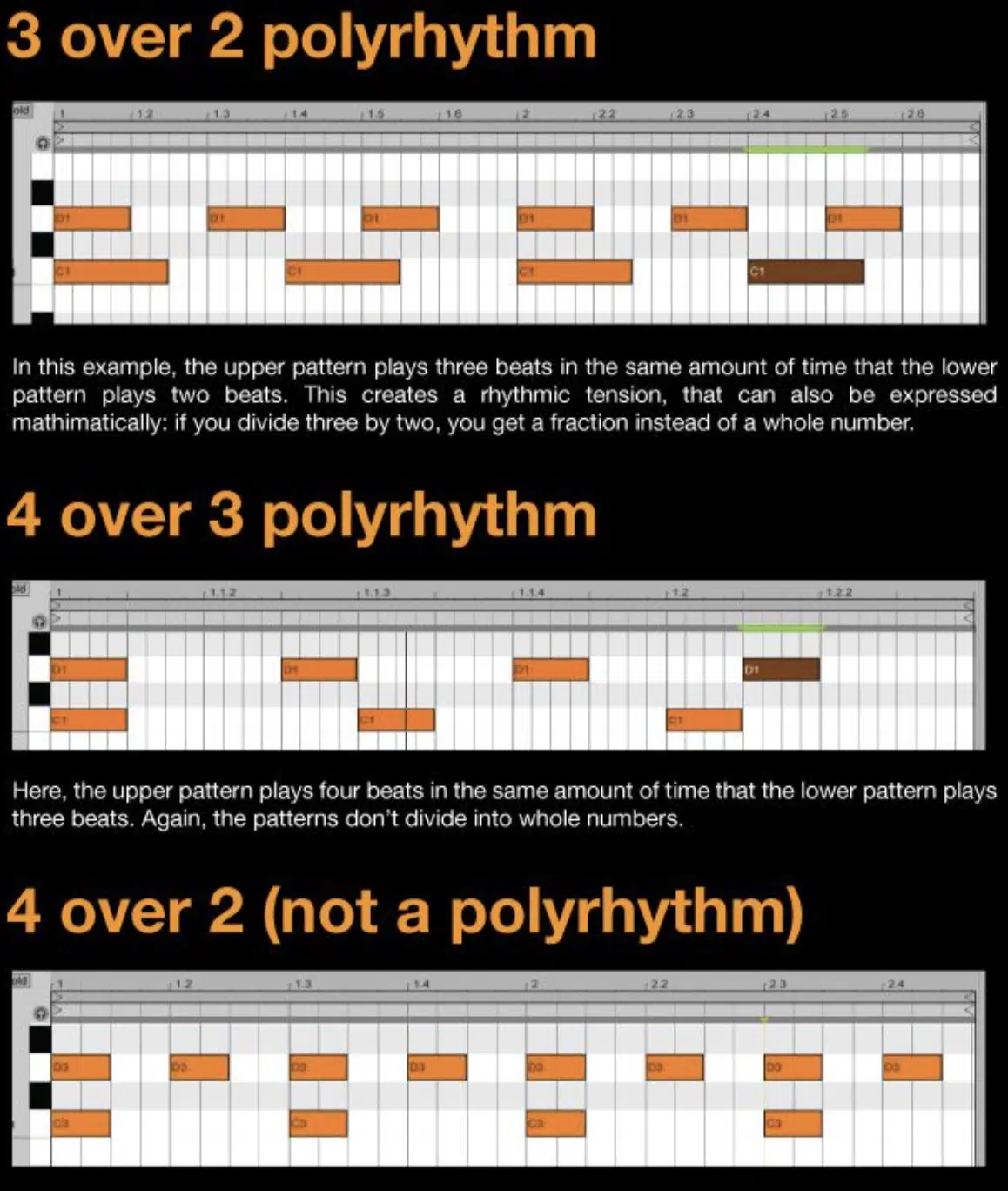
A true polyrhythm occurs when you play, for example, three notes in the same time span as two notes. This is commonly called a "3 against 2" or "3 over 2" polyrhythm. Here, the ratio 3:2 is irreducible. The two rhythmic layers do not share a simple underlying pulse and will only align at the beginning of each cycle. This creates a characteristic rhythmic tension and complexity.
This relationship can be framed in terms of relative tempo, a concept that should be familiar from your work in physics. If we define the "2" side of a 3:2 polyrhythm as our base tempo (the pulse), the "3" side can be thought of as playing at a tempo that is precisely 3/2 or 1.5 times faster.
The following video provides an excellent introduction to this concept, contrasting polyrhythms with standard rhythms before introducing the core method for their construction.
Play any POLYRHYTHM easily with this trick! (Interactive rhythm video)
The video "Play any POLYRHYTHM easily with this trick!" by Saher Galt clearly defines what makes a rhythm "polyrhythmic."
Watch the introductory section from the definition. The key insight here is that polyrhythms involve "fundamentally different subdivisions of the beat," where one cannot be derived from the other by simple multiplication.
The Constructive Method: Least Common Multiple (LCM)
Since the two parts of a polyrhythm don't naturally align, how can we construct them with precision? The solution lies in finding a finer-resolution grid that can accommodate both rhythms. The mathematical tool for this is the Least Common Multiple (LCM).
For a polyrhythm of against , the LCM of and gives the total number of subdivisions in the smallest possible repeating cycle. This number defines our construction grid.
Let's use the quintessential 3 against 2 polyrhythm as our case study.
-
Find the LCM: The least common multiple of 3 and 2 is . This tells us our rhythmic cycle can be represented by a grid of 6 equal parts (i.e., sextuplets).
-
Calculate Spacing: We determine where each rhythm's notes fall on this new grid.
- For the '2' side: . This rhythm will sound on every 3rd subdivision of our 6-part grid.
- For the '3' side: . This rhythm will sound on every 2nd subdivision.
-
Map to the Grid: We now place the notes on a number line from 1 to 6.
- '2' Rhythm Hits: 1, 2, 3, 4, 5, 6
- '3' Rhythm Hits: 1, 2, 3, 4, 5, 6
-
Combine for the Composite Rhythm: The full polyrhythmic pattern is the union of these two sets of hits.
- Composite: 1 (Both), 2, 3 ('3' side), 4 ('2' side), 5 ('3' side), 6 (rest)
The resulting pattern can be spoken as "ONE, three, FOUR, five." To internalize this, try tapping the '2' rhythm with one hand and the '3' rhythm with the other while counting to 6.
The video below walks through this exact process and includes an interactive exercise to help you master the 3 against 2 feel.
Play any POLYRHYTHM easily with this trick! (Interactive rhythm video)
This next segment from Saher Galt's video demonstrates the LCM method and guides you through performing it.
First, watch the explanation of the LCM trick, which visualizes the 6-part grid for our 3:2 example. Then, actively participate in the interactive exercise. Tapping along is a highly effective way to move this concept from an abstract idea to an embodied feeling.
This LCM method is universal. For a 4 against 3 polyrhythm, . The '4' side hits every 3rd subdivision of the 12-part grid (1, 4, 7, 10), and the '3' side hits every 4th subdivision (1, 5, 9).
A Formal Approach: Algorithmic Generation
Given your mathematical background, you might appreciate a more formal, algorithmic way to generate these patterns without drawing grids. We can use modular arithmetic to generate the sequence of hits for an against polyrhythm, where we track the pulses against a background of subdivisions.
The algorithm is as follows: to generate the sequence for Y against X, start with the number 1, and successively add (modulo ). Stop when you return to 1.
Let's generate the sequence for 5 against 7. Here, we are finding the placement of 5 evenly spaced notes within a grid of 7. Our generator is and our modulus is . This is unconventional notation, the resource uses X against Y, where Y is the upper faster rhythm. Let's use the resource's language to be consistent. For "x against y", the algorithm is to "start with 1, and successively add y (mod x)".
Let's try 7 against 5. Here, x=7, y=5. We add 5 (mod 7).
- Start: 1
- (1 + 5) mod 7 = 6
- (6 + 5) mod 7 = 11 mod 7 = 4
- (4 + 5) mod 7 = 9 mod 7 = 2
- (2 + 5) mod 7 = 7 mod 7 = 0. In a 1-indexed system, this is 7.
- (7 + 5) mod 7 = 12 mod 7 = 5
- (5 + 5) mod 7 = 10 mod 7 = 3
- (3 + 5) mod 7 = 8 mod 7 = 1. We are back at the beginning.
The resulting sequence is 1, 6, 4, 2, 7, 5, 3. This tells you the exact subdivisions within the '7' grid where the '5' notes should land. The following article details this method and provides a helpful reference table.
A Somewhat Extensive Guide to Polyrhythms - Cadence Corner
This article from Cadence Corner provides a more formal, mathematical approach to generating polyrhythmic patterns.
Focus on the section titled "1. As mathematically precise as possible." Read the description of the modular arithmetic algorithm. Then, study the worked example for the 7 against 5 polyrhythm. Finally, examine the table of sequences, as it's a useful reference for quickly programming these rhythms in your DAW.
Advanced Application: Approximating Complex Polyrhythms
What about a seemingly intractable polyrhythm like 21 against 37? Using the LCM method would require a grid of subdivisions, which is impractical.
Here, we can use approximation. The ratio 37/21 is approximately 1.762. Can we find a simpler fraction that is close to this value?
This is very close. This tells us that a 37 against 21 polyrhythm will sound and feel very similar to a 7 against 4 polyrhythm, but with the faster '37' side being slightly sped up relative to the 7:4 feel. This insight allows you to internalize the feel of a complex rhythm by anchoring it to a simpler, more manageable one.
This clever technique is explained in the video below.
Polyrhythm Tutorial using Math
The video "Polyrhythm Tutorial using Math" by Project JDM explores the concept of polyrhythms as tempo ratios and introduces this powerful approximation method.
Please watch two key segments: Polyrhythms as Ratios: Ratios and BPM. This section frames polyrhythms as a ratio of speeds, which should be highly intuitive from your physics background. Approximation Method: Approximating Complex Rhythms. Pay close attention to how the complex 37:21 polyrhythm is approximated by the much simpler 7:4, providing a practical way to internalize its feel.
Conclusion
In this lesson, we have moved beyond the simple grid and into the world of conflicting rhythmic layers. You now possess a robust framework for understanding and constructing these complex patterns, grounded in clear mathematical principles.
Key Takeaways:
- A polyrhythm is the simultaneous layering of two rhythms with irreducible subdivisions of the beat (e.g., 3:2, 4:3, 5:4).
- The Least Common Multiple (LCM) of the two numbers in a polyrhythm gives the necessary grid resolution to construct the pattern precisely.
- The LCM method involves finding the LCM, calculating the spacing for each rhythm within that grid, and mapping the notes accordingly.
- Complex polyrhythms can be understood by approximating their ratio with a simpler fraction, allowing you to grasp their feel by relating them to more common patterns.
- A formal modular arithmetic algorithm can be used to generate the exact sequence of hits for any polyrhythm.
For your practical work, you can now go into your DAW, set the piano roll grid to the LCM of your desired polyrhythm (e.g., set a 1/12 grid for 4:3), and program the patterns you've derived.
In our next lesson, we will clarify a common point of confusion by distinguishing polyrhythms from their close cousin, polymeters. While polyrhythm deals with conflicting subdivisions within a bar, polymeter deals with conflicting bar lengths or meters themselves.
