Welcome back. In our previous lesson, we established a rigorous mathematical framework for constructing polyrhythms using the least common multiple (LCM) and modular arithmetic. We defined a polyrhythm as the superposition of two rhythms with conflicting subdivisions over a shared time span.
Today, we will address a common and important point of confusion in rhythm theory. The goal of this lesson is to clearly distinguish between polyrhythm, which you now understand, and its close relative, polymeter. While the terms are often used interchangeably in casual discussion, they describe two distinct techniques for creating rhythmic complexity. Mastering this distinction is essential for precise control and communication, especially when programming the experimental structures you're interested in.
The Fundamental Distinction: Beat vs. Bar
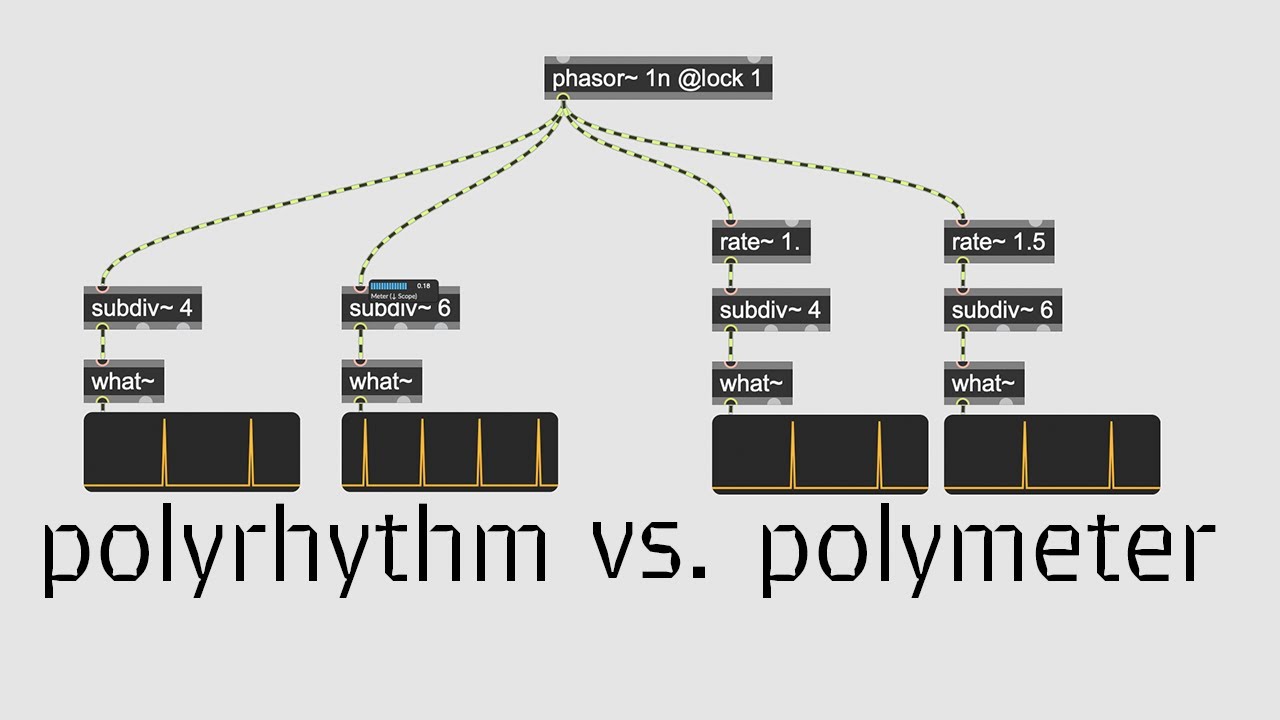
In the last lesson, we saw that in a polyrhythm (like 3 against 2), the two rhythmic layers share the same overall duration—typically one bar—but the individual notes within them have different lengths.
Polymeter inverts this relationship. In a polymeter, the individual notes (the underlying pulse or tempo) have the same length, but the bars or rhythmic cycles themselves have different lengths.
Let's establish a visual and conceptual anchor for this idea.

Think of it in terms of two simultaneous physical processes:
- Polyrhythm: Two waves are confined to the same length of string, but one has 3 nodes and the other has 4. To fit within the same boundary conditions, their wavelengths must be different. Their starting points always align.
- Polymeter: Two processes are occurring at the same rate (e.g., ticking every second), but one is programmed to repeat a cycle every 3 seconds, and the other every 4 seconds. They start together, but their cycle-repeat signals will diverge and only realign after seconds.
To see and hear this in action, the following video provides clear, concise definitions and audio examples.
[Music Theory in 5m #18] Polyrhythm vs polymeter, layering several rhythms
The video "Polyrhythm vs polymeter" from Woochia offers straightforward explanations of both concepts.
First, watch the definition of polyrhythm from the beginning. This will serve as a quick review of what we covered last lesson. Notice the emphasis on "same duration." Next, watch the definition of polymeter from the next section. Here, the key phrases are "different bar lengths" and "subdivisions can be of the same duration." Finally, the short summary neatly encapsulates the difference.
For another perspective, Andrew Huang provides an exceptionally clear and direct summary.
Andrew Huang's video "POLYRHYTHMS vs POLYMETERS" gets straight to the point with DAW-based examples.
Watch these three short clips to solidify the core definitions: Definition of polymeter: same pulse, different phrase lengths. Definition of polyrhythm: different beat groups, same time to play. The final summary: a concise recap of the distinction.
A More Formal Perspective
Now that we have the core intuition, we can refine our definitions. A polyrhythm involves different beat schemes interacting within a single metric hierarchy. For example, in a 3:2 polyrhythm within a 4/4 bar, the 4/4 meter remains the absolute frame of reference. The '2' might be quarter notes, while the '3' are quarter-note triplets, but both are fundamentally subdivisions of the overarching 4/4 measure.
A polymeter, by contrast, implies the true superposition of two or more independent meters. There isn't one single governing time signature.
The following thesis excerpt introduces some useful terminology for this distinction.
[PDF] A Case Study In Polymeter, Polyrhythm, And Polytempo THESIS ...
This paper by Martim Schneider Galvão provides a more academic distinction between these rhythmic concepts.
Read the paragraph that begins with the definitions. The author distinguishes between rhythms that are "measure-preserving" (polyrhythms, which sync up every measure) and those that are "beat-preserving" (polymeters, where the underlying beat/pulse is constant but the measure lengths differ). This formal language can be a helpful way to categorize the phenomena.
Polymeter in Experimental Music
Your interest in composers who push boundaries makes polymeter a particularly relevant topic. It has been a key device for creating large-scale, evolving rhythmic structures.
Frank Zappa's Explicit Polymeter
Frank Zappa, a self-taught composer with a deep appreciation for rhythmic complexity, used polymeter extensively. In his piece "Toads of the Short Forest," he even narrates the metric arrangement for the audience.
[PDF] A Case Study In Polymeter, Polyrhythm, And Polytempo THESIS ...
Let's return to the thesis to look at a concrete example of polymeter from the work of Frank Zappa.
Read the section discussing Zappa's music, specifically the analysis of this piece. The description of different band members playing in 7/8, 3/4, and 5/8 simultaneously, all while maintaining a common tempo (a "beat-preserving" structure), is a perfect example of true polymeter.
Steve Reich's Simulated Polymeter
Minimalist composer Steve Reich achieved a similar perceptual effect through a different mechanism: phasing. In works like Drumming, one musician maintains a steady pattern while another very gradually increases their tempo, causing their pattern to slowly drift out of phase with the first. After a certain duration, they lock into a new, stable phase relationship (e.g., shifted by one eighth note).
This process can be seen as a temporary, localized use of polytempo (different simultaneous tempos) to achieve an effect that simulates polymeter. The gradual rhythmic displacement creates the same sense of two independent timelines that you get with polymeter. Given your background in physics, you can think of this as a musical analogue to phase drift or beat frequency generation from two slightly detuned oscillators.
Combining Polyrhythm and Polymeter
In electronic music production, these are not mutually exclusive concepts. You can, and often will, use them simultaneously to create deeply layered rhythmic beds. A track might have a foundational 4/4 groove, with a synth line in a 3/4 polymeter creating a repeating, evolving tension, while a percussion layer uses 3:2 polyrhythmic triplets to add internal complexity.
Andrew Huang demonstrates this exact scenario in a song from his own catalog.
Returning to Andrew Huang's video, let's see how these concepts are combined in a real-world production.
First, watch the section on compositional use, where he layers a polymetric element (a bell in 3/4) and a polyrhythmic element (triplet tambourine) over a standard 4/4 beat. Then, for a more complex example relevant to your experimental interests, watch the breakdown of the song's bridge, which uses 5/8, 11/8, and 7/8 polymeters concurrently.
Conclusion
Today we've drawn a clear line between two powerful rhythmic tools. While they both create fascinating rhythmic tension, their underlying mechanics are distinct.
Key Takeaways:
- Polyrhythm: Different subdivisions, same cycle length. Two or more rhythms with notes of different durations are fit into the same time span. They resolve at the end of every bar. (e.g., 3 against 2).
- Polymeter: Same subdivision, different cycle lengths. Two or more meters with notes of the same duration (same tempo) are played simultaneously. Their downbeats drift apart and only realign after the LCM of their lengths. (e.g., 3/4 against 4/4).
- The distinction can be framed as measure-preserving (polyrhythm) versus beat-preserving (polymeter).
- These techniques can be simulated (Reich's phasing) or used explicitly and simultaneously (Zappa, Huang) to build intricate rhythmic architectures.
In our next lesson, we will get practical and focus on the primary tool for programming these complex subdivisions in a DAW: tuplets. We will explore how to use triplets, quintuplets, and other groupings to break free from the standard binary grid and implement the polyrhythmic ideas we've been discussing.