Introduction
In our last lesson, we established a clear distinction between polyrhythm and polymeter, focusing on how they create rhythmic tension through different mechanisms. We saw that polyrhythms, our main focus today, involve fitting different numbers of subdivisions into the same span of time. This naturally raises a practical question: how do we actually create these rhythms in a musical context?
This lesson provides the answer by introducing tuplets. You will learn to program rhythmic patterns using triplets, quintuplets, and other non-binary groupings, which are the fundamental building blocks for realizing the complex polyrhythmic structures that interest you. We will start with the basic definition and implementation of tuplets in a DAW, and then explore how they can be used for more experimental applications—from creating sophisticated "swing" feels to systematically approximating irrational tempo ratios, a concept that will connect directly with your mathematical background.
What Are Tuplets?
At its core, Western musical notation is built on a binary system of division: a whole note divides into two half notes, a half note into two quarter notes, and so on. Tuplets are the primary mechanism for breaking this binary constraint. They allow us to divide a rhythmic duration into a different number of equal parts.
The most common example is the triplet, where a duration normally occupied by two notes is instead divided into three. To get a foundational understanding of this concept and its generalizations, the following video provides an excellent overview.
The video "Tuplets: It's Complicated" from the 12tone channel offers a clear and concise introduction to the world of tuplets.
First, watch the section that introduces triplets from the beginning. It explains how triplets divide a quarter note into three even parts instead of the usual two eighth notes. Next, watch the section that generalizes the concept from the following segment. This part introduces quintuplets (5 notes) and septuplets (7 notes), establishing that you can theoretically divide a rhythmic space into any number of equal parts.
As the video explains, a tuplet involves playing n notes in the time normally allocated to m notes of the same type. The notation often includes a number (n) written above the notes.
- Triplets (3:2): Three notes in the time of two. An eighth-note triplet has a duration of of a standard eighth note.
- Quintuplets (5:4): Five notes in the time of four. A sixteenth-note quintuplet has a duration of of a standard sixteenth note.
- Septuplets (7:4 or 7:8): Seven notes in the time of four or eight, depending on context.
Understanding these ratios is key. A tuplet creates a polyrhythm by superimposing a rhythm with a subdivision of n over a context that implies a subdivision of m.
Programming Tuplets in a DAW
In a Digital Audio Workstation (DAW), you don't typically draw tuplets using traditional notation. Instead, you change the sequencer's grid to a tuplet-based division. Most DAWs have a "triplet grid" option (often labeled with a "T", e.g., 1/8T or 1/16T) which re-divides each beat into three, six, or twelve parts instead of the usual two, four, or eight.
The next video demonstrates this process and shows how to apply tuplets in a practical production context.
How to use triplets and other tuplets
This video from Splice, "How to use triplets and other tuplets," provides a hands-on look at programming these rhythms in a DAW.
Watch from the beginning to see how to access and use a triplet grid. Notice how a simple triplet added to a hi-hat pattern can add syncopation and forward momentum. Then, skip to the section on other tuplets, from quintuplets and septuplets. This part is particularly relevant to your experimental interests, as it shows how to set up grids for 5 and 7 notes per beat and suggests a powerful creative strategy: breaking these odd groupings into smaller cells of twos and threes.
Advanced Rhythmic Applications of Tuplets
While tuplets are essential for creating simple polyrhythms, their application extends into far more nuanced and complex territory.
Asymmetric Tuplet Feels
As mentioned in the Splice video, odd-numbered tuplets like quintuplets are rarely used as just a stream of five evenly spaced notes. They gain their characteristic feel from being internally grouped into asymmetric patterns, most commonly combinations of 2 and 3.
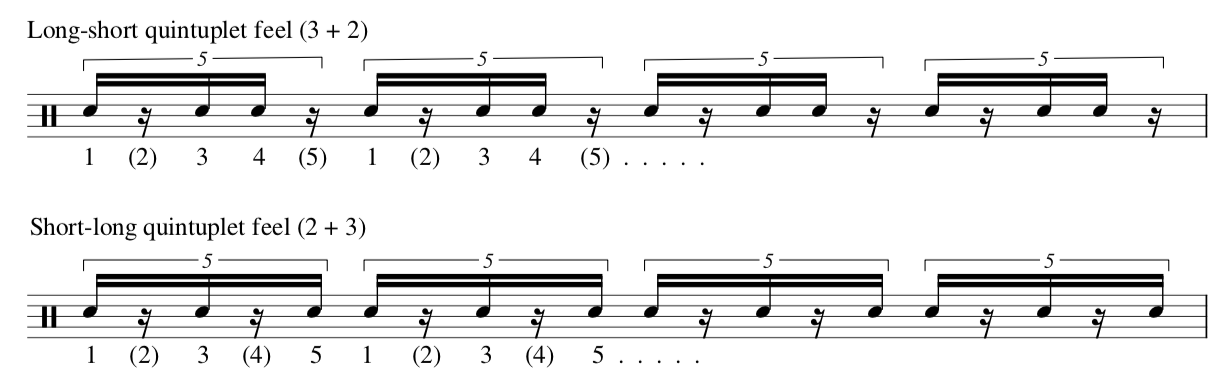
When programming a quintuplet hi-hat or percussion line, try accenting the notes according to these 3+2 or 2+3 patterns. This breaks the monotony of the grid and creates a much more dynamic and compelling groove, a technique common in breakbeat and experimental electronic music.
Sophisticated Swing and "Drunken" Rhythms
Tuplets can also be used to create very specific "swing" ratios beyond the standard triplet-based shuffle. Swing works by delaying the off-beats, creating a ratio between the duration of the on-beat and the off-beat note. While 1:1 is straight time and 2:1 is standard triplet swing, we can use other tuplets to achieve feelings in between.
The following resource explains how producers, particularly in hip-hop and neo-soul, use quintuplet and septuplet grids to achieve this.
NYU Music Experience Design Lab
This article from the NYU Music Experience Design Lab discusses polyrhythms and provides some fascinating real-world examples of tuplet-based swing.
Read the section under the heading "How about some real-world examples?". Focus on the descriptions of: 5:3 Swing: Using a quintuplet grid, the beat is divided into five parts. The first note of a pair lasts for three of these parts, and the second note lasts for two. This creates a unique swing ratio that is less pronounced than triplet swing. 4:3 Swing: Using a septuplet grid, the beat is divided into seven parts. The first note lasts for four parts and the second for three. This creates a very subtle, "drunken" feel, famously associated with producer J Dilla.
This technique is a perfect example of how a deep, almost microscopic control of rhythmic placement can have a dramatic impact on the overall feel of a track.
Approximating Irrationality
Here we venture into territory that connects directly with your physics and mathematics background. The composer Conlon Nancarrow famously wrote music for player pianos that involved canons where voices moved at tempos related by irrational ratios, such as . Such a rhythm is, by definition, infinitely non-repeating. How could a human ensemble possibly perform this?
The solution lies in approximation. One can use a sequence of rational polyrhythms, created with complex tuplets, to approximate the irrational ratio with arbitrary precision. This is analogous to approximating an irrational number like with fractions like or .
The following academic article delves into exactly this topic, analyzing how Nancarrow's work was arranged for live performance. We will focus on the core principle.
MTO 20.1: Callender, Performing the Irrational - Music Theory Online
This article from Music Theory Online by Clifton Callender explores the methods used to arrange Nancarrow's irrational tempo canons for human performers. It's a deep dive, but the central idea is highly relevant.
Please read section "2. Approximating ratios". Don't worry about memorizing every detail. Instead, focus on grasping these key concepts: The idea of using rational approximations (like 7/5, 17/12, 24/17) for the irrational number \sqrt{2}. The trade-off between accuracy and performability. A more accurate ratio like 41:29 is harder to play and perceive than a simpler one like 7:5. The brilliant strategy explained in paragraphs [2.8] and [2.9]: To perform a difficult polyrhythm like 24:17, the arranger breaks the 17-part division into more manageable chunks, leading to an alternation of 11-tuplets and triplets/sextuplets.
This reveals something profound: the complex tuplets you might see in experimental scores are not arbitrary. They can be the result of a systematic process of approximating a "perfect" but unplayable mathematical relationship. This is a prime example of theory guiding practice at the highest level of rhythmic complexity.
Practical Exploration: The Groove Pizzeria
To get a hands-on feel for these concepts, I recommend experimenting with a tool called the Groove Pizzeria, which is designed for exploring polyrhythms.
NYU Music Experience Design Lab
Return to the same article and read the introductory section to understand the tool.
Read the section titled "The Groove Pizzeria" to understand the interface. Click the link in the article to open the web app.
Once you have the Groove Pizzeria open, try the following experiments:
- Create a Quintuplet Beat: Set one circle to 5 subdivisions and the other to 4, with the same overall duration. This creates a 5:4 polyrhythm. Program a simple kick/snare pattern in the 4-part circle and a hi-hat pattern in the 5-part circle.
- Experiment with 3+2 Feel: In the 5-part circle, try creating a
(note, note, rest, note, rest)pattern. Can you hear the 3+2 feel emerge? - Simulate 5:3 Swing: Set both circles to 10 subdivisions. In one circle, place notes on steps 1 and 6 (a straight 2-beat pulse). In the other, place notes on steps 1 and 4. This creates a 3-against-2 feel within the 5-part micro-timing, simulating the 5:3 swing. Listen to how it drags compared to the straight rhythm.
Conclusion
Today, we've moved from the abstract concept of polyrhythm to the practical tool for its implementation: the tuplet. You now have a framework for understanding and programming rhythms that break free from standard binary divisions.
Key Takeaways:
- Tuplets allow you to divide a time span into any number of equal parts (e.g., 3, 5, 7), creating polyrhythmic relationships against the underlying duple meter.
- In a DAW, tuplets are programmed by changing the sequencer grid (e.g., to a triplet or quintuplet grid).
- Odd-numbered tuplets derive their character from asymmetric groupings (e.g., a quintuplet felt as 3+2).
- Tuplets can be used to create highly specific swing ratios (like 5:3 or 4:3) for nuanced grooves.
- At an advanced level, complex tuplet combinations can be used to systematically approximate irrational tempo ratios, turning a mathematical curiosity into performable music.
In our next lesson, we will build directly on the ideas of swing we touched upon today. We'll delve deeper into the mechanics of swing and shuffle, exploring how the systematic delay of off-beat notes creates the characteristic grooves of genres like house and breakbeat.