Introduction
In our previous lesson, we explored ADSR envelopes, which provide a "one-shot" contour for shaping parameters like amplitude and filter cutoff over the life of a single note. This is essential for defining a sound's attack, body, and decay. However, to imbue our sounds with continuous, cyclical movement—like the shimmer of vibrato, the rhythmic pulse of tremolo, or the evolving sweep of a "wobble" bass—we need a different tool.
This lesson introduces the Low-Frequency Oscillator (LFO), the workhorse of cyclical modulation in synthesis. We will explore what an LFO is, its fundamental parameters (rate, shape, and depth), and how it functions as a control signal. Your background in physics will make the core concept of an oscillator instantly familiar; here, we will investigate its application as a modulator operating at sub-sonic frequencies. We will then apply LFOs to the three most common destinations—pitch, filter cutoff, and amplitude—to create a range of classic and essential synthesis effects.
What is a Low-Frequency Oscillator?
An LFO generates a periodic waveform, just like the audio oscillators we use to create the initial tone of a synth patch. The key difference is its purpose and frequency range. Instead of producing an audible pitch, an LFO typically operates below 20 Hz (the lower limit of human hearing) and its output signal is used to automatically "turn the knobs" of other synthesizer parameters. It creates repeating, cyclical change.
To begin, let's watch a short video that clarifies the role of an LFO as a control source.
10 creative ways to use LFOs (Synth tips and tricks)
This video from the channel loopop starts with a great explanation of what an LFO is and, perhaps more importantly, what it isn't.
Watch the introductory segment from the beginning. The presenter makes two excellent points: the "low-frequency" part of the name can be a misnomer, as some LFOs can reach audio rates, and the "oscillator" part can be misleading, as its purpose is to impact sound, not create it.
The analogy of an LFO being a device that "turns knobs for us" is a powerful one. It takes a parameter and rhythmically moves it back and forth, up and down, or between different states according to the LFO's settings.
The Fundamental Parameters of an LFO
The behavior of an LFO is governed by three primary parameters, which are direct analogues to the properties of any wave.
- Rate (or Frequency): This determines the speed of the oscillation, measured in Hertz (Hz) or, in many modern synthesizers, as subdivisions of the project's tempo (e.g., 1/4 note, 1/8 note, 1 bar). A slow rate (e.g., 0.1 Hz) creates a gradual, evolving change, while a faster rate (e.g., 8 Hz) creates a rapid flutter or wobble.
- Shape (or Waveform): This defines the contour of the modulation signal over one cycle. The standard synthesizer waveforms each produce a distinct character of movement:
- Sine/Triangle: Smooth, continuous back-and-forth motion. Ideal for gentle vibrato or wah-wah effects.
- Square (or Pulse): Abrupt switching between two values (e.g., high and low). Perfect for creating rhythmic on/off effects or sharp trills.
- Sawtooth/Ramp: A linear ramp followed by an instant reset. A ramp-up creates a continuously rising effect that snaps back down, while a ramp-down (reverse saw) does the opposite.
- Random (or Sample & Hold): Generates a series of random, stepped values. This creates unpredictable, often "bleepy" or "computery" textures.
- Depth (or Amount): This is the amplitude of the LFO's waveform. It controls the intensity or range of the modulation. A low depth will cause a subtle change around the parameter's set value, while a high depth will cause a drastic sweep.
The following video provides a clear demonstration of these three core parameters in action.
10 creative ways to use LFOs (Synth tips and tricks)
Let's return to the loopop video to see how depth, rate, and shape work together.
Watch the segment from LFO parameters. Pay attention to how he isolates and demonstrates the effect of depth (using an attenuator), rate (both free-running and synced), and various shapes.
While rate, shape, and depth are the essentials, professional synthesizers offer more nuanced controls. The following reading provides a more exhaustive list that you may encounter.
LFO Variables & Destinations - Control Voltage
This article from Control Voltage provides a detailed breakdown of typical LFO variables found in modular and software synthesizers.
Please read the section titled "Typical LFO Variables". This covers concepts like Polarity (unipolar vs. bipolar signals), Phase offsetting, Reset (restarting the LFO cycle with a new note), and Delay/Fade Time.
Primary Applications: Modulating Amplitude, Pitch, and Filter
Now that we understand the LFO's controls, let's explore its three most common applications. These form the backbone of dynamic sound design.
1. Amplitude Modulation: Tremolo and Gating
When an LFO is routed to control the VCA (or the final amplitude stage), it creates a cyclical change in volume.
- A smooth sine or triangle wave LFO creates tremolo, a continuous pulse in loudness.
- A square wave LFO creates a gating effect, switching the sound on and off rhythmically.
- Audio-Rate Modulation (AM): If the LFO's rate is increased into the audible range (> 20 Hz), the effect ceases to be a rhythmic pulse and instead becomes a timbral change known as Amplitude Modulation (AM) Synthesis. This process creates new frequencies called sidebands, often resulting in metallic or bell-like tones.
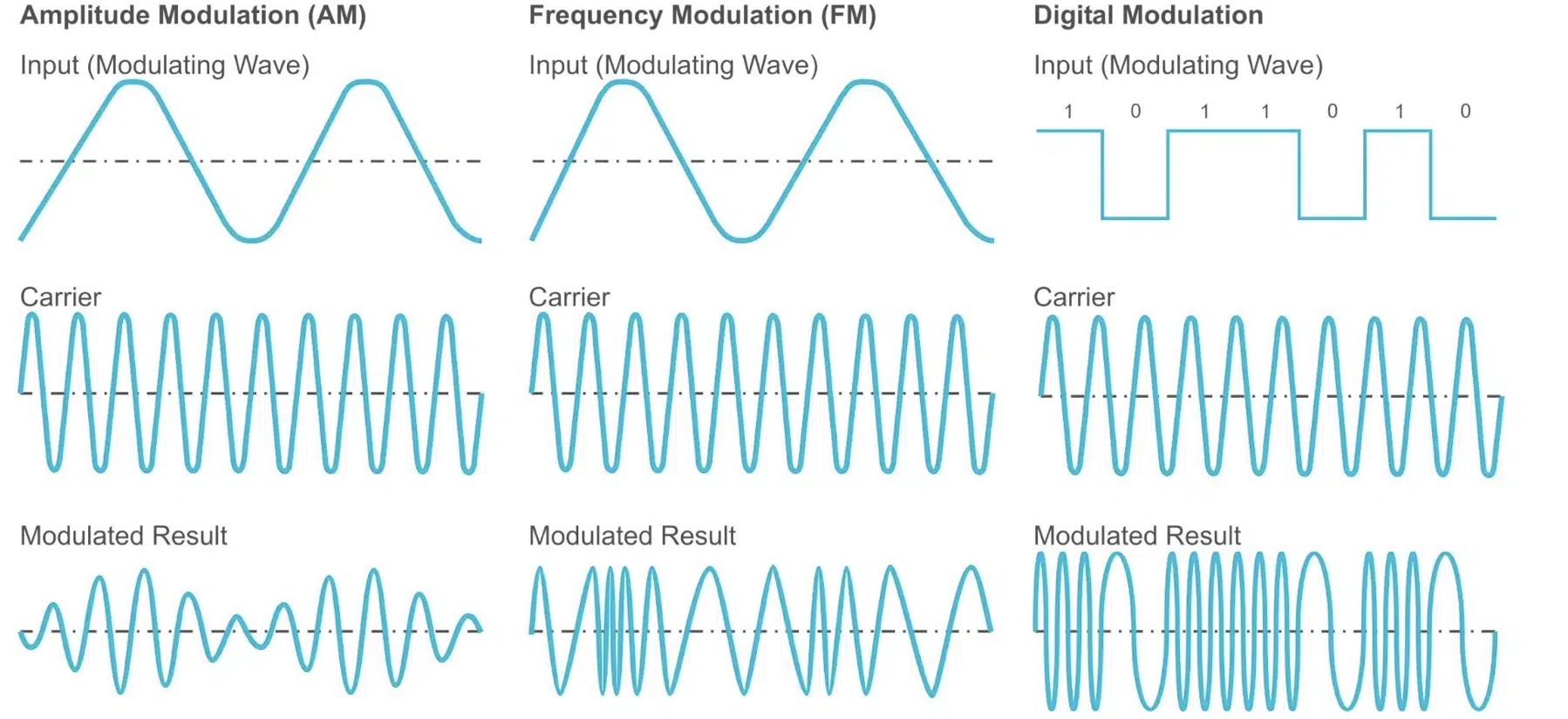
Watch these quick demonstrations of an LFO modulating amplitude.
Sound Design Theory: LFO & Envelope explained!
This clip from Woochia demonstrates the creation of tremolo and briefly touches on AM synthesis.
Watch from tremolo and AM.
2. Pitch Modulation: Vibrato and FM
When an LFO is routed to modulate the frequency of an audio oscillator, it creates a cyclical change in pitch.
- A gentle sine or triangle wave LFO creates vibrato, a subtle and expressive wavering of pitch common to vocals and string instruments. The depth of modulation must be carefully controlled, as too much will result in an over-the-top "siren" effect.
- A square wave LFO will cause the pitch to jump abruptly between two notes, creating a trill.
- Audio-Rate Modulation (FM): As with amplitude, if the LFO's rate enters the audio range, it becomes Frequency Modulation (FM) Synthesis. This is a powerful technique for generating extremely complex and harmonically rich sounds from simple waveforms, which we will explore in our next lesson.
This video demonstrates the transition from vibrato to FM synthesis.
10 creative ways to use LFOs (Synth tips and tricks)
The loopop video has an excellent segment on pitch modulation.
Watch from vibrato and FM. Notice how a small depth creates a pleasing vibrato, but as the rate and depth increase, the sound transforms into a complex, metallic FM tone.
3. Filter Cutoff Modulation: Wah, Wobble, and Sweeps
Modulating the filter's cutoff frequency is arguably one of the most common and powerful uses of an LFO in electronic music. It creates dynamic timbral change.

- A sine or triangle LFO applied to a low-pass or band-pass filter creates the classic "wah-wah" effect.
- Syncing an LFO to the track's tempo to modulate a low-pass filter is the foundation of countless rhythmic patterns, most famously the dubstep "wobble" bass.
- A slow saw or triangle wave can create a long, evolving filter sweep, gradually adding or removing brightness over several bars.
Let's see this in action.
Sound Design Theory: LFO & Envelope explained!
The Woochia video provides a classic example of a filter "wobble" effect.
Watch the segment from filter modulation, which shows how an LFO on a low-pass filter can create rhythmic timbral interest.
Advanced Concepts: Multi-LFOs and Parametric Shapes
The creative potential of LFOs extends far beyond these basic applications. Two advanced concepts are particularly relevant given your background.
Modulating an LFO with another LFO
You can create more complex, less repetitive modulation by using one LFO to control the parameter of another. For instance, a very slow sine wave LFO could be used to gradually increase and decrease the rate of a second LFO that is modulating a filter. This results in a filter sweep that continuously speeds up and slows down, creating an organic, evolving texture.
10 creative ways to use LFOs (Synth tips and tricks)
This loopop segment demonstrates modulating one LFO with another.
Watch from LFO modulating LFO to see how this "second-order modulation" can produce more interesting patterns than a single, static LFO.
2D Shape-Based LFOs
Standard LFOs produce a single control signal over time, . However, it is possible to generate two synchronized control signals, and , from parametric equations to define a two-dimensional trajectory. These two signals can then modulate two different audio parameters simultaneously.
This is a perfect intersection of mathematics and sound design. For example, the simple parametric equations for a circle:
can be used to modulate two parameters in a smooth, circular pattern. You could map to the filter cutoff and to stereo panning, creating a sound that swirls in both timbre and space. More complex parametric curves, like Lissajous figures or the "Butterfly Curve," can create fantastically intricate and evolving modulation patterns.
XY Shape LFO Modulation — User Guide - Mashav
This guide, written for a specific audio plugin, contains an excellent theoretical introduction to 2D LFOs.
Please read the following sections: Start with "What is a shape LFO?" for a concise overview. Then, read the section "Mathematical Shapes". You don't need to memorize the equations, but focus on the table and descriptions that connect the mathematical properties of each shape (Circle, Lissajous, Rose, Star, etc.) to its "Musical Character."
Conclusion
In this lesson, we moved from the one-shot dynamics of ADSR envelopes to the cyclical, repeating motion generated by LFOs. By understanding and applying this fundamental tool, you can bring continuous life and movement to your synthesizer patches.
Key Takeaways:
- An LFO is a sub-audio oscillator whose output is used as a control signal to modulate other synth parameters.
- The primary LFO parameters are Rate (speed), Shape (waveform/contour), and Depth (intensity).
- The three most common modulation targets are Amplitude (creating tremolo), Pitch (creating vibrato), and Filter Cutoff (creating wah-wahs, wobbles, and sweeps).
- When an LFO's rate enters the audio range, it transitions from a modulator to a generator of new timbres through AM or FM synthesis.
- Advanced techniques, like modulating LFOs with other LFOs or using 2D parametric shapes, open up a vast space for creating complex, evolving sounds.
We have now seen a preview of what happens when a modulating oscillator's frequency becomes audible. In our next lesson, we will dive deep into this topic, focusing specifically on Frequency Modulation (FM) Synthesis, a powerful method for generating a huge palette of complex sounds from very simple building blocks.