Introduction
In our last lesson, we constructed the theoretical framework for modal harmony, learning how to build diatonic chords from modes and arrange them into the static, "floating" loops that are foundational to electronic music. You learned the principles of establishing a modal tonic, emphasizing characteristic notes, and avoiding the gravitational pull of functional harmony.
Today, we transition from theory to practice. This lesson is a hands-on workshop where you will synthesize everything we've covered in this module. Your objective is to apply your chosen mode to create a complete 8-bar melodic and harmonic loop in your DAW. We will walk through the entire creative process, from selecting a modal palette to programming the final riff. This capstone project will solidify your ability to use modes as a powerful tool for defining the entire mood and character of a track.
Step 1: Choosing Your Mode and Tonal Center
The first and most crucial step is selecting your mode. This decision is not arbitrary; it's an aesthetic choice that defines your track's emotional color and genre inclinations. Will it be the melancholic optimism of Dorian, the grinding tension of Phrygian, or the futuristic airiness of Lydian?
To help guide your choice, let's consult a resource tailored to electronic music production.
How to Use Modes to Write More Interesting Electronic Melodies
This article by Leiam Sullivan is an excellent practical guide. It connects modes directly to the sounds and genres you're interested in.
First, review the section describing each mode's feel and signature notes. Then, pay close attention to the genre cheat sheet, which suggests common modes for house, techno, and experimental music.
After reviewing the guide, select a mode that aligns with the style you want to create. For a deeper dive into the specific character and construction of each mode, the "Periodic Table of Modes" video we've referenced before is an invaluable resource for review.
Once you have your mode, choose a tonal center (or root note). This will be the "home" note for your entire loop. Good starting points are often notes like C, A, or E, but any of the 12 notes will work. All melodic and harmonic decisions will be made in relation to this anchor point.
Step 2: Practical Principles for Modal Composition
With a mode and a root note selected, the goal is to make your music sound modal. This means actively reinforcing the modal center and its unique flavor, while actively resisting the pull towards a more conventional major or minor key.
The following guide provides a concise set of rules for achieving a genuinely modal sound. These are not just theoretical concepts, but practical instructions for programming your loop.
How to Play a Mode So You Sound Like You're in a Mode
This article from Musician Poster offers a fantastic, no-nonsense checklist for modal composition.
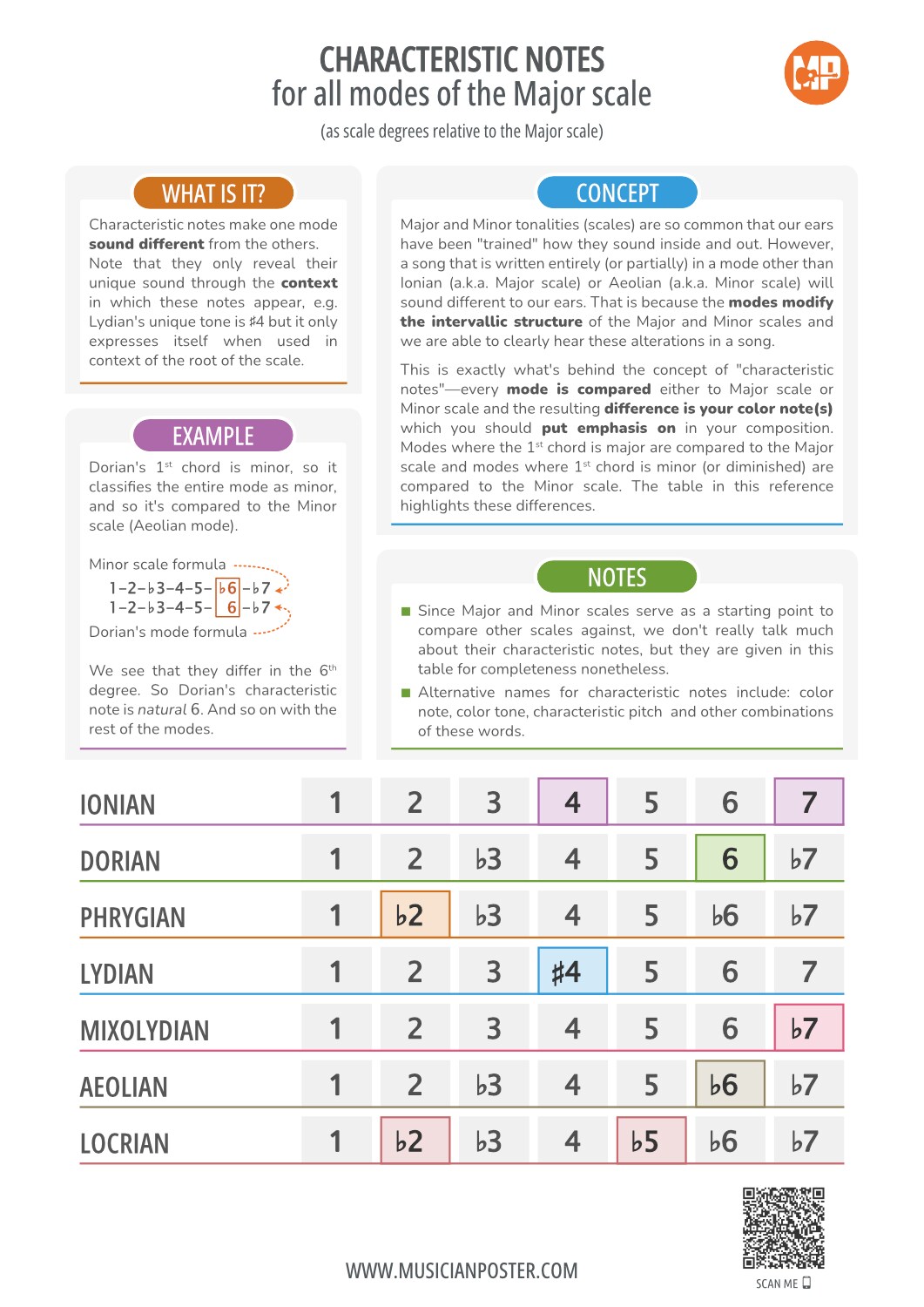
Read through the main principles of the guide. Focus on these key actions: Focus on the One chord to establish your chosen root. Emphasize the characteristic "color" notes of your mode. Avoid functional harmony, which we discussed in the last lesson. Use stepwise "lateral" chord movements instead of the "circular" V-I motion. Avoid chords with a tritone that want to resolve elsewhere. Consider ambiguous chords like sus chords to further obscure tonal function.
Keep these principles in mind as you move to your DAW. They are your blueprint for the next steps.
Step 3: A Worked Example - Crafting a Phrygian Techno Loop
Let's put this all together with a concrete example relevant to your interest in darker, more experimental genres. We'll build an 8-bar loop in E Phrygian.
1. The Setup:
- Mode: E Phrygian. The notes are E, F, G, A, B, C, D.
- Characteristic Note: The ♭2, which is F. This semitone relationship (E-F) creates the mode's signature dark, tense sound.
- Tempo: 130 BPM, typical for techno.
2. The Harmonic Foundation (The Drone):
Following the principle of "focus on the One chord," the simplest and most effective approach in a genre like techno is often to use a drone or pedal tone. Instead of a complex chord progression, we'll establish our E Phrygian center by having a continuous bass note on E throughout the 8 bars. This creates a powerful, hypnotic anchor.
3. The Riff (The Ostinato):
Now, we need a melodic element. In techno, this is often a short, repeating riff or ostinato, where timbral modulation is as important as pitch. Our goal is to emphasize the characteristic ♭2.
- A simple riff could be a sequence like: E - F - G - F.
- This riff constantly returns to the tonic E and pivots around the tense F note, making the Phrygian quality unmistakable.
4. Adding Experimental Edge (Rhythm and Timbre):
This is where we can draw from more advanced, genre-specific techniques. The video "Music Theory for Techno" offers some excellent ideas that align with your interests.
This video from Underdog Electronic Music School provides techniques that are perfect for our Phrygian techno example.
Watch the segment from ostinato and repetition. Notice the focus on short, repeating riffs where the timbre changes over time. Then, watch from the polymeter section. The instructor demonstrates using a random sequencer and setting the step length to a number not divisible by four (like 5 or 7) to create a polymeter.
To make our E Phrygian loop more interesting, we could:
- Program the Riff Polymetrically: Instead of a 4-beat pattern, program the E-F-G-F riff into a 7-step sequencer and let it run against the 4/4 drum beat. This creates a constantly shifting, hypnotic groove that avoids simple repetition. Your background in mathematics will make the logic of this immediately apparent: the pattern will take 7 bars of 4/4 to fully resolve.
- Focus on Timbre: Use a synth with a resonant filter (like a 303 emulation). Program the riff, then automate the filter cutoff and resonance over the 8-bar loop. The melodic content stays the same, but the sonic character is always evolving. Add distortion to further enhance the industrial texture.
The final 8-bar loop would consist of a 4/4 kick drum, a steady bass drone on E, and the 7-step E-F-G-F riff with filter automation playing over the top. This is a complete, effective modal loop built from first principles.
Step 4: Your Turn - The Capstone Project
Now it's your turn to apply these concepts. Your task is to create your own 8-bar melodic and harmonic loop.
-
Choose Your Mode: Select a mode other than Phrygian.
- Dorian or Mixolydian are excellent for a house or deep techno feel.
- Lydian is great for an ambient or experimental IDM sound.
- Aeolian provides a classic melodic techno foundation.
-
Set Up Your Project: Open your DAW, set a tempo appropriate for your chosen genre, and create an 8-bar loop.
-
Build the Harmonic Loop:
- Choose a simple 2 or 3-chord modal schema from our previous lesson (e.g.,
i-IVfor Dorian,I-♭VIIfor Mixolydian). - Program these chords using simple synth pads or stabs. Remember to keep the voicings relatively simple.
- Choose a simple 2 or 3-chord modal schema from our previous lesson (e.g.,
-
Create the Bassline: Program a bassline that reinforces the modal tonic. It can play the root notes of the chords, or it can be a pedal tone on the main root of the mode.
-
Write the Melodic Riff:
- Create a simple, repeating melody or ostinato.
- Crucially, make sure your melody features the characteristic note of your mode prominently. This is what will give the loop its unique flavor.
-
(Optional) Experimental Challenge:
- Incorporate one of the advanced techniques from the "Music Theory for Techno" video. Can you program your riff with a polymetric length? Can you create interest primarily through timbral change (distortion, detuning, filters) rather than melodic complexity?
This project is the culmination of our work on modes. Take your time, experiment, and listen closely to how each element contributes to the overall modal sound.
Conclusion
In this lesson, you've consolidated your theoretical knowledge of modes into a practical, creative workflow. You now have a systematic process for composing compelling melodic and harmonic loops that define a track's identity. You understand that successful modal composition is a matter of deliberate choices: selecting a mode for its flavor, reinforcing its unique characteristics, and actively resisting the conventions of tonal harmony.
Key Takeaways:
- Modal composition in electronic music begins with choosing a mode as an aesthetic palette.
- Effective modal loops are built by reinforcing the tonic (via drones or repetition) and emphasizing the mode's characteristic note in both harmony and melody.
- Techniques like ostinato, polymeter, and timbral modulation are powerful tools for developing modal ideas in genres like techno and IDM.
- Simple modal schemas (e.g., i-IV, I-♭VII) provide proven, effective foundations for harmonic loops.
This lesson completes our module on Modes and Modal Harmony. In our next module, "Chord Construction and Voicing," we will zoom in from the macroscopic scale of harmonic systems to the microscopic level of the chords themselves. You will learn to build any triad, seventh chord, or extension from scratch, giving you granular control over the texture and color of the harmonies you program.