Introduction
In our previous lesson, we explored the characteristic sounds and emotional palettes of the modes most frequently used in house and techno. You learned to select a mode, like Dorian for its soulful coolness or Phrygian for its grinding tension, as a foundational aesthetic choice for a track. We focused on melody and basslines to establish these modal flavors.
Now, we will elevate this understanding from single melodic lines to full harmonic textures. This lesson directly addresses the core of creating the hypnotic, looping chord progressions that define much of electronic music. We will learn how to systematically build chords from any mode and, crucially, how to arrange them into static, non-functional harmonic loops. You will understand the fundamental distinction between the goal-oriented harmony of classical music and the atmospheric, "sound world" approach of modal harmony, providing you with the principles to craft compelling loops that can sustain a track's energy indefinitely.
Harmonizing the Modes
Just as we can build a set of diatonic chords from the major (Ionian) and minor (Aeolian) scales, we can do the same for every other mode. The process is identical and systematic: for each note in the modal scale, we stack thirds using only other notes from that same scale to form a triad.
Let's take D Dorian as our example, a mode you know is a staple in house music. The notes are D, E, F, G, A, B, C.
- i chord (on D): D-F-A (a D minor triad)
- ii chord (on E): E-G-B (an E minor triad)
- III chord (on F): F-A-C (an F major triad)
- IV chord (on G): G-B-D (a G major triad)
- v chord (on A): A-C-E (an A minor triad)
- vi° chord (on B): B-D-F (a B diminished triad)
- VII chord (on C): C-E-G (a C major triad)
Notice the i-IV progression we discussed in the last lesson, Dm to G major, arises naturally from this process. The video "Composing with Modes" demonstrates this procedure for the Phrygian mode.
In this video, musician Michael Keithson walks through the process of building the diatonic chords for a mode.
Watch the segment from creating chords. The presenter applies the "stacking thirds" method to the C Phrygian scale, revealing the unique set of major, minor, and diminished chords that belong to that mode.
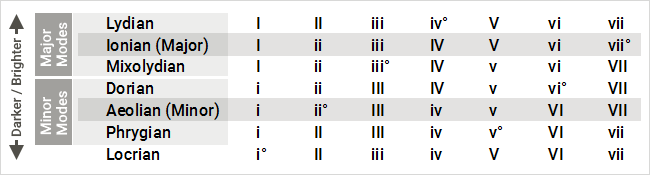
This systematic generation of chords can be done for all seven modes. The image below provides a complete reference guide, showing the quality (major, minor, diminished) of the diatonic triad built on each scale degree for every mode. It's a powerful map of the harmonic landscape available to you.
Tonal Gravity vs. Modal Floating
Now that we have our chords, which ones should we use? A simple progression like Dm7 - G7 - CMaj7 (a ii-V-I in C Major) feels like it's going somewhere. It has a powerful sense of forward motion and resolution. This is the essence of tonal or functional harmony. Its primary engine is the tension created by the dominant chord (V) pulling irresistibly toward the tonic (I).

Modal harmony, especially in the context of electronic music loops, operates on a different principle. It aims to create a static, cyclical soundscape—a 'vibe' that can repeat for minutes on end without demanding resolution. It feels less like a narrative with a destination and more like a sustained environment.
The following video provides an excellent analogy, contrasting the "gravity" of tonal harmony with the "floating" quality of modal harmony.
Understanding Modal Harmony To Create Amazing Chord Progressions
This video from QJamTracks, "Understanding Modal Harmony," clearly explains the conceptual difference between tonal and modal harmonic approaches.
First, watch from the introduction. Pay close attention to the concepts of harmonic function (tonic, subdominant, dominant) and the idea of "gravity" pulling the music back to the tonic. The video then introduces modal harmony as something that "floats" without this pull. Then, watch the recap from the summary, which reinforces this core distinction. This is the central concept for creating effective loops.
Crafting the Non-Functional Loop: Three Guiding Principles
To achieve this "floating" quality and create a successful modal loop, you need to make deliberate chord choices that reinforce the modal center and avoid triggering the gravitational pull of tonal harmony. Here are three guiding principles.
1. Establish the Modal Tonic
Your loop must constantly reaffirm the root chord of the mode as its sonic center of gravity, or "home base." The listener's ear needs to be convinced that, for example, Dm is the tonic in a D Dorian piece, not C major (the relative major). This is often achieved by starting the loop on the tonic chord, returning to it frequently, or underpinning the progression with a constant bass note on the modal root (a pedal tone).
2. Emphasize Characteristic Chords
The most powerful way to evoke the unique color of a mode is to use the chords that contain its characteristic note.
- In D Dorian, the characteristic note is B (the major 6th). The chords containing B are E minor (ii) and G major (IV). Using the i-IV progression (Dm-G) is effective precisely because the IV chord showcases the defining note of the mode.
- In G Mixolydian, the characteristic note is F (the flattened 7th). The chords containing F are C major (IV), E diminished (vii°), and F major (♭VII). A I-♭VII loop (G-F) is quintessentially Mixolydian.
3. Handle Tritones with Extreme Care
The tritone (an interval spanning six semitones) is the engine of dominant function. In a C major scale, the tritone exists between B and F. This interval is found within the V7 chord (G7: G-B-D-F) and the vii° chord (B-D-F), creating a powerful instability that wants to resolve to the C major tonic.
Each mode contains this same tritone, but its relationship to the modal tonic changes. Chords containing the tritone can destabilize your modal center and make the listener's ear snap back to a familiar major/minor resolution.
The same video from QJamTracks provides an excellent analysis of which chords to be cautious with, again using D Dorian as an example.
Understanding Modal Harmony To Create Amazing Chord Progressions
This video delves into the practicalities of choosing chords and, more importantly, which ones to avoid in a modal context.
Watch from the rules for a summary of how to compose a modal sequence, focusing on the advice to be careful with dominant and diminished chords. Then, for a detailed breakdown, watch from the chord analysis. The presenter identifies the "no go" chords in C Ionian (which contains the notes of D Dorian) and explains why they pull away from the Dorian center. This is a critical insight for maintaining modal stability.
As a general rule for creating static loops, avoid chords that function as a V7 or vii° relative to the parent major key. For D Dorian (relative to C Major), this means being wary of G7 and Bdim. While a G major chord (the IV chord) is great for establishing the Dorian sound, a G dominant 7th chord (G-B-D-F) contains the B-F tritone and can sound like it wants to resolve to C major, breaking the D Dorian feel.
Modal Schemas: Proven Loop Formulas
Music theorists have identified common, effective modal progressions, often called "schemas" or "shuttles." These are simple two- or three-chord loops that perfectly encapsulate a mode's character and are ideal for electronic music.
The article "Modal Schemas" from Open Music Theory provides an excellent catalog of these patterns.
Modal Schemas – Open Music Theory - VIVA's Pressbooks
This article introduces common, repeatable chord patterns (schemas) for several modes, which are perfect for building loops.
Start by reading the section on Mixolydian schemas, focusing on the I–♭VII "Subtonic shuttle." Next, read about Aeolian schemas. Pay attention to the "Aeolian shuttle" (i–♭VII–♭VI–♭VII) as a classic minor-key loop. Then, read the section on Dorian, which formalizes the i–IV "Dorian shuttle" we've already discussed. Finally, review the Lydian shuttle (I–II♯) for a brighter, more ethereal looping option.
Here are some of the most useful schemas for your genres:
- Dorian Shuttle:
i – IV(e.g.,Am - Din A Dorian) - Mixolydian Shuttle:
I – ♭VII(e.g.,C - B♭in C Mixolydian) - Aeolian Shuttle:
i – ♭VII – ♭VI(e.g.,Am - G - Fin A Aeolian) - Phrygian: The most common Phrygian "loop" is often a simple melodic or harmonic oscillation between the tonic and the ♭2, such as
EmtoFchords, or just an F note over an E bass drone, emphasizing that tense semitone relationship.
These shuttles are the bread and butter of non-functional harmony. Building a track around one of these simple, powerful loops is a highly effective production strategy.
An Advanced Aside: Quartal Harmony
Given your background in physics and mathematics, you may appreciate a more radical solution to avoiding tonal gravity. The very structure of triads—stacked thirds—is intrinsically linked to the sound of tonal harmony. An alternative approach, pioneered in modal jazz, is quartal harmony, which builds chords by stacking fourths instead of thirds.
A chord like E-A-D is a quartal voicing. It has no clear major or minor quality. Its ambiguity makes it perfect for modal contexts, as it avoids the inherent functional tendencies of triadic chords. The key to using this technique, as explained in the Berklee article "Modal Harmony in Jazz Composition," is to deploy these quartal voicings over a persistent bass note that anchors the modal tonic. This allows for rich harmonic movement above the bass without ever implying a tonal resolution. While a deep dive is beyond this lesson, knowing this technique exists opens a door to more experimental harmonic textures that fit well within your target genres. You can explore this further in the article LINK.
Conclusion
You have now moved beyond single-note modal melodies to understanding the construction and deployment of modal harmony. You can create the very static, hypnotic, and colorful chord loops that form the harmonic engine of so much house, techno, and ambient music.
Key Takeaways:
- Diatonic chords for any mode are built by stacking thirds using only notes from that mode's scale.
- Modal harmony aims to create a static "sound world," contrasting with tonal harmony's goal-oriented "gravity."
- To create effective non-functional loops, you must establish the tonic, use characteristic chords, and avoid chords containing a strong tritone that can pull the harmony away from the modal center.
- Modal "shuttles" (e.g., i-IV in Dorian, I-♭VII in Mixolydian) are simple, powerful, and proven formulas for creating modal loops.
In our next lesson, we will put all of this together. You will choose a mode, harmonize it, select a modal schema, and program a complete 8-bar melodic and harmonic loop in your DAW. This will be the capstone exercise for this module, consolidating your understanding of modal composition in a practical, creative project.