Introduction
In our last lesson, we developed the fundamental techniques for composing with modes, focusing on how to establish a clear tonal center and emphasize the characteristic note of a mode to give it a distinct identity. We've moved from simply knowing what a mode is to knowing how to make a melody sound truly Dorian or Phrygian.
Now, we will shift our focus from technique to application. This lesson addresses a core question for any producer: which modes should you reach for to achieve a specific sound or fit within a particular genre? We will explore the tonal colors and moods of the modes most commonly used in house and techno. Your goal is to be able to consciously select a mode just as you would select a synth patch or a drum sample—as a foundational element that defines your track's character. We will investigate why Dorian and Mixolydian are staples of house music, and why Phrygian is so effective for the dark, driving energy of techno.
The Modal Palette in Electronic Music
Before diving into specific genres, let's establish a clear overview of the emotional landscape each mode offers. While our previous lesson touched on this, the article "How to Use Modes to Write More Interesting Electronic Melodies" provides an excellent, producer-focused summary of each mode's character and signature note.
How to Use Modes to Write More Interesting Electronic Melodies
This article provides a concise breakdown of the "feel" and common applications for each mode in an electronic music context.
Please read the introductory table and then the section titled How the modes behave. As you read, pay attention to the descriptive language used for each mode ("soulful," "tense," "dreamy") and note the "signature note" that creates this flavor. This is the palette we'll be working with.
This framework of "moods" is not arbitrary. It's a direct consequence of each mode's unique intervallic structure relative to its root note—the very characteristic notes we learned to emphasize in our last lesson.
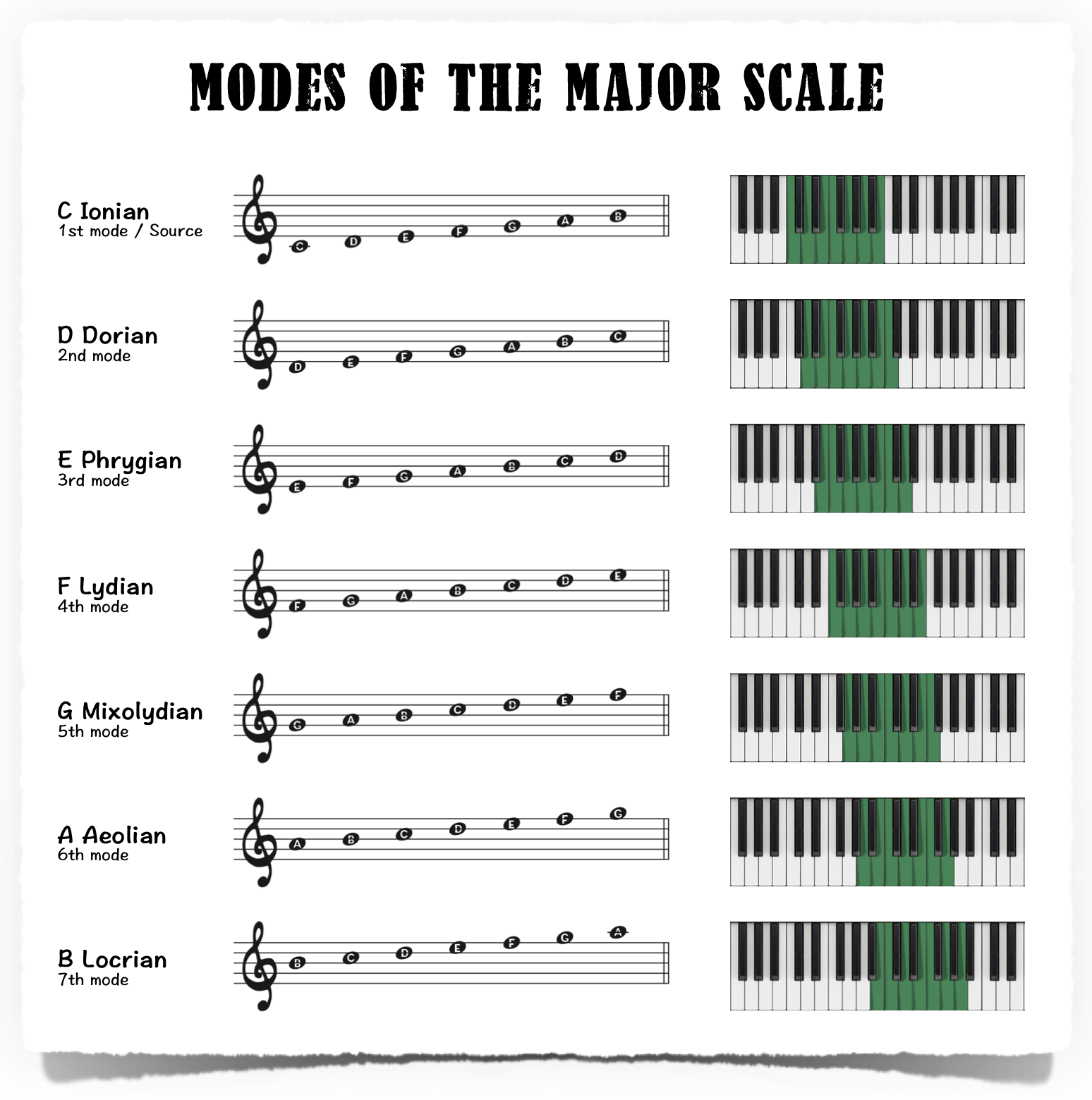
The Sound of House: Groove and Soul
House music, in its many forms, often balances propulsive rhythm with a sense of warmth, soul, or hypnotic groove. Two modes are particularly effective at creating this atmosphere: Dorian and Mixolydian.
Dorian: The "Cool" Minor
The Dorian mode is often described as a "brighter" or "cooler" minor scale. Its characteristic note, the natural 6th, lifts it out of the melancholy of the standard Aeolian (natural minor) mode, giving it a more optimistic and soulful quality. This makes it a perfect match for the smooth, rolling basslines of deep house and the jazz-inflected stabs of soulful house.
The connection becomes even clearer when you consider the roots of house music in funk and disco. The Dorian mode is incredibly common in funk. A video from David Bennett explains this connection and introduces a quintessential Dorian harmonic device.
Songs that use the Dorian mode
This video, "Songs that use the Dorian mode," provides excellent examples and highlights the mode's connection to funk.
First, watch from the beginning to hear a direct comparison between Dorian and natural minor. Listen for how the natural 6th provides a "whimsical and intriguing" quality. Next, watch the section on funk from Dorian in funk. The presenter identifies a common chord progression he calls the "Dorian vamp," moving from the minor one chord (i) to the major four chord (IV). This i-IV movement is a cornerstone of the Dorian sound in funk and, by extension, in many styles of house music.
The reason the i-IV progression so perfectly captures the Dorian sound is that the major IV chord contains the natural 6th degree of the scale. For example, in D Dorian, the i chord is D minor (D-F-A) and the IV chord is G major (G-B-D). That B natural is the characteristic note, the natural 6th, that defines the Dorian mode. Building a track around this two-chord loop is a classic way to create a deep house groove.
Mixolydian: The "Funky" Major
While Dorian provides a cool minor feel, Mixolydian offers a major-key energy but with more grit and groove. Its characteristic note is the flat 7th (). This note removes the strong "leading tone" pull back to the tonic that exists in the standard Ionian (major) scale. The result is a more relaxed, open, and blues-inflected sound that can loop endlessly without feeling the need to resolve. This makes it ideal for upbeat, groove-led house, disco, and electro.
The article "The Mixolydian Mode" from Producertech offers a good summary of its character.
Musical Modes: The Mixolydian Mode | Blog - Producertech
This resource focuses specifically on Mixolydian, detailing its mood and construction.
Read the introduction starting from its description to understand its "mellow, relaxed, but also bold quality" and its use in genres like Lofi House. Then, review the section on its construction to solidify your understanding of the flattened 7th.
The gives Mixolydian its bluesy, dominant-like character, making it feel propulsive and funky rather than "happy" or "final" like the major scale. A common Mixolydian progression in house music is a vamp between the major I chord and the major chord (e.g., G major to F major in G Mixolydian).
The Sound of Techno: Tension and Hypnosis
Techno, particularly in its darker and more industrial forms, thrives on tension, repetition, and hypnotic atmosphere. While any mode can theoretically be used, one stands out for its ability to instantly create a dark, grinding feel: the Phrygian mode.
Phrygian: The "Dark" Minor
The Phrygian mode is defined by its characteristic flat 2nd (). This note is only a semitone above the root, creating an immediate and powerful dissonance. The melodic movement from the down to the tonic is intensely charged, lending itself perfectly to the aggressive, hypnotic riffs common in techno.
This isn't just about sounding "minor"; it's about creating a specific kind of pressure. A video from Underdog Electronic Music School explains this perfectly in the context of techno production.
This video gets straight to the point about creating a dark atmosphere for techno.
Watch the section from 1:30 to 2:11. The presenter contrasts the major scale with minor and Phrygian, highlighting Phrygian as a "typical techno scale" precisely because the flattened 2nd gives an "evil feeling" when it approaches the root note.
This movement is the core of the Phrygian sound in techno. A simple, repetitive bassline or synth arp that hammers this relationship (e.g., oscillating between F and E in E Phrygian) can form the foundation of an entire track, creating a sense of perpetual, unresolved tension.
It's also worth noting that the standard Aeolian mode (natural minor) is a workhorse in many forms of techno, especially melodic techno. It provides a more cinematic and emotional sadness without the specific grinding tension of Phrygian.
A Producer's Cheat Sheet
To consolidate this, the article we looked at earlier contains a "cheat sheet" that is an invaluable starting point for choosing modes based on genre.
How to Use Modes to Write More Interesting Electronic Melodies
This section provides a quick-reference list of modes commonly associated with various electronic music genres.
Review the list under the heading Modes by Genre. Notice how Dorian, Mixolydian, Phrygian, and Aeolian appear repeatedly across the styles you're interested in.
Treat this list not as a set of strict rules, but as a summary of common practice. The most interesting music often comes from applying these tools in conventional and unconventional ways.
Conclusion
You can now connect the theoretical structure of modes to the practical aesthetics of electronic music genres. This ability to pre-select a tonal color is a significant step in moving from a reactive to a proactive composer.
Key Takeaways:
- House Music often relies on modes that provide groove and soul.
- Dorian (natural 6th) offers a "cool" minor sound, perfect for deep and soulful house. Its connection to funk (especially the i-IV vamp) is a key reason for its prevalence.
- Mixolydian (flat 7th) provides a "funky" major sound, ideal for energetic, blues-inflected house and electro grooves that can loop endlessly.
- Techno often uses modes that create tension and dark atmospheres.
- Phrygian (flat 2nd) is a quintessential techno mode. The semitone interval between the and the root creates a powerful, grinding tension ideal for hypnotic and aggressive tracks.
- The choice of mode is a fundamental decision that shapes the entire mood and genre-feel of your production.
In our next lesson, we will build upon this foundation. Now that you can choose the right mode for your track and compose a melody within it, we will learn how to harmonize these modes with triads, enabling you to create the static chord loops and harmonic textures that are the bedrock of house, techno, and countless other electronic styles.