Introduction
In our last lesson, we explored the distinct personality of each diatonic mode, arranging them along a spectrum from "bright" to "dark" and linking their mood to their unique intervallic structure. You learned to identify the single characteristic note that defines each mode's sound relative to a standard major or minor scale. Now, it's time to put that knowledge into action.
This lesson bridges the gap from passive recognition to active creation. Our goal is to compose melodies and basslines that intentionally and effectively emphasize the characteristic tone of a given mode. Simply using the notes of a mode isn't enough; our ears, conditioned by years of listening to major and minor music, can easily misinterpret a modal melody. We will learn the techniques required to firmly establish a modal tonality, ensuring that when you write in Phrygian, it sounds definitively Phrygian—dark, tense, and powerful—and not simply like an ambiguous fragment of a major scale.
The Challenge of Modal Composition: Escaping Tonal Gravity
Before we begin composing, it's important to understand a core challenge. The Ionian (major) and Aeolian (natural minor) modes are so prevalent in Western music that they act like deep potential wells, or stable equilibrium points. Melodies built from other modes, if not constructed carefully, have a tendency to "fall back" into these familiar territories, losing their unique modal character in the process.
For example, if you write a melody using the notes of G Mixolydian (G A B C D E F), but you don't sufficiently emphasize the G as the tonic, the listener's ear might hear the notes as belonging to the key of C Major, with G being the fifth degree (the dominant). Your intended cool, bluesy G Mixolydian piece ends up sounding like an unresolved phrase in C Major.
To counteract this, we must employ two key strategies:
- Firmly establish the tonic of the mode as the undisputed "home base."
- Strategically emphasize the characteristic note to constantly remind the listener of the mode's unique flavor.
Foundational Techniques for Modal Writing
The Berklee Online course article "Music Modes" provides an excellent, systematic guide for writing strong modal melodies. We will use its principles as our framework.
Music Modes: Major and Minor Modal Scales in Music Theory
This section from Berklee's article outlines five essential rules for making modal melodies work. These principles directly address the challenge of establishing a clear modal center and character.
Please read the section titled Writing Modal Melodies. Pay close attention to the five numbered points, as they form the technical basis for the rest of our lesson.
Let's unpack those five points with a focus on electronic music production.
- Use all notes of the scale: This ensures you don't create ambiguity. If you write a melody in A Dorian but never use the note F#, it could just as easily be A Aeolian.
- Make frequent use of the characteristic note: This is the core of today's lesson. This "flavor note" is what you'll use to define your sound.
- Emphasize the tonic note: This anchors your composition. In genres like techno, a constant, pulsing root-note bassline is a powerful way to achieve this.
- Use a "melodic cadence": Simple melodic movements, like from the 2nd degree to the tonic (2-1) or the 7th to the tonic (7-1), create a sense of arrival and reinforce your chosen root.
- Avoid the tritone (in most cases): The tritone within a mode often implies the V-I resolution of its relative major key, which can pull your music away from its modal center. For instance, in C Dorian, the tritone E-B♭ can strongly suggest a resolution to F major, not C. While this can be used intentionally in advanced contexts, it's best to be cautious with it for now.
The following video, "Composing with Modes," offers practical demonstrations of these ideas, particularly the importance of establishing a solid tonal center.
This video by Michael Keithson provides excellent, listenable examples of how to ground your modal compositions.
First, watch the section from 5:30 to 7:36. The presenter discusses the critical importance of establishing the tonic or "home base," using techniques like repetition and leveraging strong cadences. Next, watch from 7:36 to 9:56. Here, he explains the concept of "character tones" (our characteristic notes) and demonstrates how leaning on them in a melody distinguishes one mode from another, using the minor modes as a clear example.
A Workshop in Modal Composition
Now let's apply these techniques to craft melodies and basslines in a few key modes relevant to your target genres. As a quick reference, here are the characteristic notes for all seven modes.
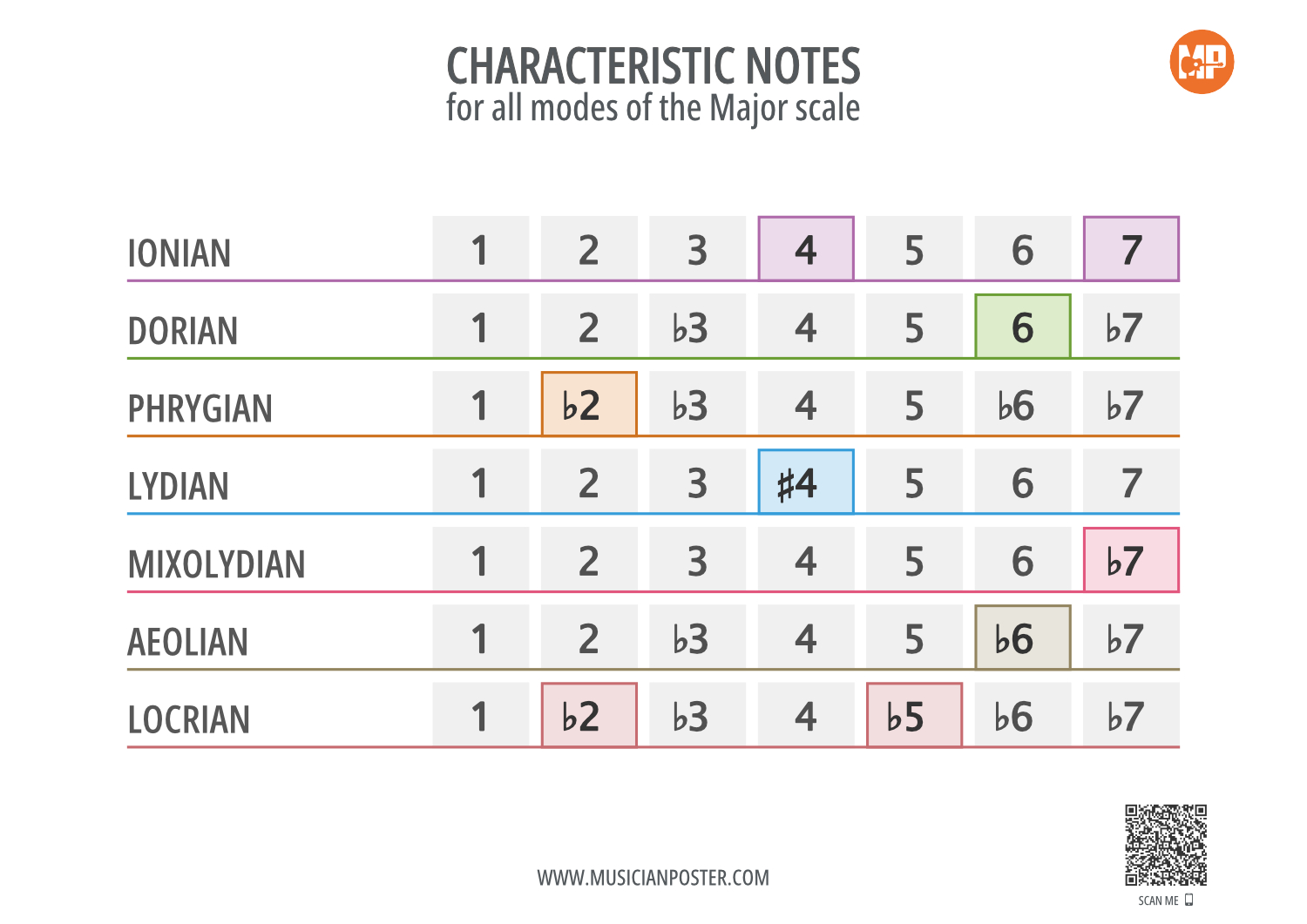
The article "How to Use Modes to Write More Interesting Electronic Melodies" is a great resource that connects these modes directly to electronic music genres and uses the term "signature note" for the characteristic note.
How to Use Modes to Write More Interesting Electronic Melodies
This article is tailored for electronic producers and provides genre-specific advice.
First, read the section How the modes behave. This gives a fantastic breakdown of each mode's feel, best uses, and signature note. Then, quickly look at the genre cheat sheet under the heading Modes by Genre to see where these sounds are most common.
Phrygian (♭2) for Techno and Industrial
The Phrygian mode is defined by its lowered 2nd degree, which creates a dark, grinding tension with the root. The interval from the ♭2 to the tonic is a semitone, giving it a powerful, almost menacing pull. This makes it a staple in techno and industrial music.
- Tonic: Establish a driving, repetitive root note bassline.
- Characteristic Note (♭2): Use the ♭2 in a hypnotic, short riff (an ostinato) that resolves down to the tonic. The constant tension and release of ♭2 -> 1 is the essence of the Phrygian sound.
The video "Music Theory for Techno" directly addresses this.
This video from Underdog Electronic Music School is laser-focused on creating techno and provides an excellent, practical take on using Phrygian.
Watch from 1:30 to 2:11 for an explanation of the Phrygian scale's "evil feeling." Then, watch from 2:40 to 3:08 for advice on thinking in intervals, especially the Phrygian ♭2. Finally, the concept of ostinato (short repeating riffs) is highly relevant to making this work.
Dorian (nat. 6) for House and Melodic Techno
Dorian is the "bright minor" mode. The natural 6th provides an optimistic lift that distinguishes it from the more melancholic Aeolian mode. This makes it perfect for deep house basslines and soulful, hypnotic grooves.
- Tonic: Use a rolling bassline that frequently returns to the root note.
- Characteristic Note (nat. 6): Create a melody or bassline that moves between the minor 3rd and the natural 6th. This contrast between the "minor" feel of the ♭3 and the "major" feel of the natural 6th is the source of Dorian's unique character.
Let's see a demonstration of this in the "Composing with Modes" video.
This section provides a musical example of Dorian composition.
Watch the short Dorian example from 12:45 to 13:25. Listen for how the melody feels minor but has a certain smoothness and forward motion, which comes from the use of the natural 6th.
Lydian (#4) and Locrian (♭5): Handling Instability
Lydian and Locrian are challenging for a similar reason: the interval between the root and a characteristic note (#4 in Lydian, ♭5 in Locrian) is a tritone. This inherent instability requires a firm hand to control.
- Lydian (#4): To prevent the tonality from resolving to the fifth, use a strong pedal tone on the root note. Let the melody and pads float above, introducing the dreamy #4. This is common in ambient music and film scores.
- Locrian (♭5): This is the darkest, most dissonant mode. The tonic chord itself is diminished and unstable. To make it work, you must relentlessly hammer the root note home with a pedal or a powerful, repetitive riff. This mode is best suited for experimental noise or creating moments of extreme tension.
The "Composing with Modes" video offers excellent strategies for taming these two modes.
These sections address the specific challenges of composing with Lydian and Locrian.
First, watch the segment on Lydian from 14:55 to 17:10. Notice the techniques of pedaling the root or staying on the tonic chord to maintain the Lydian flavor. Next, watch the segment on Locrian from 18:14 to 20:23. The presenter discusses the instability of the diminished tonic chord and demonstrates how continuously returning to it can establish the tonal center, even amidst the dissonance.
Your Turn: Practical Exercise
It's time to apply these concepts in your DAW.
- Choose a mode and a root note. Let's start with D Dorian.
- Set your DAW's tempo to 120 BPM.
- Establish the tonic: Create a simple 4-bar loop where a bass synth plays a D note on the first beat of every bar.
- Compose a bassline/melody: Using the notes of D Dorian (D, E, F, G, A, B, C), write a simple 4-bar melody or a more active bassline.
- Emphasize the characteristic note: Make sure your melody prominently features the B natural (the natural 6th). Try placing it on a strong beat or making it the highest note of a phrase.
- Contrast with Aeolian: Copy your 4-bar loop. In the new loop, change every instance of B natural to B flat. You are now in D Aeolian. Listen to the difference in mood. The "lift" of Dorian should be gone, replaced by the more standard melancholy of natural minor.
This exercise will give you a direct, tangible feel for how a single characteristic note, when emphasized, can completely transform the emotional color of a musical idea.
Conclusion
You now have a practical toolkit for composing music that genuinely captures the essence of the modes. By learning to control the listener's perception—firmly grounding the tonality in your chosen root and strategically deploying the characteristic note—you can move beyond the simple happy/sad dichotomy of major and minor and unlock a much wider palette of emotional colors for your productions.
Key Takeaways:
- To write effective modal music, you must combat the pull of standard major/minor tonality.
- The two primary strategies are to emphasize the tonic (through repetition, pedal tones, and cadences) and emphasize the characteristic note.
- The characteristic note is the "flavor" note that defines a mode's sound (e.g., ♭2 for Phrygian, nat. 6 for Dorian, #4 for Lydian).
- Different modes lend themselves to different genres: Phrygian is great for dark techno, Dorian for deep house, Mixolydian for funk-influenced styles, and Lydian for ambient pads.
- Unstable modes like Lydian and Locrian require a very strong tonic anchor (like a pedal tone) to prevent the tonality from collapsing.
In our next lesson, we will take the next logical step. Now that we can write modal melodies, we need to know how to support them. We will learn to harmonize a mode with diatonic triads, building the static, non-functional chord loops that are a cornerstone of house, techno, and many other forms of electronic music.