Introduction
In our last lesson, we deconstructed the seven diatonic modes, identifying the single characteristic note that defines each one's structure relative to a standard major or minor scale. This provided a precise, formulaic way to understand their construction. Now, we will explore the perceptual consequences of these structural differences.
This lesson bridges the gap between the "what" and the "why." You will learn to describe the specific tonal quality, mood, and emotional color associated with each mode. We will move beyond simple labels like "happy" or "sad" and develop a more nuanced understanding of modal character, framing it within a systematic spectrum of "brightness" and "darkness." Your background in physics will be useful here, as we'll see that these perceived qualities are a direct result of systematically altering the intervallic structure of a scale—much like how perturbing a physical system changes its emergent properties.
From Structure to Sensation: The Spectrum of Brightness
The concept of "brightness" is a powerful tool for classifying modes. It's more descriptive than emotional labels and provides a quantifiable way to order the modes based on their intervallic content. Let's begin by exploring this idea.
The Modes Ranked by Brightness
The video "The Modes Ranked by Brightness" by David Bennett introduces this concept perfectly. It explains why thinking in terms of a bright-to-dark spectrum is more sophisticated than using simple emotional terms.
Watch the opening section from 0:45 to 1:26, where the presenter defines the concept of modal brightness as a spectrum of light.
This idea of a spectrum isn't just a metaphor; it has a concrete basis in the structure of the scales. As we learned previously, the modes can be generated by progressively flattening notes, moving from Lydian (brightest) to Locrian (darkest). A musician and theorist, Anton Schwartz, provides a wonderfully systematic way to visualize this using the circle of fifths, a concept you're familiar with from our early lessons on tuning.
Brightness and Darkness in Jazz Harmony | Anton Schwartz
This article formalizes the concept of brightness by mapping it onto the circle of fifths. This perspective should resonate with your analytical approach, as it treats brightness as a function of the scale's "center of mass" relative to the tonic.
Read the following sections: Start from the beginning and read down to the end of the first section, as the author introduces the core idea using C major and C minor. Continue through the next section, where the modes are derived systematically by replacing the "brightest" note with the next "darkest" one. Observe how the collection of notes shifts around the circle of fifths. Finally, read the short section on the relativity of brightness. The key insight here is that brightness is not an absolute property of a note collection, but is defined relative to a chosen tonic, or frame of reference.
This framework gives us a robust model: moving a scale's notes clockwise (sharper) on the circle of fifths relative to the tonic increases brightness, while moving them counter-clockwise (flatter) increases darkness.
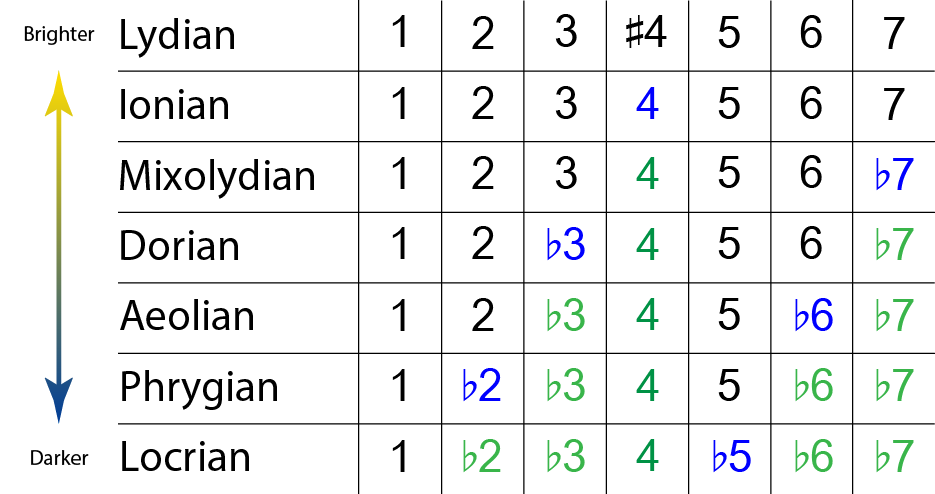
A Tour Through the Modal Spectrum
Now, let's explore the personality of each mode, starting with the brightest and moving to the darkest. As we go, we will reference two videos that provide excellent descriptions and musical examples.
MODES: How to Understand & Actually Use Them | Music Theory
We will refer back to Ryan Leach's video from our previous lesson, this time focusing on his descriptions of each mode's sound and typical usage.
Keep this video in mind as we will be jumping to the specific timestamps for each mode.
The Modes Ranked by Brightness
We will also use David Bennett's video, which provides different examples and reinforces the concepts with excellent visuals.
Similarly, we will reference specific sections of this video for each mode.
The Major Modes (Major 3rd)
-
Lydian (Characteristic Note: #4)
- Mood: The brightest mode. Its sound is often described as magical, ethereal, uplifting, wondrous, and transcendental. The #4 avoids the strong pull-to-the-root of the perfect 4th, creating a feeling of floating or flying.
- Context: John Williams famously uses it for themes associated with awe and wonder, such as in E.T. and "Yoda's Theme" from Star Wars.
- Watch: Leach
on Lydian and Bennetton Lydian .
-
Ionian (The Major Scale)
- Mood: Our baseline for "bright." It's happy, clear, and stable. Its familiarity can sometimes make it sound conventional or plain, what Ryan Leach calls "plain vanilla major."
- Context: The sound of the vast majority of pop, classical, and mainstream Western music.
- Watch: Leach
on Ionian .
-
Mixolydian (Characteristic Note: ♭7)
- Mood: A "darker" major sound. The ♭7 removes the leading tone, weakening the pull to the tonic and creating a smoother, "cooler," and more relaxed feel. It's often described as bluesy or rocky. David Bennett calls it "major's edgy brother."
- Context: Extremely common in blues, rock, and funk. Think of "You Really Got Me" by The Kinks or Coldplay's "Clocks."
- Watch: Leach
on Mixolydian and Bennetton Mixolydian .
The Minor Modes (Minor 3rd)
-
Dorian (Characteristic Note: Natural 6)
- Mood: The brightest of the minor modes, sitting right in the middle of the spectrum. It's minor, but the natural 6th adds a surprising "lift" or optimism. This duality gives it a complex character: cool, jazzy, pensive, heroic, or bittersweet.
- Context: A staple in funk ("Uptown Funk"), folk music ("Scarborough Fair"), and modal jazz. In electronic music, its cool, sophisticated feel makes it a favorite for deep house basslines.
- Watch: Leach
on Dorian and Bennetton Dorian .
-
Aeolian (The Natural Minor Scale)
- Mood: Our baseline for "dark." It is the sound of "sadness" in modern music. It can also be described as smooth, hollow, or melancholy.
- Context: Pervasive across all genres when a sad or serious mood is required.
- Watch: Leach
on Aeolian and Bennetton Aeolian .
-
Phrygian (Characteristic Note: ♭2)
- Mood: Darker and more tense than Aeolian. The ♭2 creates a powerful downward pull to the tonic, resulting in a sound that is sinister, exotic, and dramatic. It has strong Spanish or Middle Eastern associations (often called the "Spanish Phrygian" scale).
- Context: Very common in heavy metal for its aggressive sound. In electronic music, particularly techno, the Phrygian mode's tension is often exploited for dark, driving sequences.
- Watch: Leach
on Phrygian and Bennetton Phrygian .

The Diminished Mode
- Locrian (Characteristic Note: ♭5)
- Mood: The darkest and most unstable mode. The ♭5 creates a diminished (tritone) interval with the root, which destabilizes the tonic chord itself. The sound is dissonant, tense, and unresolved. Leonard Bernstein called it "strangely unsatisfying."
- Context: Very rare in melodic or harmonic music. When used, it's typically for jarring effect in genres like metal or experimental music. Its primary use is often as a theoretical source for complex chords in jazz improvisation, rather than as a stable tonal center.
- Watch: Leach
on Locrian and Bennetton Locrian .
An Empirical Perspective on Modal Emotion
So far, our descriptions have been qualitative. Given your scientific background, you might ask: is there empirical data to support this ranking of modal "mood"? The answer is yes. Music perception is an active field of research, and studies have investigated how listeners emotionally categorize the modes.
The following resource is a research paper that does just that. It's a fantastic example of applying scientific methodology to a seemingly subjective artistic question.
[PDF] Emotional Connotations of Diatonic Modes - David Temperley
This paper by David Temperley and Daphne Tan experimentally tests the perceived "happiness" of the diatonic modes. It proposes and evaluates several competing hypotheses for why modes have the emotional character they do. This is a deep dive, but it directly addresses the 'why' with empirical rigor.
First, read the section The Emotional Connotations of Scales and Modes (up to Figure 3). This introduces several theories that attempt to explain modal emotion: Consonance Theory: Based on the properties of the tonic triad. Height Theory: Associates higher pitches with more positive emotion. Line-of-Fifths Theory: A more abstract model related to the scale's position on the line of fifths. Familiarity Theory: Suggests we perceive the most common mode (Ionian) as happiest. Next, skip to the Results section. Look at Figure 10 and read the accompanying paragraph analyzing the findings. This graph is the core result, showing the measured "happiness" score for each mode. Finally, read the first few paragraphs of the section Evaluating the Hypotheses. This is where the authors interpret their data in the context of the theories. Pay close attention to the main conclusion: the Familiarity Hypothesis seems to be the best predictor, as Ionian (the most familiar) is rated happiest. However, the data also shows a strong trend consistent with the Height/Line-of-Fifths theories, which almost perfectly predicts the bright-to-dark spectrum we've been discussing. The main exception is Lydian, which is less happy than Ionian, likely due to its unfamiliarity.
The study beautifully confirms our intuitive ranking (Phrygian < Aeolian < Dorian < Mixolydian < Ionian), but with a fascinating twist. The "happiest" mode isn't the structurally brightest (Lydian), but the most familiar (Ionian). This suggests our emotional response is a complex interplay between a scale's intrinsic structure and our cultural conditioning.
Conclusion
Today, we've connected the objective structure of the modes to their subjective emotional impact. We've seen that these perceived qualities aren't random but follow a predictable pattern along a spectrum from bright to dark, a spectrum which can be visualized systematically on the circle of fifths.
Key Takeaways:
- The moods of the diatonic modes can be organized on a brightness spectrum: Lydian (brightest), Ionian, Mixolydian, Dorian, Aeolian, Phrygian, and Locrian (darkest).
- Lydian (#4): Magical, wondrous, uplifting.
- Ionian (Major): The familiar "happy" standard.
- Mixolydian (♭7): Cooler, bluesy, and more relaxed than major.
- Dorian (nat. 6): A complex minor mode with a hopeful or heroic lift.
- Aeolian (Minor): The familiar "sad" standard.
- Phrygian (♭2): Dark, tense, and sinister, with a "Spanish" flavor.
- Locrian (♭5): Unstable, dissonant, and generally avoided as a tonal center.
- Empirical studies suggest that while this structural brightness-darkness axis is a strong predictor of perceived emotion, familiarity also plays a crucial role, explaining why Ionian is typically perceived as the "happiest" mode.
We now have a complete picture of each mode's identity—its structure and its resulting mood. In our next lesson, we will put this knowledge into practice. You will learn how to compose melodies and basslines that intentionally emphasize a mode's characteristic note, allowing you to evoke these specific tonal colors in your own electronic music productions.