Introduction
In our last lesson, we established the dual nature of understanding modes: the "relative" method, which derives them by rotating the starting point of a parent major scale, and the "parallel" method, which analyzes their structure against a major or minor scale with the same root. While the relative method helps us find the notes, the parallel method is where we unlock a mode's unique identity.
This lesson focuses squarely on that identity. We will pinpoint the single characteristic note that defines each mode's unique flavor. Think of it as isolating the one "perturbation" to a familiar system (the major or minor scale) that fundamentally changes its behavior and sound. By the end of this lesson, you will be able to instantly define any mode by its relationship to its parallel major or minor counterpart and identify the single note responsible for its character. This is the most efficient and practical way to internalize the modes for composition.
Defining the Characteristic Note
A characteristic note is the single scale degree that makes a mode sound different from its closest "standard" reference scale—either the major scale (for major-type modes) or the natural minor scale (for minor-type modes). This note is the key to the mode's sonic color.
The chart below provides an excellent overview. It compares each mode to either the Major scale (Ionian) or the Minor scale (Aeolian) and highlights the specific interval that is different. This difference is the characteristic note.
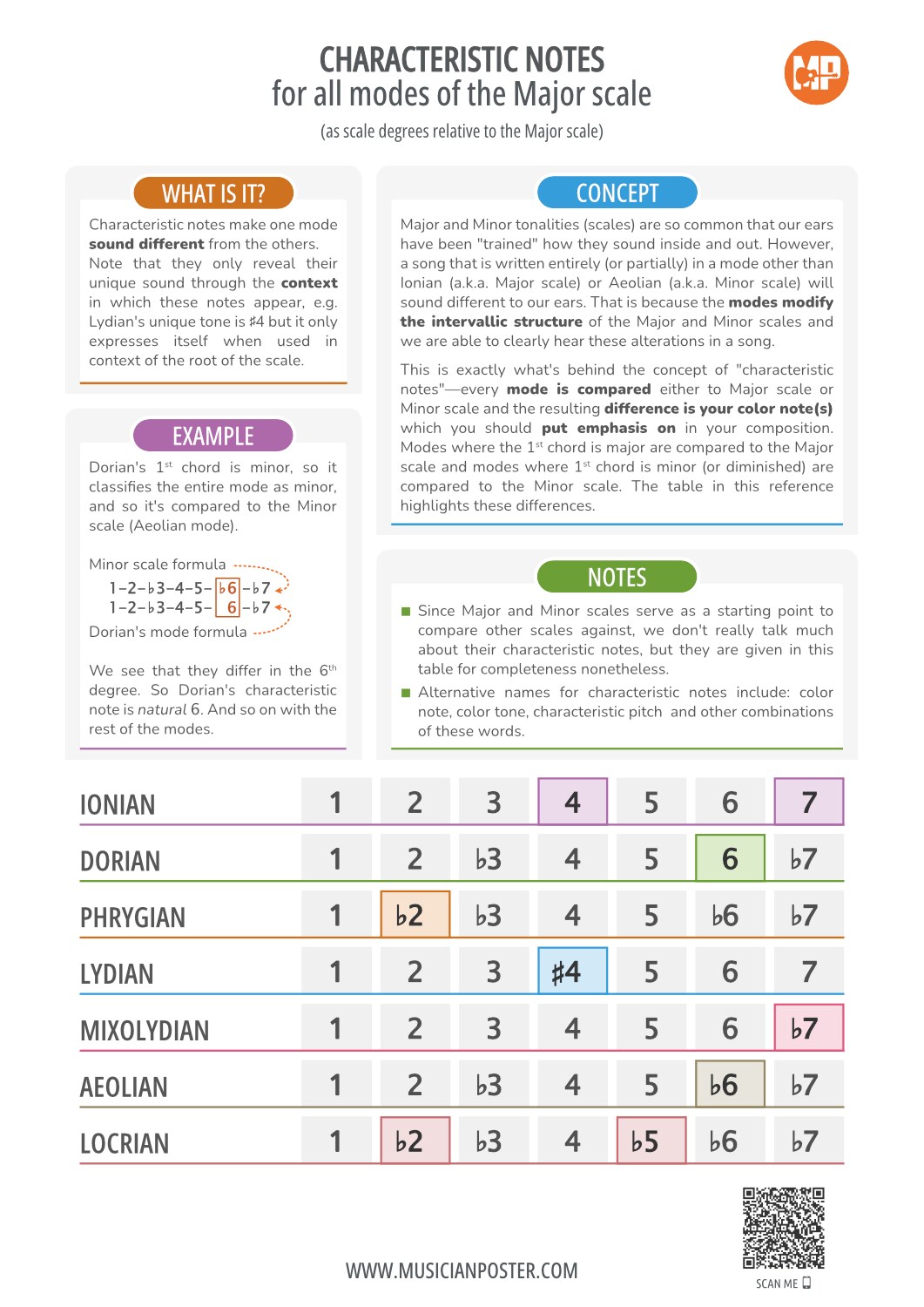
Rather than memorizing seven different note patterns, this approach allows you to think in terms of simple alterations. For example, "Dorian = Minor with a raised 6th."
A Systematic Framework: The Spectrum of Brightness
Before we dissect each mode, it's helpful to have a framework for organizing them. Your physics background gives you an appreciation for ordered systems, and modes are no different. They can be arranged on a continuous spectrum from "brightest" to "darkest" based on the number of raised (sharp/natural) or lowered (flat) notes they contain relative to the major scale.
The following blog post, written by mathematical physicist John Baez, provides a concise explanation of this concept. It's a perspective you will likely find intuitive.
Modes (Part 1) - Azimuth - WordPress.com
This article frames the modes in a way that should resonate with a scientific mindset, organizing them by a quantifiable property: the number of alterations from a baseline.
Read the section beginning with the discussion on brightness and darkness. Pay attention to the chart that lists the modes from Lydian (brightest) to Locrian (darkest). This ordering is not arbitrary; it's a systematic progression.
The general principle is:
- Lydian (one sharp) is brighter than Ionian (major).
- Modes become progressively "darker" as we introduce more flats, following a specific order (♭7, then ♭3, then ♭6, etc.).
This gives us the following order, from brightest to darkest:
Lydian → Ionian → Mixolydian → Dorian → Aeolian → Phrygian → Locrian
The Modes and Their Defining Notes
Now, let's go through each mode in this bright-to-dark sequence, identifying its parent scale and characteristic note. The following video is an excellent guide. We will watch it section by section as we discuss each mode.
MODES: How to Understand & Actually Use Them | Music Theory
The video "MODES: How to Understand & Actually Use Them" by Ryan Leach clearly explains each mode by relating it to a parallel major or minor scale and highlighting its unique characteristic note.
First, watch the introduction from 0:50 to 1:55 for a great overview of this "parallel" approach. We will then proceed through the modes one by one.
The Major Modes
These modes all contain a major third, giving them a generally "major" or "happy" quality. Their reference scale is the major scale (Ionian).
-
Lydian Mode (Brightest)
- Watch:
Lydian section in the Ryan Leach video. - Formula: 1, 2, 3, #4, 5, 6, 7
- Comparison: Major scale with a raised fourth.
- Characteristic Note: The sharp fourth (#4). This creates an augmented fourth (tritone) interval above the root, giving Lydian its uniquely bright, ethereal, and "uplifting" sound.
- Watch:
-
Ionian Mode
- Watch:
Ionian section . - Formula: 1, 2, 3, 4, 5, 6, 7
- Comparison: This is the major scale. It has no alterations and serves as our baseline for brightness.
- Watch:
-
Mixolydian Mode
- Watch:
Mixolydian section . - Formula: 1, 2, 3, 4, 5, 6, ♭7
- Comparison: Major scale with a lowered seventh.
- Characteristic Note: The flat seventh (♭7). This removes the "leading tone" quality of the major scale's 7th degree, resulting in a sound that is still major but smoother, more "bluesy," and less conventionally resolved.
- Watch:
The Minor Modes
These modes all contain a minor third, giving them a generally "minor," "darker," or "sad" quality. Their reference scale is the natural minor scale (Aeolian).
-
Dorian Mode
- Watch:
Dorian section . - Formula: 1, 2, ♭3, 4, 5, 6, ♭7
- Comparison: Natural minor scale with a raised sixth.
- Characteristic Note: The natural sixth (6). A standard minor scale has a flat sixth (♭6). The presence of this major sixth interval gives Dorian a unique quality—it's minor, but with a surprising lift or "heroic" brightness.
- Watch:
-
Aeolian Mode
- Watch:
Aeolian section . - Formula: 1, 2, ♭3, 4, 5, ♭6, ♭7
- Comparison: This is the natural minor scale. It is our baseline for the minor modes.
- Watch:
-
Phrygian Mode
- Watch:
Phrygian section . - Formula: 1, ♭2, ♭3, 4, 5, ♭6, ♭7
- Comparison: Natural minor scale with a lowered second.
- Characteristic Note: The flat second (♭2). This creates a tense minor second interval right above the root, giving the mode a distinctly dark, "Spanish," or "exotic" sound.
- Watch:
The Diminished Mode
- Locrian Mode (Darkest)
- Watch:
Locrian section . - Formula: 1, ♭2, ♭3, 4, ♭5, ♭6, ♭7
- Comparison: Phrygian scale with a lowered fifth. (Or, Natural minor with a ♭2 and ♭5).
- Characteristic Notes: The flat fifth (♭5) is the most significant. The presence of a diminished fifth (tritone) above the root makes the tonic chord unstable, which is why this mode is the least common in tonal music. It shares the flat second (♭2) with Phrygian.
- Watch:
The image below shows these characteristic notes on the staff, providing a helpful visual anchor.

Summary
To consolidate this, here is a summary of all seven modes, their parent scale type, their characteristic alteration, and their full interval formula. This is the key information to take away from this lesson.
| Mode (Bright to Dark) | Type | Characteristic Note (vs. Parent) | Formula (1 2 3 4 5 6 7) |
|---|---|---|---|
| Lydian | Major | #4 | 1, 2, 3, #4, 5, 6, 7 |
| Ionian | Major | (Baseline) | 1, 2, 3, 4, 5, 6, 7 |
| Mixolydian | Major | ♭7 | 1, 2, 3, 4, 5, 6, ♭7 |
| Dorian | Minor | Natural 6 | 1, 2, ♭3, 4, 5, 6, ♭7 |
| Aeolian | Minor | (Baseline) | 1, 2, ♭3, 4, 5, ♭6, ♭7 |
| Phrygian | Minor | ♭2 | 1, ♭2, ♭3, 4, 5, ♭6, ♭7 |
| Locrian | Diminished | ♭2 and ♭5 | 1, ♭2, ♭3, 4, ♭5, ♭6, ♭7 |
For a final review, watch this quick recap from the Ryan Leach video.
MODES: How to Understand & Actually Use Them | Music Theory
This short segment provides a perfect summary of what we've just covered.
Watch the final recap from 7:46 to 8:23. It reinforces the idea of remembering each mode by its single "special" note.
Conclusion
Today we have moved beyond simply generating modes to truly understanding their construction. By focusing on the "parallel" comparison, we have seen that each mode's distinct identity comes from a single characteristic note that alters it from a familiar major or minor scale. This efficient, "delta-based" view is the most powerful way to internalize the modes for practical use in composition and improvisation.
Key Takeaways:
- Modes can be organized on a spectrum from "bright" to "dark" based on their alterations relative to the major scale: Lydian, Ionian, Mixolydian, Dorian, Aeolian, Phrygian, Locrian.
- Lydian's character comes from its #4.
- Mixolydian's character comes from its ♭7.
- Dorian's character comes from its natural 6 (in a minor context).
- Phrygian's character comes from its ♭2.
- Locrian's unstable character comes from its ♭5.
- Ionian (major) and Aeolian (natural minor) serve as the un-altered baselines for their respective groups.
In our next lesson, we will explore the subjective side of these structural differences. We will describe the specific moods and tonal qualities these characteristic notes create and begin to see how they are strategically employed in house, techno, and other electronic genres to evoke particular feelings and textures.