Introduction
In our previous lesson, we established that a scale's unique character arises from its intervallic structure, specifically the arrangement of intervals relative to its root note. We saw that modes are essentially "rotations" of a parent scale—they share the same total set of intervals but sound vastly different because the tonal center has shifted.
Today, we will formalize this concept by focusing on the primary method of generating these modes. This lesson is dedicated to deriving the seven diatonic modes—Ionian, Dorian, Phrygian, Lydian, Mixolydian, Aeolian, and Locrian—directly from a single parent major scale. We will explore how this process, which is akin to changing the origin of a coordinate system within a fixed set of points, gives rise to a family of seven distinct but related scales.
The Architectural Blueprint: Justifying the Parent Scale
Before we can derive modes from the major scale, it's worth asking a fundamental question that should appeal to your physics background: why is the major scale structured the way it is? Its pattern of whole and half steps (W-W-H-W-W-W-H) is not arbitrary. It can be derived from the physical properties of sound, specifically the harmonic series.
The following resource, "A Scientific Theory of Music" by Guangyu Xu, provides a concise derivation of the major scale from first principles. It demonstrates that the scale's structure naturally emerges from interlocking the most consonant interval found in nature—the perfect fifth (a 3:2 frequency ratio).
[PDF] A Scientific Theory of Music - Guangyu Xu
This paper connects the abstract structure of the major scale back to its physical origins in the harmonic series, providing a rigorous foundation for its use as a parent scale.
Please read the section titled 3.2 The Major Scale. Focus on Figure 7 and the accompanying explanation, which illustrates how three major triads, built on notes a perfect fifth apart, combine to form the major scale. This process of combining acoustically pure intervals is what gives the major scale its inherent stability and makes it the foundational "parent" for Western harmony.
This derivation solidifies the major scale not just as a convention, but as a structure with deep roots in psychoacoustics. It is this well-formed blueprint that we will now use to generate its seven modal children.
The Seven Modes: A Family of Rotations
The process of deriving the modes is straightforward. We take the notes of a single parent major scale and create seven new scales by starting on each successive degree, while using the exact same set of pitches.
The simplest example uses the C major scale, which contains all the white keys on the piano: C, D, E, F, G, A, B.
- Starting on C (the 1st degree) gives us C-D-E-F-G-A-B-C. This is the C Ionian mode, which is identical to the C major scale.
- Starting on D (the 2nd degree) gives us D-E-F-G-A-B-C-D. This is the D Dorian mode.
- Starting on E (the 3rd degree) gives us E-F-G-A-B-C-D-E. This is the E Phrygian mode.
- Starting on F (the 4th degree) gives us F-G-A-B-C-D-E-F. This is the F Lydian mode.
- Starting on G (the 5th degree) gives us G-A-B-C-D-E-F-G. This is the G Mixolydian mode.
- Starting on A (the 6th degree) gives us A-B-C-D-E-F-G-A. This is the A Aeolian mode, which is identical to the natural minor scale.
- Starting on B (the 7th degree) gives us B-C-D-E-F-G-A-B. This is the B Locrian mode.
The following image provides a clear visual representation of this process on the musical staff.

To solidify this concept, please review the following short text, which summarizes this "relative" method of defining modes.
Music Theory using Tone.js - Play Modes
This webpage offers a concise summary of the concept of a parent scale and its derived modes.
Read the main introductory paragraph and review the bulleted list showing the seven modes derived from C major. The key idea here is that while the notes are the same, the "key center" for each mode is different, which changes its entire character.
Unifying Two Perspectives: Relative vs. Parallel
You now understand the "relative" method: D Dorian is the mode relative to C major that starts on the second degree. However, in the previous lesson, we introduced the "parallel" method: analyzing a mode by comparing it to a major or minor scale with the same root (e.g., comparing D Dorian to D major or D minor).
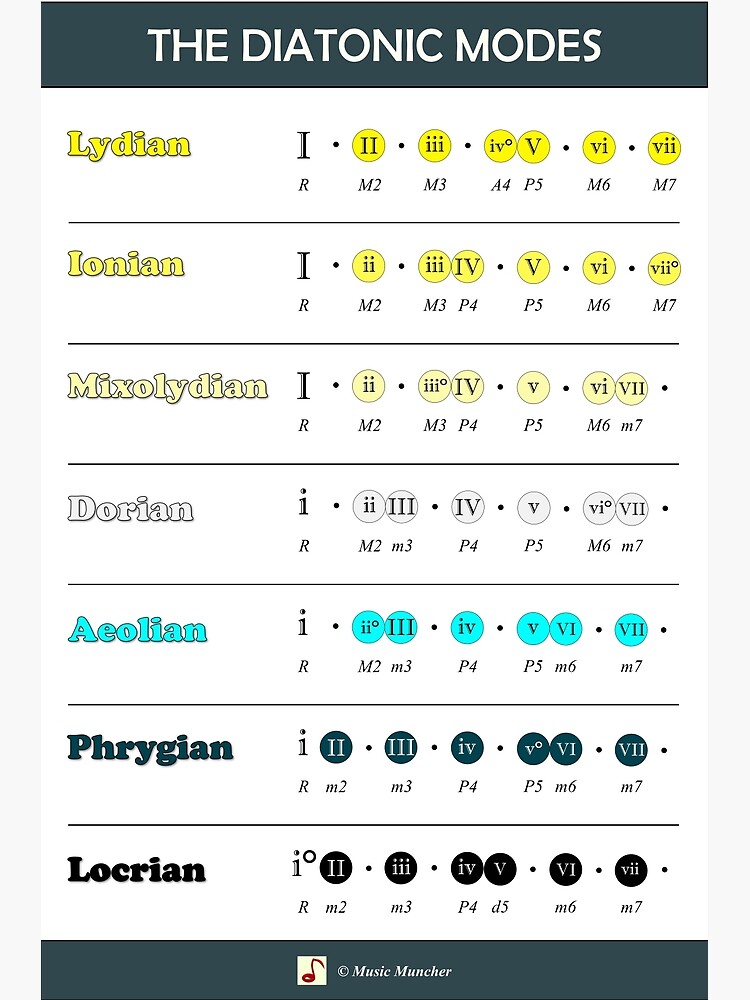
These are not competing theories; they are two complementary ways of describing the same phenomenon. Thinking relatively helps you find the notes of a mode, while thinking in parallel helps you understand its unique sound and character. The following video brilliantly demonstrates how these two perspectives are linked.
MODES ARE WAY EASIER THAN YOU THINK. Here's why.
In "MODES ARE WAY EASIER THAN YOU THINK," Charles Cornell reconciles the traditional "relative" derivation with the more practical "parallel" approach of using formulas.
First, watch the segment from 3:12 to 4:06, where the presenter describes the traditional derivation method you've just learned and explains why it can be confusing on its own. Next, watch the crucial section from 6:49 to 11:35. Here, he shows the equivalence of the two methods. For example, he demonstrates that playing the notes of C major from E to E (E Phrygian, the relative view) produces the exact same scale as taking the E major scale and applying the formula 1, ♭2, ♭3, 4, 5, ♭6, ♭7 (the parallel view). This synthesis is the key to truly understanding modes. Finally, watch his summary of all seven modes played from C, with their parallel formulas, from 12:15 to 13:29.
This video makes it clear that saying "D Dorian is the second mode of C major" is mathematically identical to saying "D Dorian is a D minor scale with a major sixth." The first statement tells you how to find the notes within a parent key, while the second tells you what makes the scale sound unique.
Conclusion
In this lesson, we have systematically derived the seven diatonic modes from their parent major scale. We've seen that this process is a logical rotation of a tonal center within a fixed set of pitches—a set whose own structure is grounded in the physics of the harmonic series.
Key Takeaways:
- The major scale, with its W-W-H-W-W-W-H structure, can be derived from interlocking major triads, which themselves are born from the harmonic series.
- The seven diatonic modes are generated by using each of the seven degrees of a parent major scale as a new starting note or tonic.
- The "relative" view (e.g., D Dorian is the 2nd mode of C major) and the "parallel" view (e.g., D Dorian is a minor scale with a raised 6th) are two equivalent and complementary ways of understanding modes. The relative view helps find the notes, while the parallel view explains the sound.
- The seven modes are: Ionian (major), Dorian, Phrygian, Lydian, Mixolydian, Aeolian (natural minor), and Locrian.
We have now laid the complete theoretical groundwork. In our next lesson, we will shift our focus entirely to the "parallel" perspective. We will identify the single characteristic note that gives each mode its unique flavor and begin exploring how these distinct tonal colors are used in the electronic music genres you're interested in.