Introduction
In our last lesson, we established that 12-tone equal temperament (12-TET) is the foundational compromise that makes modern music possible, providing a closed system of 12 discrete, equally-spaced pitches per octave. This gives us our fundamental "alphabet" of notes. Now, we will explore how selecting a specific subset of these notes—forming a scale—creates a distinct sonic and emotional character.
This lesson directly addresses how the specific arrangement of intervals within a scale defines its tonal quality. We will move beyond simple descriptions like "happy" or "sad" to a more structural analysis. Given your background in physics and mathematics, you'll find that we can quantify a scale's character through its "intervallic fingerprint." We will see that a scale is not merely a collection of pitches, but a carefully constructed web of intervallic relationships, and it is this structure that gives each scale its unique identity and musical potential.
The Intervallic Fingerprint of a Scale
Let's begin with the most common scale in Western music: the major scale. Its familiar sound is a direct result of its interval pattern. As you know, it's built from a sequence of whole (W) and half (H) steps: W-W-H-W-W-W-H. In terms of semitones, this pattern is [2, 2, 1, 2, 2, 2, 1].
While this step pattern is useful, a more powerful way to analyze a scale's character is to catalogue all the intervals formed between all of its notes. This complete inventory is often called an interval vector or interval spectrum. It's a quantitative "fingerprint" that reveals the intrinsic character of a scale.
A fascinating and highly structured way to approach this is presented in Ian Ring's "A study of musical scales." This resource formalizes the analysis in a way that should resonate with your scientific background.
A study of musical scales by Ian Ring
This resource introduces a systematic method for analyzing the intervallic content of any collection of notes, which the author Howard Hanson argued defines the character of a sonority.
Please read the section titled Interval Spectrum / Richness / Interval Vector. Start by understanding Hanson's core idea and his classification of intervals into six types: p (perfects), m (major thirds/minor sixths), n (minor thirds/major sixths), s (seconds/sevenths), d (semitones/major sevenths), and t (tritones). Then, examine the table of scales and their interval spectrums. Find the entry for the Major scale (2741 in this system's numerical notation). You'll see its spectrum is p6m3n4s5d2t. What's crucial to notice is that the other diatonic modes like Dorian, Phrygian, and Aeolian all share this exact same spectrum.
This is a profound insight. All the standard diatonic modes (which we'll explore next) are built from the exact same intervallic raw material:
- 6 perfect fourths/fifths
- 3 major thirds/minor sixths
- 4 minor thirds/major sixths
- 5 major seconds/minor sevenths
- 2 minor seconds/major sevenths
- 1 tritone
This raises a critical question: If scales like the bright, happy Major scale and the somber, sad minor scale are made of the same interval "kit," why do they feel so different? The answer lies not just in what intervals are present, but in how they are arranged relative to the root note.
The Power of the Root: How Modes Get Their Character
Modes are created by taking a single set of notes (like the white keys on a piano, which form the C Major scale) and simply starting on a different note. In more formal terms, a mode is a rotation of a parent scale. While the total interval content remains the same, the sequence of intervals starting from the new root note changes, drastically altering the scale's mood and function.
The video below offers an excellent and practical introduction to this concept. It explains each mode by comparing it to its more familiar major or minor counterpart and identifying the single characteristic note responsible for its unique sound.
MODES: How to Understand & Actually Use Them | Music Theory
This video, "MODES: How to Understand & Actually Use Them" by Ryan Leach, provides a clear, musically-grounded explanation of how a single interval change defines each mode's character.
First, watch the introduction from 00:50 to 01:55 to understand the approach of thinking about modes relative to major and minor scales. Then, watch the breakdowns for each of the seven modes. As you watch, focus on the specific interval formula and the description of the resulting sound: Ionian (Major): 1-2-3-4-5-6-7 (our baseline for bright scales) Lydian: Major with a #4. Notice how this augmented 4th creates a "lifting" or "magical" quality. Mixolydian: Major with a b7. The minor 7th gives it a "smoother," bluesy, or less conclusive feel. Aeolian (Natural Minor): 1-2-b3-4-5-b6-b7 (our baseline for dark scales) Dorian: Minor with a natural 6. This major 6th in a minor context creates a "serious but heroic" or "cool" sound, very common in funk and house music. Phrygian: Minor with a b2. The tense minor 2nd right above the root gives it a dark, "sinister" character, often used in metal. Locrian: Minor with a b2 and b5. The diminished 5th (a tritone) against the root makes it sound highly unstable and dissonant. The video's final recap nicely summarizes these characteristic notes.
Let's formalize this. The "tonal quality" of a scale is determined by the specific intervals formed between the root (the tonal center) and every other note in the scale.
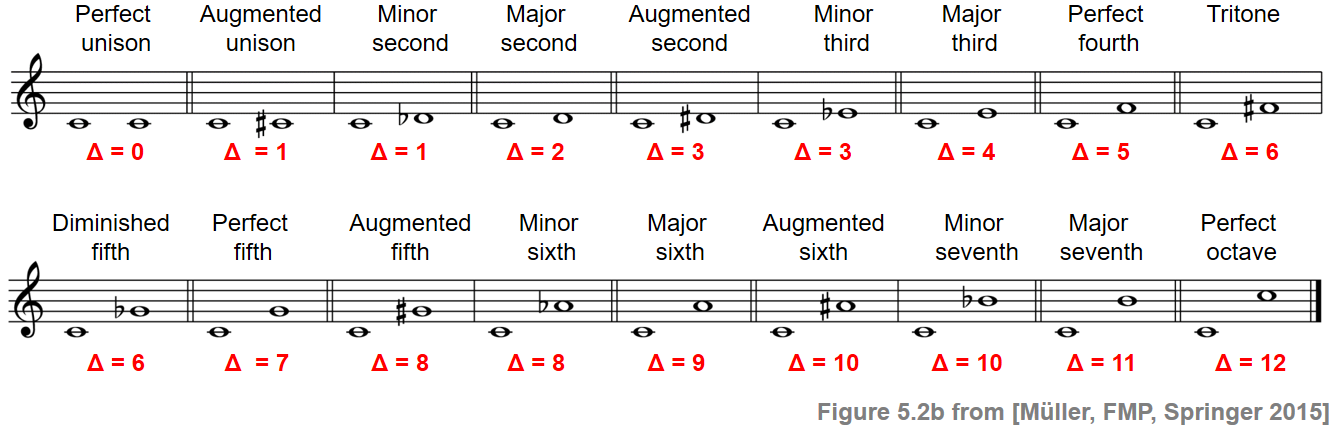
A Deeper Analysis: Structure, Symmetry, and Sound
We can push this structural analysis further. Concepts from mathematics and physics provide powerful analogies for understanding why certain scales have particular properties. The same resource by Ian Ring explores several of these.
Evenness
The "evenness" of a scale refers to how uniformly its notes are distributed across the octave.
- Perfectly even scales, like the Chromatic scale (12 notes), Whole Tone scale (6 notes), and Diminished scale (8 notes), have a tonally ambiguous and "floating" quality because no single note feels like a stronger tonal center than any other. They lack the push-and-pull of unevenly spaced scales.
- Maximally even scales are those that are as evenly distributed as possible for a given number of notes. The diatonic scale (7 notes) and pentatonic scale (5 notes) are maximally even. This balance of evenness and unevenness gives them a strong sense of direction and tonality.
Hemitonia and Tritonia
This refers to the presence or absence of semitones (hemitonic) and tritones (tritonic).
- Anhemitonic scales, like the major pentatonic scale (C-D-E-G-A), lack semitones. This contributes to their open, pleasant, and "mistake-proof" sound, as they avoid the most acute dissonances.
- Hemitonic scales, like the major scale, contain semitones (E-F and B-C). These intervals create points of tension that are fundamental to creating melodic direction and resolution.
- The tritone is the most dissonant interval within the octave. Its placement is critical. In the major scale, the single tritone occurs between the 4th and 7th degrees (e.g., F and B in C Major). In Locrian mode, the tritone occurs between the root and the 5th degree, which is why it sounds so unstable.
Your interest in industrial and noise music makes this particularly relevant. These genres often exploit scales with high degrees of hemitonia and prominent tritones to create deliberate tension and dissonance.
The Physics of Intervallic Structure
These structural properties aren't just abstract theory; they have direct physical consequences related to the harmonic series and beating, which we've touched on before. The choice of tuning system determines how "pure" the intervals in a scale are.
As you learned in the previous lesson, 12-TET is a compromise. No interval is perfectly "just" (based on simple integer frequency ratios), except the octave. However, it offers a crucial advantage: consistency.
Let's examine a resource written from a physicist's perspective.
[PDF] The physics of musical scales: Theory and experiment
This paper from the American Journal of Physics provides visual data on how intervals in different tuning systems deviate from pure, beat-less ratios.
Focus on the section VI. CIRCULATING SCALES and examine Figure 3. Compare plot (a) for Equal Temperament with plots (b), (c), and (d). In 12-TET, the deviation for any given interval type (e.g., major third) is constant, regardless of the key. In the other temperaments, some intervals are perfectly just (0 cents deviation), while others are wildly dissonant ("wolf intervals").

This consistency is why we can analyze the inherent intervallic structure of a scale in 12-TET and know that its characteristic sound will be preserved when we transpose it. The "bright" quality of Lydian or the "dark" quality of Phrygian is a stable, predictable property of their structure within our modern tuning system. The slight, uniform "out-of-tuneness" of 12-TET becomes a constant background, allowing the unique intervallic relationships within each scale to define its character.
Conclusion
Today, we've established a framework for understanding and analyzing the unique character of any scale. It's not magic or mere cultural convention; it's a direct consequence of the scale's underlying intervallic structure.
Key Takeaways:
- A scale's tonal quality is determined by its intervallic structure—the specific collection and arrangement of intervals it contains.
- An interval vector serves as a quantitative "fingerprint" of a scale, cataloging all of its intervals.
- Modes are rotations of a parent scale. While they share the same interval vector, they sound distinct because the intervals are arranged differently relative to the root note.
- Each mode has a characteristic note—a single interval relative to the root that defines its unique flavor (e.g., the #4 in Lydian, the b2 in Phrygian).
- Deeper structural properties like evenness (how uniformly notes are spaced) and the presence of semitones (hemitonia) and tritones provide further analytical tools to predict a scale's character.
- 12-TET provides a consistent framework where these structural properties are preserved across all keys, making them reliable compositional tools.
With this analytical foundation, you are now equipped to dissect any scale you encounter and understand the source of its sonic identity. In our next module, we will begin a systematic exploration of the seven diatonic modes, putting this theory into practice to see how each can be used to craft melodies and harmonies with specific emotional intent.