Introduction
Welcome to the fifth module of our course. Having spent the last module exploring the broad harmonic landscapes of modes, we now shift our focus from the macroscopic to the microscopic. We will dissect the fundamental particles of Western harmony: chords. This lesson begins that process by examining the most basic and ubiquitous chord form, the triad.
You've already encountered triads practically in your guitar and keyboard playing, and you've used them to harmonize modes in our previous capstone project. Today, your learning outcome is to move beyond pattern recognition and learn to construct the four primary types of triads—major, minor, diminished, and augmented—by systematically stacking major and minor third intervals. We will not only cover the mechanics of this construction but also delve into the mathematical and physical principles that explain why these specific structures are so foundational to music, connecting directly to the concepts of frequency ratios we explored in our first module.
The Anatomy of a Triad: Stacking Thirds
At its core, a triad is a three-note chord. While many combinations of three notes are possible, the triads that form the bedrock of Western harmony are all built using a consistent principle: stacking intervals of a third.
There are two types of thirds we will use as our building blocks:
- A Major Third (M3), which spans 4 semitones.
- A Minor Third (m3), which spans 3 semitones.
By combining these two intervals in different ways, we can generate all four primary triad qualities. The following video provides a clear and concise explanation of this process.
In this video, "Every Triad chord EXPLAINED," David Bennett offers two ways to think about triads. We're going to focus on his second, more systematic definition.
Please watch the segment from the four main types of Triad. Pay close attention to how he defines each of the four triad qualities (major, minor, diminished, augmented) as a unique combination of stacked major and minor thirds.
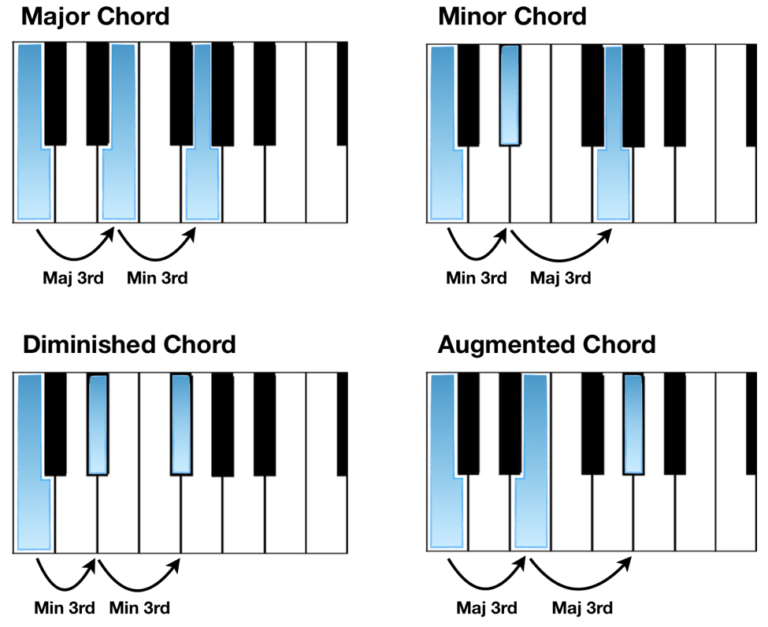
Let's formalize the constructions you just saw. Starting from a root note, we stack two thirds on top of it. The specific combination of major and minor thirds determines the triad's quality:
- Major Triad: Major Third + Minor Third (e.g., C-E-G is M3 + m3)
- Minor Triad: Minor Third + Major Third (e.g., C-Eb-G is m3 + M3)
- Diminished Triad: Minor Third + Minor Third (e.g., C-Eb-Gb is m3 + m3)
- Augmented Triad: Major Third + Major Third (e.g., C-E-G# is M3 + M3)
The image below provides a helpful visual reference for these four structures on a keyboard.
To solidify this concept, let's explore another resource that reinforces these definitions and provides practical examples of building them from scratch.
This article from monotonum.com provides a very direct summary of the triad definitions.
Read the section titled "Triads". This will reinforce the "stack of thirds" formula for each chord type. Note the observation about the dissonant tritone within the diminished triad—an important characteristic we'll return to.
The Physics of Triads: From Intervals to Ratios
You now have the procedural knowledge to build any triad. However, the question remains: why these specific combinations? Why is a stack of a major and minor third (a major triad) so stable and ubiquitous, while a stack of two major thirds (an augmented triad) is unstable and tense? Given your physics background, the underlying relationship between these interval stacks and their frequency ratios in Just Intonation will be particularly illuminating.
Recall from our first module that consonant intervals correspond to simple integer frequency ratios. Let's revisit this through the lens of a highly relevant academic paper.
[PDF] Mathematical Harmony Analysis - arXiv.org
This paper from arXiv.org provides a rigorous mathematical framework for analyzing harmony, perfectly suited to your interests. We will be referencing it throughout the course.
For now, read the passage that starts in the literature review. Focus on how the expansion of "musical numbers" to include 5 and 6 led to the definition of the major third as a 5:4 ratio and the minor third as a 6:5 ratio. Crucially, notice Zarlino's identification of the major triad with the elegant 4:5:6 ratio.
This 4:5:6 ratio is the key. Let's see how our "stack of thirds" construction directly produces it.
- We start with a root note, which we can represent by the number 4 in our ratio. Let's call its frequency .
- We stack a major third on top. The frequency of this new note is . This corresponds to the number 5 in our ratio.
- We then stack a minor third on top of that second note. The frequency of our third note is . The and cancel out, leaving . This corresponds to the number 6 in our ratio.
Thus, the procedure of stacking a major third and a minor third generates notes with frequencies in the ratio 4:5:6. This is not just an abstract mathematical curiosity. This exact ratio appears directly in the natural harmonic series.
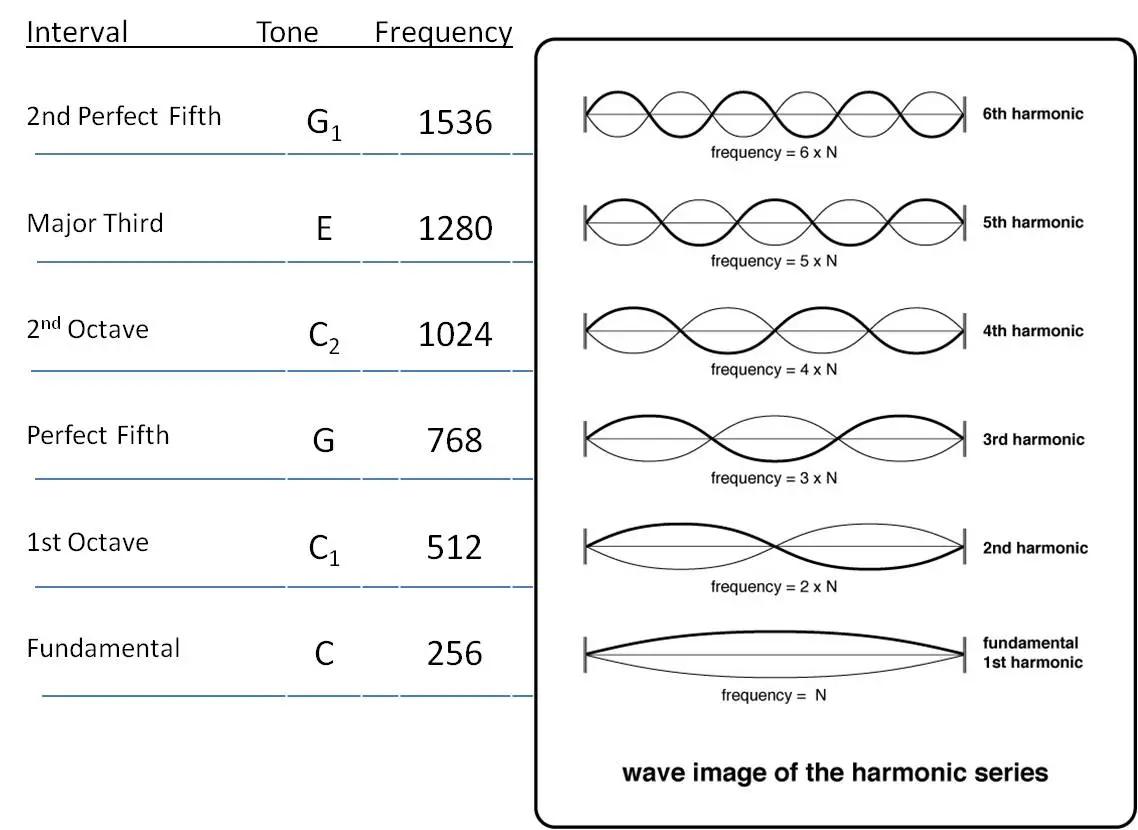
If you play a C2, the 4th, 5th, and 6th partials naturally ringing above it are C4, E4, and G4—a C major chord. The stability and "rightness" of the major triad stems from its identity as a direct, simple structure found within the physics of a single vibrating string or air column.
What about the minor triad? Its construction (minor third + major third) gives frequency ratios of . To express this with integers, we find the least common multiple of the denominators (1, 5, 2), which is 10, and multiply through:
While not as simple as 4:5:6, this is still a ratio of relatively small integers, explaining the minor triad's comparable stability and prevalence. In the "Mathematical Harmony Analysis" paper (Table 1, section 5), you can see that both the major triad (4, 5, 6) and the minor triad (10, 12, 15) share the same low "Complexity" value of 60, a mathematical measure of consonance. In contrast, more dissonant chords have much higher complexity values.
Practical Construction
Let's put this into practice. To build any triad, follow these steps:
- Start on your chosen root note.
- Count up the required semitones for the first third (4 for major, 3 for minor).
- From that second note, count up the required semitones for the second third.
Let's try a few examples. Your task is to fill in the notes for the following triads.
| Triad to Construct | Root | Second Note (The Third) | Third Note (The Fifth) | Semitone Recipe |
|---|---|---|---|---|
| G Major | G | ? | ? | M3 (4) + m3 (3) |
| A Minor | A | ? | ? | m3 (3) + M3 (4) |
| F# Diminished | F# | ? | ? | m3 (3) + m3 (3) |
| Bb Augmented | Bb | ? | ? | M3 (4) + M3 (4) |
Click to reveal the answers
| Triad to Construct | Root | Second Note (The Third) | Third Note (The Fifth) | Semitone Recipe |
|---|---|---|---|---|
| G Major | G | B | D | G -> (+4) -> B -> (+3) -> D |
| A Minor | A | C | E | A -> (+3) -> C -> (+4) -> E |
| F# Diminished | F# | A | C | F# -> (+3) -> A -> (+3) -> C |
| Bb Augmented | Bb | D | F# | Bb -> (+4) -> D -> (+4) -> F# |
This mechanical skill is essential for quickly programming chords in your DAW. For more examples and a visual demonstration of modifying triads on the piano, the following video is an excellent supplement.
Triads: Everything You Need To Know.
This video, "Triads: Everything You Need To Know," provides a great piano-based visualization and more worked examples.
You can watch the short segment on visualizing on the piano to see how these chords are just slight modifications of each other. Then, if you'd like more practice, the section from writing a triad walks through constructing triads on D and A-flat, which involves thinking about key signatures and accidentals.
Conclusion
In this lesson, you have learned the fundamental principle of triad construction: the stacking of thirds. We established that the four primary triad qualities—major, minor, diminished, and augmented—are simply the products of the four possible combinations of major and minor third intervals.
More importantly, we connected this procedural rule to the physics of sound, demonstrating that the consonant and stable nature of major and minor triads is a direct consequence of their structure being described by simple integer frequency ratios, ratios that are physically present in the natural harmonic series.
Key Takeaways:
- Triads are three-note chords built by stacking two third intervals.
- Major Triad = Major 3rd + Minor 3rd. Its Just Intonation ratio is 4:5:6.
- Minor Triad = Minor 3rd + Major 3rd. Its Just Intonation ratio is 10:12:15.
- Diminished Triad = Minor 3rd + Minor 3rd. Contains a highly dissonant tritone.
- Augmented Triad = Major 3rd + Major 3rd. Symmetrical and tonally ambiguous.
- The prevalence of major and minor triads is rooted in their low "Complexity" and their direct relationship to the harmonic series.
In our next lesson, we will continue this constructive process. By stacking another third on top of our triads, we will build the richer, more complex, and versatile family of seventh chords, which are essential for adding depth and color to your harmonic progressions.