Introduction
In our last lesson, we deconstructed chords into their various inversions, learning to identify them regardless of which note was in the bass. We saw that a C major triad remains a C major triad whether the notes are stacked as C-E-G, E-G-C, or G-C-E. This naturally leads to the question: if they are the same chord, why and when should we use these different voicings?
This lesson answers that question by introducing the concept of voice leading. We will learn how to apply the inversions you now recognize to transform a sequence of chords from a series of disjointed blocks of sound into a fluid, connected, and professional-sounding progression. The central goal is to create smoother motion in all the voices, particularly the bassline, by minimizing the distance each note travels from one chord to the next. This principle is not just an aesthetic choice; as we'll see, it has deep roots in perceptual psychology and even a certain mathematical elegance.
The Principle of Efficient Motion
At its core, voice leading is about efficiency. When you play a chord progression in root position, your hand often has to make large, awkward jumps up and down the keyboard. This can sound clunky and amateurish. Good voice leading minimizes this movement, creating a sense of flow and connection.
Let's start with a practical demonstration. The following video shows a common chord progression in a DAW, first in its "raw" root position form, and then transformed using voice leading.
EDM Chords Tutorial - Triads, Voice Leading & Inversions
This tutorial from Warp Academy, "EDM Chords Tutorial", provides a clear, practical example of applying voice leading in an electronic music context.
Please watch the following segments: First, observe the initial "amateur" sounding progression from the initial analysis. Notice the large jumps between chords. Next, see how the progression is improved by introducing inversions. Pay close attention to how the common note 'C' is kept in the same octave, and how this immediately makes the transition smoother. Finally, listen to the A/B comparison between the original and the final, voice-led progression from the final comparison. The key takeaway here is that by using inversions, we can rearrange the notes of a chord to keep them as close as possible to the notes of the previous chord.
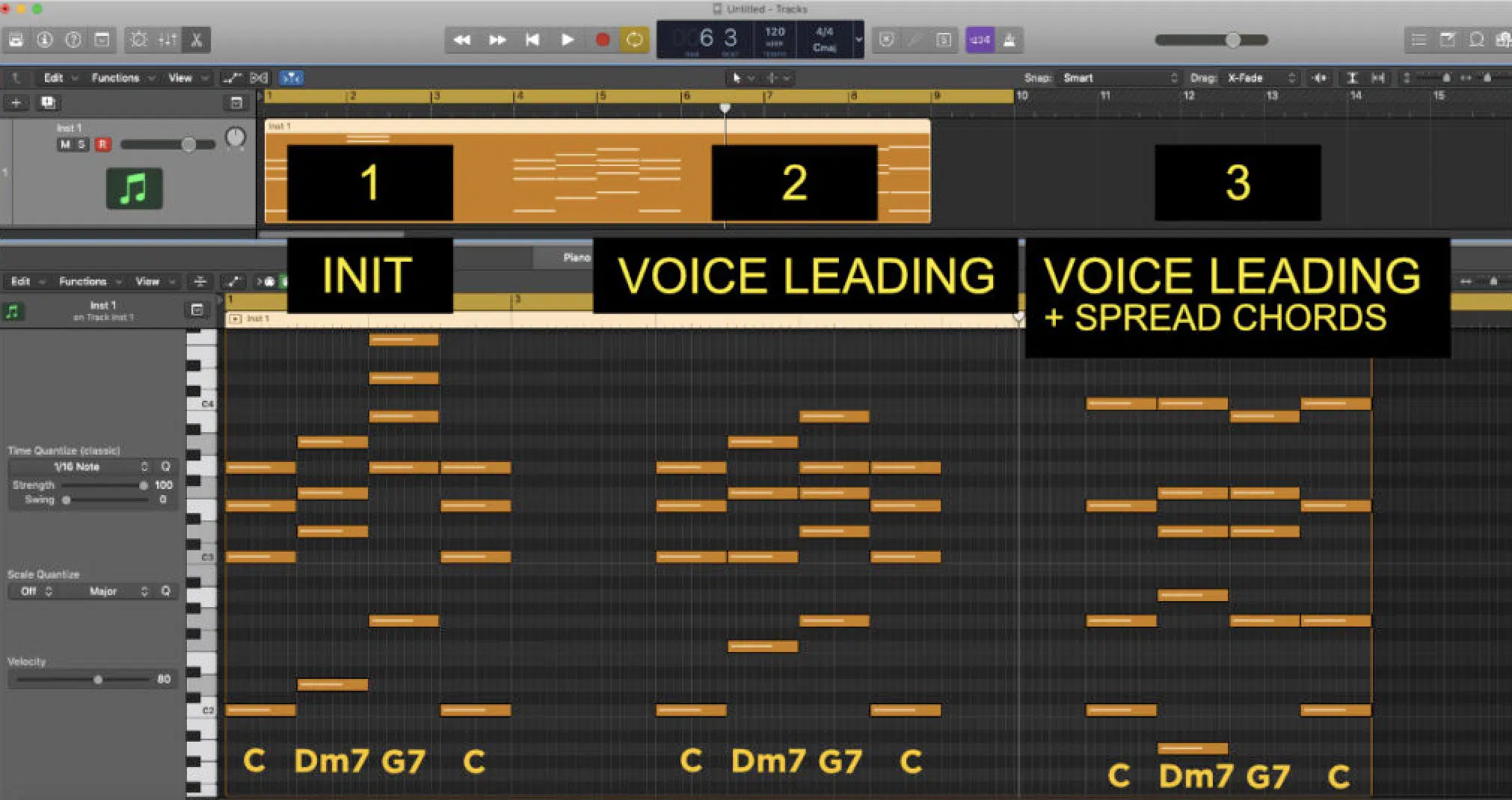
The image below perfectly captures this transformation. On the left (1), we have chords in root position, with large leaps between them. In the middle (2), inversions have been applied to minimize the movement of the individual notes, creating a much more compact and connected sequence.
The Rule of Parsimony: A Framework for Smoothness
The intuitive goal of "minimizing movement" can be formalized into a set of actionable rules, often referred to as the principle of parsimony—a term that will likely appeal to your physics background, echoing ideas like the principle of least action. It's essentially a principle of laziness or efficiency.
There are two primary rules for parsimonious voice leading:
- If a note is common to both chords, keep it in the same voice (and ideally, the same octave). This is called a common tone.
- Move the remaining notes to the nearest possible note in the next chord. This usually means moving by step (a whole or half step).
The next video explains this rule-based approach very clearly.
Where to Begin - Chord Inversions & Voice Leading
In his video "Where to Begin - Chord Inversions & Voice Leading," musician Implied Music frames voice leading as a "rule of laziness" or parsimony.
Watch the section from explaining the rule of parsimony. He outlines the two core ideas: keeping common tones and minimizing movement for the other voices. Then, see how he applies this to a full progression from the demonstration, resulting in "beautiful smooth voice leading."
This method has a dramatic effect on the bassline. When chords are all in root position, the bassline simply jumps from root to root. By using inversions, we can create a much more melodic and conjunct (stepwise) bassline.

The Geometric and Physical Underpinnings of Voice Leading
Why does this "parsimonious" movement sound good? The answer lies in the intersection of mathematics, physics, and psychoacoustics. The work of music theorist Dmitri Tymoczko provides a powerful geometric framework for understanding these principles. You are uniquely positioned to appreciate the rigor of this approach.
Tymoczko represents chords as points in a multi-dimensional space (an orbifold, to be precise). A voice leading is then a path or a set of line segments connecting the points of one chord to the points of another. The "cost" or "size" of a voice leading can be measured by the total length of these paths. Parsimonious voice leading is simply the search for the shortest possible path between two chords.
A key concept in Tymoczko's theory is the distribution constraint.
[PDF] The Geometry of Musical Chords - Dmitri Tymoczko
This highly influential paper by Dmitri Tymoczko formalizes the principles of voice leading using geometry. While the entire paper is quite advanced, we will focus on two key concepts that provide a rigorous foundation for what we've learned.
First, read the paragraph defining the distribution constraint. The core idea is that a given amount of total melodic motion is perceived as "smaller" or smoother when it is distributed evenly among several voices, rather than being concentrated in a single large leap. For instance, moving four voices by one semitone each ({1, 1, 1, 1}) is more efficient than moving one voice by four semitones and the others not at all ({4, 0, 0, 0}). This is analogous to how different vector norms (like the L1 "taxicab" norm vs. the L∞ "max" norm) measure distance. Next, read the section on voice crossings. Here, Tymoczko proves a crucial theorem: if you accept the distribution constraint, then the most efficient (minimal) voice leading between two chords will always be crossing-free. This provides a formal mathematical reason for the long-standing rule in counterpoint to avoid voices crossing over each other—it's not just an arbitrary aesthetic rule, but a consequence of the principle of efficient motion.
In essence, the smooth, pleasing sound of good voice leading is a direct perceptual consequence of its mathematical efficiency. By minimizing the total pitch distance the notes travel, we create connections that are easier for our brains to follow, resulting in a more coherent and elegant musical texture.
For those interested in the computational aspect, Tymoczko's paper also describes a polynomial-time algorithm using dynamic programming to find the minimal voice leading between any two chords. This is detailed in section 8, "A polynomial-time algorithm for finding a minimal voice leading between two chords," and may be a fascinating extension for you to explore given your background in simulations.
Practice Application
Let's apply these principles. Consider the following common chord progression, often called the "axis" progression, written here in root position in the key of C Major:
C major (C-E-G) → G major (G-B-D) → A minor (A-C-E) → F major (F-A-C)
Your task is to re-voice this progression using inversions to achieve the smoothest possible voice leading. In your DAW's piano roll, arrange the notes of each chord to follow the rules of parsimony. Aim to create the smoothest possible bassline.
- Step 1: Look at the transition from C to G. Is there a common tone? Which inversion of G major would place its notes closest to the notes of the C major chord?
- Step 2: Now move from your inverted G chord to A minor. Repeat the process.
- Step 3: Finally, move from your inverted A minor to F major.
Click for a possible solution
While there are multiple "correct" solutions, here is one very effective and common approach:
-
C major (Root Position):
C4 - E4 - G4- We start here.
-
G major (First Inversion):
B3 - D4 - G4- Common Tone: The G4 from the C major chord is kept in the same position.
- Stepwise Motion: E4 moves down by a half step to D4. C4 moves down by a half step to B3.
- Bassline: C → B (a smooth descending step)
-
A minor (Root Position):
A3 - C4 - E4- Stepwise Motion: B3 moves down to A3. D4 moves down to C4. G4 moves up to A4 or down to E4. Let's choose a version that keeps voices compact. A common voicing is
A3 - C4 - E4. The G4 moves to E4 and D4 moves to C4. - Bassline: B → A (another smooth descending step)
- Stepwise Motion: B3 moves down to A3. D4 moves down to C4. G4 moves up to A4 or down to E4. Let's choose a version that keeps voices compact. A common voicing is
-
F major (First Inversion):
A3 - C4 - F4- Common Tones: The A3 and C4 from the A minor chord are kept.
- Stepwise Motion: Only one note moves: E4 moves up a half step to F4.
- Bassline: A → A (the bass note is held, creating a strong anchor)
The resulting progression: C → G/B → Am → F/A
Original Bassline: C - G - A - F (large leaps)
Voice-Led Bassline: C - B - A - A (smooth, stepwise descent)
This creates a much more elegant and connected sound, purely by using inversions intelligently.
Conclusion
This lesson has elevated our understanding of inversions from a simple matter of identification to a powerful tool for musical composition. By applying the principles of voice leading, we can guide the individual notes within our chords along efficient, connected paths.
Key Takeaways:
- Voice leading is the art of creating smooth melodic lines for each voice within a series of chords.
- The primary tools for voice leading are chord inversions.
- The Principle of Parsimony provides a practical framework: keep common tones and move other voices by the smallest possible interval (stepwise motion).
- This practice isn't arbitrary; it is underpinned by mathematical principles of efficiency, as described by the distribution constraint, which favors evenly distributed motion and inherently avoids voice crossings.
- Applying these principles results in smoother basslines and more professional-sounding harmonic progressions.
In the next lesson, we will shift our focus from the abstract notes on the piano roll to their sonic character. We will explore how synthesizer parameters like unison, detuning, and chord stacking can take a well-voiced chord progression and transform it into a thick, rich, and texturally interesting element in your electronic music productions.