Introduction
In our previous lessons, we learned to construct a wide variety of chords, from basic triads to harmonically rich 13th chords, primarily by stacking thirds. This principle of "tertian harmony" gives us the raw material for our music. Now, we will explore a new dimension of harmonic control: the arrangement of these notes. So far, we have mostly dealt with chords in their most basic "stacked thirds" form, known as the root position.
This lesson focuses on chord inversions. We will learn how to identify triads and seventh chords when a note other than the root is in the bass. While an inversion uses the exact same set of pitches as its root position counterpart (e.g., the notes C, E, and G always form a C major triad), changing which note is lowest dramatically alters the chord's texture and its relationship to the surrounding harmony. This skill is fundamental for creating sophisticated chord progressions and basslines in your productions.
What is a Chord Inversion?
A chord is in root position when its root is the lowest-sounding note. For example, the C major triad C-E-G is in root position.
A chord is in an inversion when a note other than the root is in the bass. The identity of the chord remains the same, but its voicing changes.
To understand this concept for triads, the following video provides a clear visual and auditory introduction. The presenter uses the helpful analogy of a "snowman" to describe a chord in root position.
Triads: Everything You Need To Know.
This segment from Brad Harrison Music's "Triads: Everything You Need To Know" defines and demonstrates inversions for three-note chords.
Watch the section from the definition of inversions. Notice how the three chords shown contain the same notes (C, E, G) but have a different note in the bass, creating different "shapes."
Triad Inversions
A triad consists of three unique notes: the root, the third, and the fifth. Consequently, there are three possible positions for any triad, determined by which of these notes is in the bass.
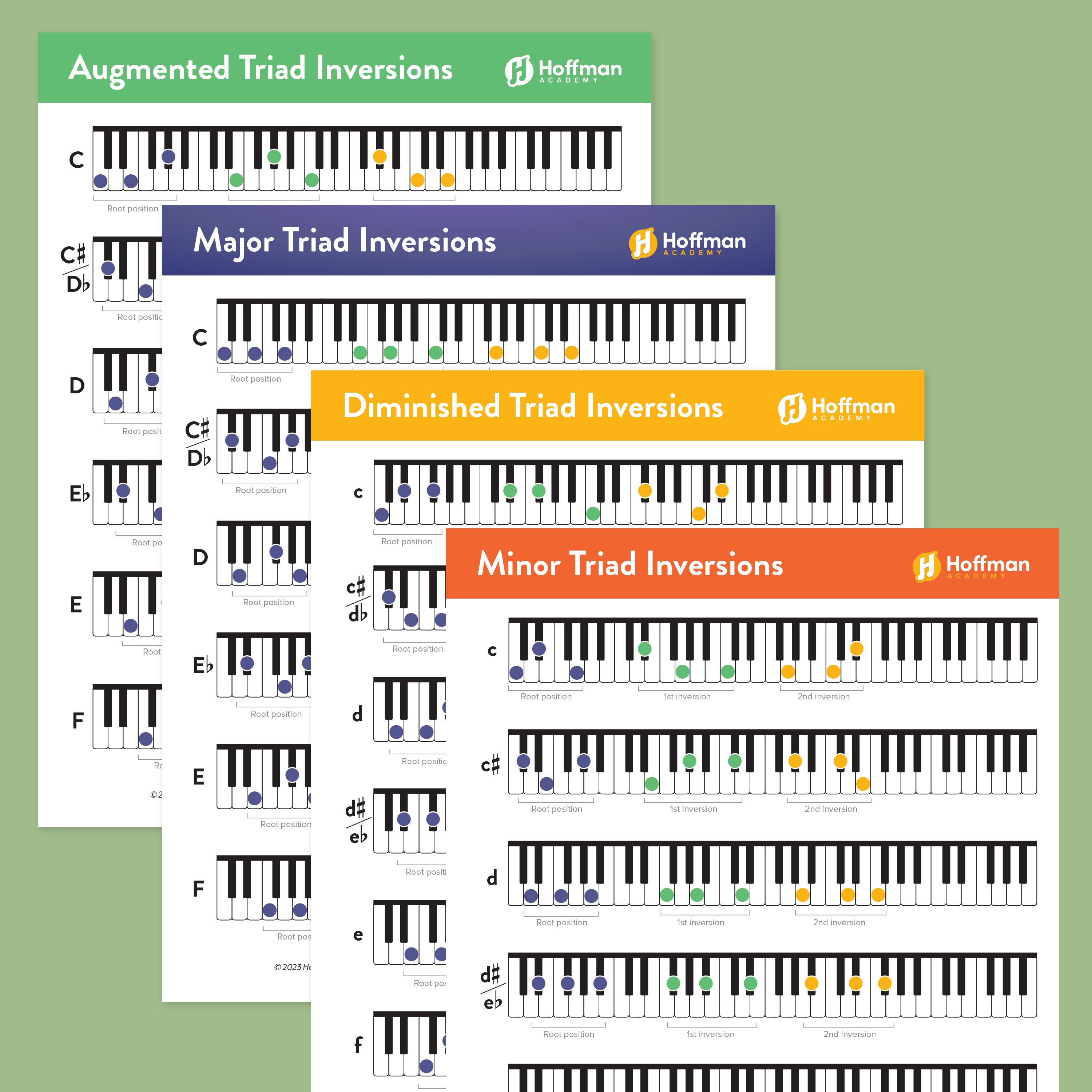
- Root Position: The root is the lowest note (e.g., C-E-G). This is the familiar "stacked thirds" shape.
- First Inversion: The third is the lowest note (e.g., E-G-C). To form this from root position, you can think of moving the original root up an octave.
- Second Inversion: The fifth is the lowest note (e.g., G-C-E). Here, both the original root and third have been moved up an octave.
The following image provides a clear visual reference for these inversions, showing how they appear on a piano roll for major, minor, diminished, and augmented triads.
Identifying Inverted Triads
When you encounter a chord in a piano roll that isn't stacked neatly in thirds, how do you identify it? The key is to mentally rearrange the notes until they form that "snowman" shape. The note that ends up at the bottom of the stack is the root.
Let's return to the video for a demonstration of this process.
Triads: Everything You Need To Know.
This short clip explains the practical technique for identifying an inverted chord.
Watch the segment on identifying inverted chords. The strategy is simple: no matter how the notes are scrambled, rearrange them into stacked thirds to find the root.
For example, if you see the notes G, C, and E in your DAW:
- Stack them in thirds: C-E-G.
- The root is C, and the quality is major.
- The lowest note in the original chord was G, which is the fifth of C major.
- Therefore, the chord is a C major triad in second inversion.
Seventh Chord Inversions
The same principle applies to seventh chords. Since they have four notes (root, third, fifth, seventh), they have four possible positions.
- Root Position: Root in bass (R-3-5-7)
- First Inversion: Third in bass (3-5-7-R)
- Second Inversion: Fifth in bass (5-7-R-3)
- Third Inversion: Seventh in bass (7-R-3-5)
This next video extends the concept of inversions to these four-note chords.
Seventh Chords - Music Theory Crash Course
This clip from Odd Quartet's "Seventh Chords - Music Theory Crash Course" demonstrates the four positions of a seventh chord.
Watch the section covering seventh chord inversions. Observe how the bass note cycles through the root, third, fifth, and finally the seventh.
A Comprehensive Reference
The following chart is an excellent summary of everything we've covered. It shows the inversions for both a major triad and a dominant seventh chord, including their appearance on the staff, their note names, their inversion names, their Roman numeral symbols, and their layout on a piano keyboard.

Understanding the Symbols (Figured Bass)
You'll notice the Roman numerals in the chart have small numbers next to them (e.g., , ). This notation, called figured bass, is a historical shorthand that specifies the intervals present above the bass note. While you don't need to master it for production, understanding its logic deepens your theoretical knowledge.
- Triad, First Inversion (): Take E-G-C. The intervals above the bass note E are a third (E to G) and a sixth (E to C). The notation singles out the most characteristic interval, the sixth.
- Triad, Second Inversion (): Take G-C-E. The intervals above the bass note G are a fourth (G to C) and a sixth (G to E). The notation includes both.
- 7th Chord, Third Inversion (): Take F-G-B-D. The intervals above F are a second (F to G), a fourth (F to B, an augmented 4th), and a sixth (F to D). The notation simplifies this to the second and fourth.
This system is a precise way of describing the intervallic structure of an inverted chord, which in turn defines its unique sound and tendency.
Identification Practice
Let's put this into practice. Your task is to identify the root, quality (e.g., major, minor, dominant 7th), and inversion for each of the following chords. The notes are given as they might appear scattered in a piano roll.
Chord 1: The notes are F, A, and D.
Chord 2: The notes are B, G, F, and D.
Chord 3: The notes are G#, E, and C.
Think through each one: stack the notes in thirds to find the root and quality, then identify which note was originally in the bass to determine the inversion.
Click to reveal the answers
Chord 1: D minor, first inversion
- Notes: F, A, D
- Stacked in thirds: D-F-A
- Root and Quality: D minor
- Bass Note: F (the 3rd of the chord)
- Conclusion: D minor in first inversion ().
Chord 2: G dominant 7th, second inversion
- Notes: B, G, F, D
- Stacked in thirds: G-B-D-F
- Root and Quality: G dominant 7th
- Bass Note: D (the 5th of the chord)
- Conclusion: G7 in second inversion ().
(Note: The Odd Quartet video analyzes this exact chord starting atthis timestamp in the context of a piece.)
Chord 3: C augmented, second inversion
- Notes: G#, E, C
- Stacked in thirds: C-E-G#
- Root and Quality: C augmented
- Bass Note: G# (the augmented 5th of the chord)
- Conclusion: C augmented in second inversion ().
Conclusion
In this lesson, we have moved beyond viewing chords as static, root-position objects. By changing the bass note, we can create inversions that, while containing the same pitches, offer new harmonic colors and possibilities for movement. This is a crucial step towards creating dynamic and flowing chord progressions.
Key Takeaways:
- Inversion is the practice of placing a note other than the root in the lowest position of a chord.
- Triads have three positions: root position (root in bass), first inversion (third in bass), and second inversion (fifth in bass).
- Seventh chords have four positions, adding a third inversion where the seventh is in the bass.
- To identify an inverted chord, you must mentally rearrange the notes into a stack of thirds. The note at the bottom of this stack is the root.
We've now established what inversions are and how to identify them. But why do we use them? The next lesson will answer this directly, as we explore voice leading—the art of moving the individual notes of one chord smoothly to the notes of the next. You will see how inversions are the primary tool for transforming a clunky, jumping progression into a fluid and professional-sounding one.