Introduction
In our last lesson, we constructed the five primary seventh chords by stacking thirds and investigated the physics behind their unique sonic qualities, particularly the role of harmonic beating in creating the tension of the dominant 7th. We saw that harmony can be built systematically, layer by layer. Today, we will continue that process, moving beyond four-note chords to explore richer and more complex harmonic colors.
This lesson addresses how to build extended chords (9ths, 11ths, and 13ths) and suspended chords (sus2, sus4). We will continue our principle of stacking thirds to create lush, jazz-inflected harmonies, and then explore a different method of chord alteration—substitution—to create the open, ambiguous sound of suspended chords. For your work in house, techno, and even more experimental genres, these chords provide a vast palette for creating everything from deep, soulful pads to tense, unresolved harmonic beds.
Extending Tertian Harmony: 9ths, 11ths, and 13ths
Just as we built seventh chords by adding a third on top of a triad, we can build extended chords by continuing to stack thirds on top of a seventh chord. These new notes are called extensions. They are numbered 9, 11, and 13, which are simply the notes 2, 4, and 6 played an octave higher.

A crucial rule of nomenclature distinguishes these from simpler chords: for a chord to be called a 9th, 11th, or 13th, the 7th must be present. If you add a 9th to a triad without a 7th, it's called an "add9" chord. This distinction is fundamental.
To begin, let's establish the basic principle of finding these extensions. The following video explains how extensions are derived by counting up the major scale of the chord's root.
The Ultimate Guide to Chord Extensions
The video "The Ultimate Guide to Chord Extensions" from the Noah Kellman channel provides an excellent foundation for this topic.
Watch the introductory section from the beginning. Pay close attention to the rule that all extensions are numbered based on the major scale of the root, regardless of whether the chord itself is major, minor, or dominant. This is a core principle of harmonic analysis.
Now, let's explore how these extensions are applied to different chord qualities.
Major and Minor Extensions
When adding extensions to major and minor chords, we encounter some important acoustic constraints.
- Major Chords: Adding a natural 11th (the 4th scale degree) to a major chord creates a harsh dissonance. The interval between the major 3rd and the perfect 4th is a minor second (e.g., E and F in a C major context). As we know from our study of wave interference, this creates significant beating. To avoid this, composers typically use a sharp 11th (#11), which creates a more pleasing major second interval with the 3rd.
- Minor Chords: In a minor chord, the third is flatted (b3). The interval between the b3 and a natural 11th is a major second (e.g., Eb and F in a C minor context), which is consonant. Therefore, minor chords can freely use the natural 11th.
This video demonstrates the construction of major and minor extended chords, incorporating these principles.
The Ultimate Guide to Chord Extensions
Let's continue with Noah Kellman's guide.
Watch the sections on major chord extensions and minor chord extensions. Notice his demonstration of the "clashy" natural 11th in major chords and how the #11 resolves this. Also, observe the clear, open sound of the natural 11th in the minor chord context.
Dominant Extensions and Alterations
Dominant 7th chords are built for tension, and their extensions offer a rich vocabulary for manipulating that tension. While they also use the #11 for the same reason as major chords, they are unique in their frequent use of altered extensions. These are extensions that have been chromatically raised or lowered to increase dissonance and drive towards resolution. Common alterations include:
- b9 (flat nine)
- #9 (sharp nine)
- #11 (sharp eleven), which can also be seen as a b5 (flat five)
- b13 (flat thirteen), which can also be seen as a #5 (sharp five)
The next segment of the video covers the vast world of dominant extensions.
The Ultimate Guide to Chord Extensions
This part of the video explores the many flavors of dominant chords.
Watch the detailed segment on dominant chord extensions. The instructor demonstrates combinations like the C13(b9, #11) and the C7(#9, #5), which are staples of jazz harmony. Don't worry about memorizing every combination; the goal is to understand the principle of alteration.
The resource below provides a much deeper dive into each extension, including their historical context and emotional character. Given your interest in formal theory, you'll find the detailed analysis of how each extension interacts with the core chord tones particularly valuable.
Section 6.4: Popular Chord Types - Offtonic Theory
The "Offtonic Theory" guide offers detailed, insightful, and often witty commentary on chord construction.
Read through the subsections on chord extensions, starting from "Chord Extensions". Focus on these key sections: The 9 (#6.4.5): Understand the distinction between a "9th chord" (with a 7th) and an "add9" chord (without). The #9/b10 (#6.4.7): The author explains why this note is called a #9 but is often technically a b10, and traces its use back to the "English Cadence" of the Renaissance—a great example of a modern sound with deep historical roots. The 11 (#6.4.8) and #11/b5 (#6.4.9): These sections elaborate on the 3rd/11th clash and introduce the concept of tritone substitution, a powerful reharmonization technique based on the enharmonic equivalence of certain dominant chords. The b13/#5 (#6.4.10) and The 13 (#6.4.11): These cover the final set of common extensions.
Suspended Chords: Replacing the Third
While extended chords add notes to a harmonic structure, suspended chords work by replacing a note. Specifically, the third of the chord (which defines its major or minor quality) is removed and replaced by either a perfect fourth (sus4) or a major second (sus2).
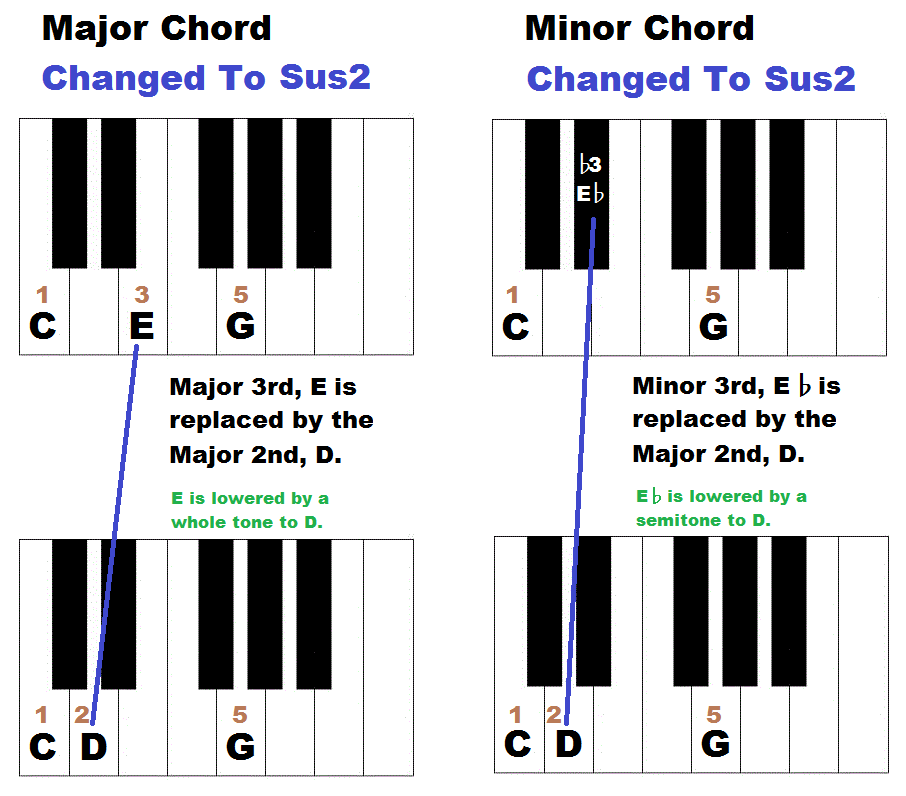
The term "suspended" refers to the feeling of unresolved tension these chords create. By removing the third, they become harmonically ambiguous—neither major nor minor. This creates a floating, open quality that is very common in ambient music, pads in house tracks, and as a way to create melodic movement over a static root.
The following video clearly explains and demonstrates the formation and sound of suspended chords.
Suspended vs Add Chords vs Extensions (9, 11, 13) on the Piano
In "Suspended vs Add Chords vs Extensions," Jason Zac provides a clear, practical demonstration of these different chord types.
Watch the first section on suspended chords. He explains how sus2 and sus4 chords are formed by replacing the third and demonstrates their unstable, "hanging" quality that begs for resolution back to a standard triad. He also shows how you can combine them (sus2 and sus4) to create more complex, ambient textures.
A Clear Framework: Suspended vs. Added vs. Extended
The terminology around these chords can be a common point of confusion. Let's solidify the distinctions with a clear framework, which the same video recaps nicely.
Suspended vs Add Chords vs Extensions (9, 11, 13) on the Piano
Let's continue with Jason Zac's video to clarify the differences between these chord families.
Watch the remainder of the video, which covers add chords, extensions, and a final summary. The key takeaway is the role of the 3rd and 7th: Suspended (sus): The 3rd is replaced by a 2 or 4. Added (add): A 2, 4, or 6 is added to a triad. The 3rd is present, but the 7th is absent. Extended (9, 11, 13): A 9, 11, or 13 is added to a chord that already contains a 7th.
This framework is essential for both analyzing and communicating harmonic ideas correctly. The presence or absence of the 3rd and 7th fundamentally changes the chord's name and function.
Practical Construction Exercise
To ensure you've grasped these concepts, let's practice building a few of these chords. Determine the notes for the following chords.
| Chord to Construct | Root | 3rd | 5th | 7th | Extension(s) |
|---|---|---|---|---|---|
| F Major 9th | F | A | C | E | ? |
| D Minor 11th | D | F | A | C | ? |
| A Dominant 7(b9) | A | C# | E | G | ? |
| G sus4 | G | (none) | D | ? (replaces 3rd) | |
| C add9 | C | E | G | (none) | ? |
Click to reveal the answers
| Chord to Construct | Root | 3rd | 5th | 7th | Extension(s) | Notes |
|---|---|---|---|---|---|---|
| F Major 9th | F | A | C | E | G (9th) | F - A - C - E - G |
| D Minor 11th | D | F | A | C | G (11th) | D - F - A - C - G |
| A Dominant 7(b9) | A | C# | E | G | Bb (b9) | A - C# - E - G - Bb |
| G sus4 | G | (none) | D | C (4th) | G - C - D | |
| C add9 | C | E | G | (none) | D (9th) | C - E - G - D |
Conclusion
Today, we have dramatically expanded our harmonic toolkit. By continuing to stack thirds, we've built the rich, colorful 9th, 11th, and 13th chords. We also learned about an alternative way to create harmony through substitution, resulting in the ambiguous and open sound of sus2 and sus4 chords.
Critically, we have established a formal framework for naming these chords, understanding that the presence of the 3rd and 7th are the key determinants for whether a chord is classified as suspended, added, or extended.
Key Takeaways:
- Extended chords (9ths, 11ths, 13ths) are built by stacking thirds on top of a seventh chord. Their name requires the 7th to be present.
- Certain extensions are acoustically constrained; the natural 11th clashes with a major 3rd, necessitating the use of the #11.
- Altered extensions (e.g., b9, #9, b13) are common on dominant chords to increase tension.
- Suspended chords (sus2, sus4) are created by replacing the 3rd of a triad, resulting in a harmonically ambiguous sound.
- Added-note chords (e.g., add9, 6/9) are triads with extra notes but no 7th.
Now that we have a large vocabulary of chords, from simple triads to complex 13ths, the next question is how to arrange their notes effectively. Our next lesson will introduce chord inversions and voice leading, teaching you how to create smooth and logical motion between the chords in a progression.