Introduction
In our previous lesson, we focused on the architectural aspect of chords, learning to arrange them through voice leading to create smooth, efficient progressions. You now understand how to choose inversions to guide the notes along paths of minimal motion, a concept that likely resonates with principles of efficiency you've encountered in physics and computation. We've established the what and where of the notes in a chord progression.
This lesson transitions from the structural arrangement of notes to their sonic character. A perfectly voice-led chord progression played on a simple oscillator can still sound thin and lifeless. To achieve the rich, powerful sounds characteristic of electronic music, we need to manipulate the very fabric of the sound waves themselves. We will explore how synthesizer parameters like unison, detuning, and stacking transform a simple chord into a complex, textured, and full-bodied sonic event. This is where the physics of sound meets the art of sound design.
From a Single Wave to a Wall of Sound
The quest for "thicker" sounds is as old as synthesis itself. A single oscillator, no matter the waveshape, produces a sound that can lack the depth and complexity of acoustic instruments or large ensembles.
More Creative Synthesis With Delays
This article from Sound On Sound provides excellent historical context for why synthesists have always sought to create richer textures.
Please read the first two sections, starting from the beginning and ending just before the heading "Creating Chorused Sounds Without Chorus". Pay attention to the discussion on how early organ and synth designers used multiple sound sources and slight pitch discrepancies to overcome the "thin" sound of early electronic instruments.
As the article notes, the core principle is creating the illusion of multiple instruments playing simultaneously. In modern synthesis, the most powerful tool for this is unison.
Unison: Engineering a "Super Sound"
At its core, unison takes a single incoming note and generates multiple copies, or voices. These voices are not perfect duplicates; they are intentionally altered in pitch and stereo position. This process exploits fundamental principles of wave physics and psychoacoustics to create a sound that is perceived as wider, richer, and more powerful than the sum of its parts.
The video "what UNISON actually does" gives a concise overview of this effect.
Watch the introductory segment from the beginning. The key takeaway is how our brain interprets tiny differences in pitch and stereo imaging, fusing the multiple copies into a single, cohesive "super sound."
The two primary parameters that control the unison effect are detuning and the number/spread of voices. Let's dissect each.
The Physics of Detuning: Interference and Beating
When you combine two sound waves of slightly different frequencies, they interfere with each other. At points where the waves are in phase, their amplitudes add together (constructive interference), and at points where they are out of phase, they cancel each other out (destructive interference).

This continuous cycle of constructive and destructive interference creates a periodic variation in amplitude, which we perceive as a "beating" or "shimmering" effect. The frequency of this beat is simply the difference between the two source frequencies: .
This phenomenon is the physical engine behind the richness of unison.
Fatter Eurorack Synth Tones With Unison Detuning
The video "Fatter Eurorack Synth Tones With Unison Detuning" by Voltage Control Lab provides an excellent audible demonstration of this physical principle.
First, watch the explanation of the beating phenomenon. Then, listen to the practical demonstration from the demonstration, where two oscillators are slowly brought in and out of tune. Notice how the beating slows to a stop when they are perfectly in tune and becomes faster as the detuning increases.
The amount of detuning is typically controlled in cents. As we covered in Module 1, a cent is a logarithmic unit, equal to 1/100th of a semitone. Because our perception of pitch is logarithmic, a 5-cent detune sounds proportionally the same whether you're in a low or high octave, whereas a 5 Hz detune would be a huge interval in low registers and barely noticeable in high ones. This makes cents the musically relevant unit for this task.
Even a tiny amount of detuning, on the order of a single cent, can introduce an audible "swirling" texture.
Audio Frequency Chart Memorization with 99.2% Accuracy
This forum discussion offers a remarkably deep dive into the practical and mathematical realities of cents, Hz, and tuning, which will be very relevant to your physics background.
First, read the post by user "rock" that explains the mathematical relationship between cents and frequency, clarifying why cents are a proportional, logarithmic measure. Next, jump to the final post by "Hexspa" and note this critical observation: "With synths, even a 1 cent detune creates a 'swirling' sound which is a very slow 'beat'." This highlights how sensitive our ears are to the phase interference caused by even minute pitch differences in a harmonic context.
Voices and Stereo Spread
The second key component of unison is the number of voices and how they are arranged in the stereo field. The effect changes dramatically depending on whether you use an even or odd number of voices.
Let's return to "what UNISON actually does" to understand the role of voice count and blending.
Watch the section explaining the difference between even and odd voice counts. Even Voices (2, 4, 6...): The voices are spread symmetrically in the stereo field (e.g., for 2 voices, one is panned left and one right). This creates a very wide, spacious sound but can lack a solid "center." Odd Voices (3, 5, 7...): One voice remains perfectly in tune and panned to the center. The remaining (even number of) voices are detuned and spread around it. This results in a sound that feels more stable, strong, and mono-compatible, with both a solid core and stereo width. Then, watch the explanation of the blend knob. This control, typically active with odd voice counts, adjusts the volume balance between the central voice and the detuned, panned voices, allowing you to dial in the perfect amount of width versus centered stability.
A classic example of this is the supersaw, an iconic sound in trance and other electronic genres, which is typically created using 7 or more detuned sawtooth oscillators. The odd number provides a stable core, while the numerous detuned voices create an exceptionally thick, buzzing texture.
Stacking vs. Layering: A Crucial Distinction
The terms "stacking" and "layering" are often used interchangeably, but they describe two distinct sound design techniques. The image below provides a clear visual summary.
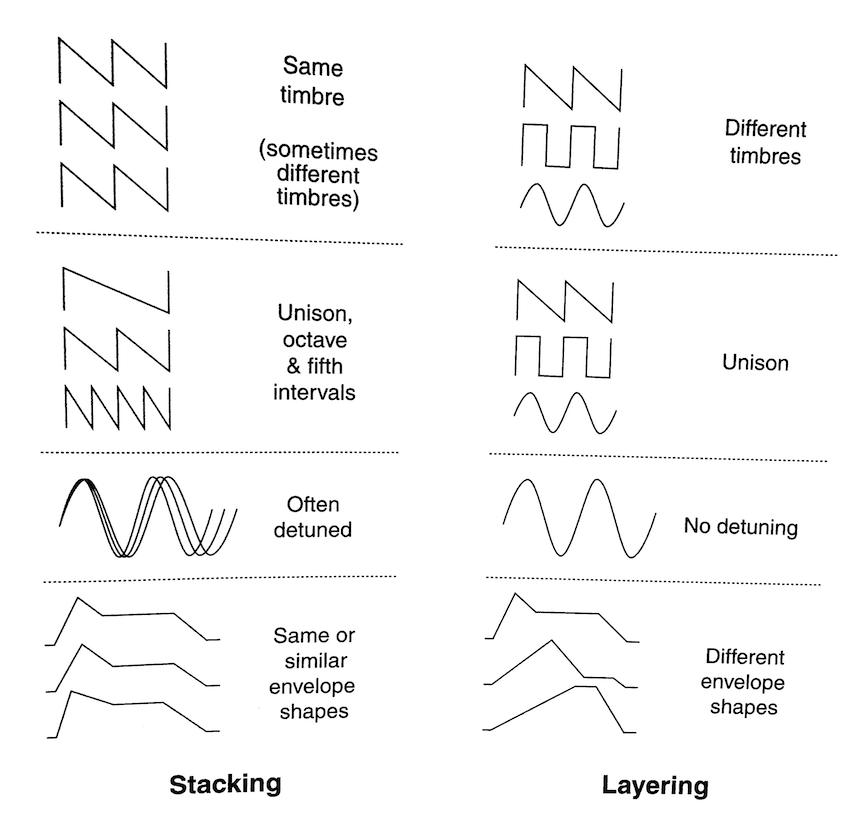
Let's break down the differences based on this visual guide:
Stacking
- Goal: To make a single sound source feel thicker, richer, and wider. Unison is a form of automated stacking.
- Timbre: Uses the same or very similar waveforms (e.g., multiple sawtooths).
- Tuning: The core technique is detuning the voices relative to each other. You can also stack voices at different octaves or other harmonic intervals (like a perfect fifth) to add body.
- Envelope: All voices typically share the same amplitude and filter envelope shapes, so they behave as a single entity.
Layering
- Goal: To create a new, complex, hybrid timbre by combining distinct sound sources.
- Timbre: Uses different waveforms (e.g., a saw wave for brightness, a square wave for body, and a sine wave for low-end weight).
- Tuning: The layers are perfectly in tune with each other. There is no intentional detuning or beating between layers.
- Envelope: Each layer often has a unique envelope. For example, a percussive "pluck" layer with a fast decay could be layered with a "pad" layer that has a slow attack, creating a sound that evolves over time.
The Sound on Sound article we looked at earlier described a classic technique that is actually an example of layering to achieve a thicker sound. It involves selecting a sawtooth wave on one oscillator and a pulse wave on another, then adding pulse-width modulation (PWM) to the second. This combines two distinct timbres to create a more complex final result.
Conclusion
Today, we've moved beyond the skeletal structure of chords to give them flesh and blood. By understanding and applying synth parameters rooted in the physics of wave interference, you can transform simple chords into the complex, dynamic textures that define electronic music.
Key Takeaways:
- Unison creates a thicker, wider sound by generating multiple detuned and stereo-spread copies (voices) of an oscillator.
- Detuning creates slight frequency differences between voices, causing phase interference and an audible beating effect that our brain perceives as richness and movement. This is controlled using cents for musically proportional results.
- The number of unison voices determines the stereo character: even numbers produce a wide, spacious sound, while odd numbers provide a more stable, centered sound with a strong mono core.
- Stacking involves combining similar, detuned sound sources to thicken a single sound.
- Layering involves combining different, in-tune sound sources (often with different envelopes) to create a new, hybrid timbre.
In our next lesson, we will build upon this foundation. Now that you know how to voice-lead your chords and how to make them sound texturally rich, we will examine specific chord voicings — like power chords and sparse, open structures — that are particularly effective for the industrial, techno, and breakbeat genres you're interested in.