Introduction
In our previous lesson, we established the concept of relative keys, understanding that C major and A minor are two sides of the same coin, sharing the exact same collection of notes. This fundamental insight leads to a powerful consequence: relative keys must share the same key signature. Today, we will explore the tool that brings this entire system into sharp focus—the Circle of Fifths.
This lesson will demonstrate how the Circle of Fifths acts as a generative map for all 24 major and minor key signatures. We will not only learn the practical rules for using it but also delve into the mathematical and physical principles that dictate its structure. You will learn why this cycle is based on fifths, what makes it a mathematically complete system, and how the version we use is a clever compromise to a physical imperfection in tuning. By the end, you will be able to determine the key signature for any key with confidence.
Building the Circle: A Cycle of Fifths and Fourths
The Circle of Fifths is constructed from a single, powerful principle: repeatedly moving by the interval of a perfect fifth. As we discovered in previous lessons, the perfect fifth is the most consonant interval after the octave, possessing a simple frequency ratio of approximately 3:2. Starting from a note with no accidentals, C, and ascending by perfect fifths generates a sequence of keys.
The video "Circle of fifths" from the discovermaths channel provides a clear visual demonstration of this construction.
First, watch from 01:09 to 01:52. This segment shows how moving clockwise from C generates the "sharp" side of the circle: C \to G \to D \to A, and so on. Next, watch from 01:58 to 02:52. This part explains the counter-clockwise motion. Moving counter-clockwise is equivalent to moving down a fifth, or more commonly, up a perfect fourth. This generates the "flat" side of the circle: C \to F \to B\flat, etc. The video also introduces the concept of enharmonic equivalence at the bottom of the circle (F\sharp = G\flat).
This dual motion gives us our first practical rule:
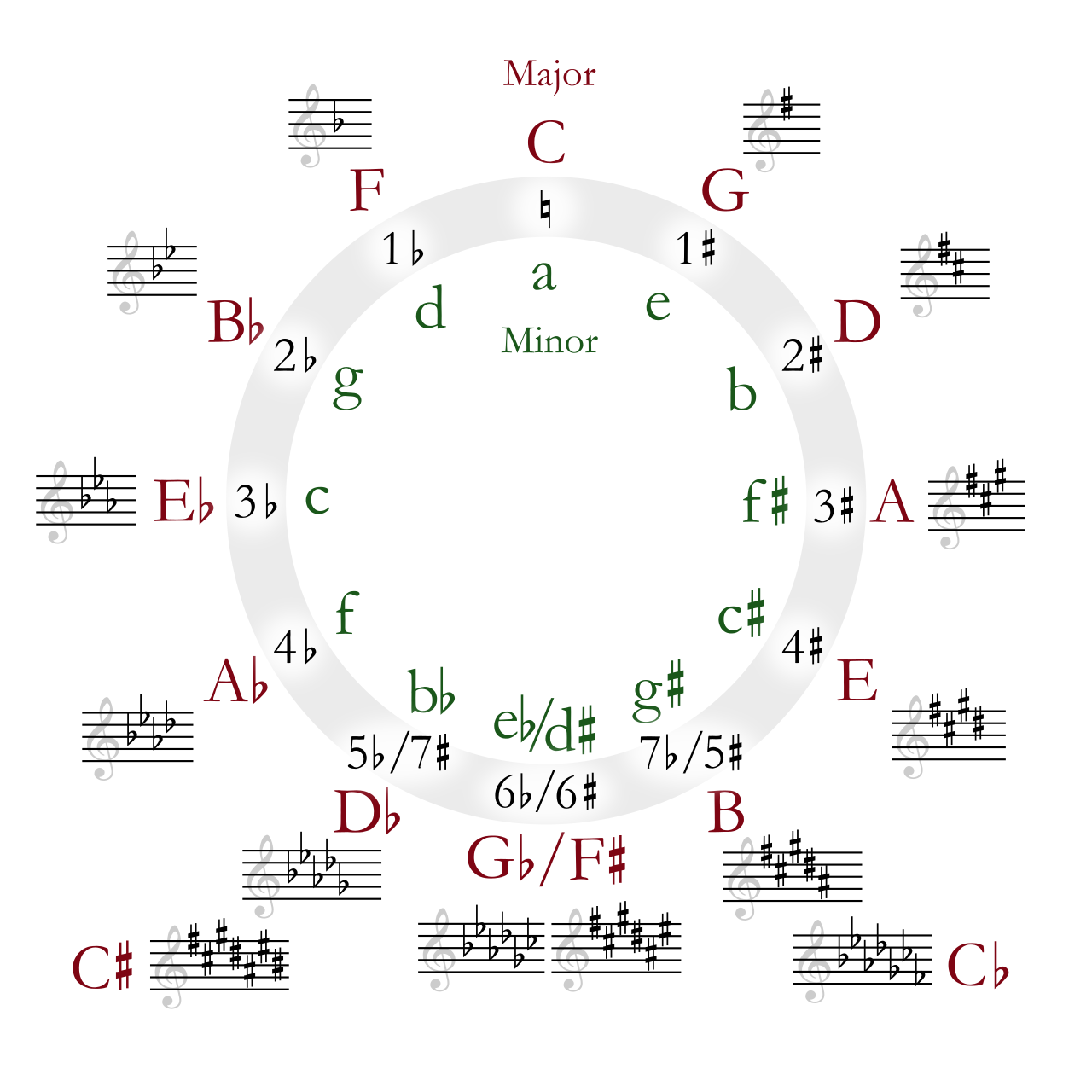
- Moving clockwise by a perfect fifth adds a sharp to the key signature.
- Moving counter-clockwise by a perfect fourth adds a flat to the key signature.
This entire system is captured in the following diagram, which will be our central reference.
The Mathematical Engine: Why the Circle "Works"
A natural question arises from your mathematical background: why a circle of fifths? Why does this particular interval allow us to visit every one of the 12 chromatic notes exactly once before returning to the start, while a circle of, say, major thirds would not? The answer lies in the principles of group theory.
We can model the 12 pitches of our equal-tempered system as the cyclic group of integers modulo 12, denoted , where C=0, C=1, and so on up to B=11. An interval is simply addition within this group. A perfect fifth corresponds to moving up 7 semitones, so it is the operation +7. Building the circle of fifths is equivalent to repeatedly applying this operation:
0 (C) 7 (G) 14 2 (D) 9 (A) ...
The sequence generated by repeatedly adding 7 mod 12 forms a cyclic subgroup . The key insight comes from a theorem in group theory:
For a cyclic group , the subgroup generated by an element , written , is equal to the entire group if and only if and are relatively prime, i.e., .
In our case, and . Since , the element 7 is a generator of the group . This mathematically guarantees that repeatedly adding 7 will visit every integer from 0 to 11 before repeating.
[PDF] The Application of Group Theory to Music Theory
This paper provides the formal mathematical framework for this concept.
First, read the section "Building a Group from the Scale," specifically this passage, which formally establishes the twelve-tone scale as the group \mathbb{Z}_{12}. Then, read the following section, "Cyclic Subgroups of the Twelve-tone Scale Group," focusing on the part that discusses the subgroup ⟨7⟩. This text explicitly states the theorem and shows why the circle of fifths (generated by 7) and fourths (generated by 5, since \text{gcd}(5, 12) = 1) span the entire scale, while other intervals do not.
This mathematical property is why the circle of fifths is such a fundamental structure in Western music. There is no "circle of major thirds" because . The subgroup only contains the notes {C, E, G}, forming an augmented triad.
The math behind the circle of fifths
For a more intuitive, visual explanation of this same mathematical principle, the video "The math behind the circle of fifths" is excellent.
Watch from the beginning to 03:58. The video explains the concept of "steps" and prime factors in an abstract way before applying it directly to the 12-tone scale. It clearly demonstrates why step sizes of 5 (perfect fourth) and 7 (perfect fifth) create complete cycles, while other intervals like 2, 3, 4, and 6 create smaller, disconnected shapes.
The Physical Imperfection: The Pythagorean Comma
We have established the mathematical elegance of the circle in the idealized system of 12-tone equal temperament. However, if we look at the physics of pure intervals, a problem emerges. The pure perfect fifth has a frequency ratio of exactly 3:2. The octave is 2:1.
If we start at a pitch and ascend by 12 pure fifths, the final frequency will be . To compare this to our starting pitch, we must bring it down by some number of octaves. Seven octaves is . Let's compare these two values:
They are not the same. The ratio between them, , is known as the Pythagorean comma. This means that a circle built from pure, acoustically perfect fifths does not actually close. It forms a spiral.

The Circle of Fifths we use in modern music is a product of the 12-tone equal temperament system. This system slightly compromises the purity of the perfect fifth (making it instead of ) in order to make 12 of them fit perfectly inside 7 octaves, thereby forcing the circle to close.
The "discovermaths" video also addresses this exact point.
Please watch the segment from 03:01 to 04:15. It explicitly contrasts the "closed" circle of equal temperament with the "spiral of fifths" that arises from Pythagorean tuning due to this comma.
Finding Any Key Signature: The Practical Rules
With this deep understanding in place, let's return to the practical application of using the Circle of Fifths to identify key signatures.
Major Keys
-
Locate the Key: Find the major key on the outer ring of the circle.
-
Count the Steps from C: The number of sharps or flats is the number of steps (clockwise for sharps, counter-clockwise for flats) from the top position (C Major).
- Example: E Major is 4 steps clockwise from C, so it has 4 sharps.
- Example: A Major is 4 steps counter-clockwise from C, so it has 4 flats.
-
Identify the Accidentals: The sharps or flats are added in a specific order.
- Order of Sharps: F, C, G, D, A, E, B
- Order of Flats: B, E, A, D, G, C, F (the reverse of the sharps)
Applying this to our examples:
- The 4 sharps for E Major are F, C, G, and D.
- The 4 flats for A Major are B, E, A, and D.
Minor Keys
As we learned in the last lesson, a minor key shares the same key signature as its relative major.
- Find the Relative Major: Locate the minor key on the inner ring. Its relative major is directly outside it.
- Use the Major Key's Signature: The key signature for the minor key is identical to that of its relative major.
- Example: To find the key signature for F minor, we find its relative major, which is A Major. A Major is 3 steps clockwise from C, so it has 3 sharps (F, C, G). Therefore, F minor also has 3 sharps.
Conclusion
Today we have fully explored the Circle of Fifths, from its practical use to its deep structural origins. You now have a systematic method for identifying the key signature of any major or minor key.
Key Takeaways:
- The Circle of Fifths arranges keys in a cycle of perfect fifths (clockwise) and perfect fourths (counter-clockwise).
- Moving clockwise from C adds sharps in the order F, C, G, D, A, E, B.
- Moving counter-clockwise adds flats in the order B, E, A, D, G, C, F.
- This cyclic structure is a mathematical consequence of 7 and 12 being relatively prime, making the interval of a perfect fifth a generator of the group .
- The closed circle is a feature of equal temperament, which compromises the purity of the fifth to resolve the Pythagorean comma.
- The key signature for any minor key is found by identifying the signature of its relative major.
You are now equipped with a complete map of the diatonic tonal system. In our next lesson, we will begin to explore scales that exist outside this strict major/minor framework, starting with the pentatonic and blues scales, which are fundamental building blocks for melodies and basslines in many forms of electronic music.