Introduction
In our last lesson, we constructed the three primary minor scales and saw that the natural minor is, in fact, the sixth mode of the major scale. This observation—that the notes of A natural minor are identical to the notes of C major—is the crucial starting point for today's topic. We will now formalize this connection by defining the concept of relative keys.
This lesson will explain the relationship between relative major and minor keys, a fundamental principle of Western tonality. You will learn not only the theoretical definition but also why two keys with the same notes can sound so different, how to find the relative key for any given major or minor scale, and how this relationship is elegantly visualized in the circle of fifths. This understanding is essential for analyzing music and for creating harmonically coherent compositions.
The Duality of Tonality: Same Notes, Different Center
The core idea of relative keys is that a major scale and a natural minor scale can share the exact same collection of pitches. The pair C major and A minor is the canonical example:
- C Major: C - D - E - F - G - A - B
- A Natural Minor: A - B - C - D - E - F - G
They are built from the same seven notes. The profound difference in their sound and emotional character arises not from the notes themselves, but from the note that serves as the tonal center, or tonic. The entire melodic and harmonic structure gravitates toward this central pitch, establishing its "home base" and defining the overall mood. Shifting the tonal center from C to A is what transforms the bright, stable quality of major into the more somber or reflective quality of minor.
RELATIVE MODES - How C Major and A Minor are Same but Different [MODES - MUSIC THEORY]
The video "RELATIVE MODES" from Signals Music Studio provides a brilliant aural demonstration of this principle. It treats the notes as a fixed data set and shows how changing the harmonic context—the tonal center—radically alters our perception.
Watch from the beginning to 01:42. Notice how a melody that sounds major is transformed into a minor one simply by emphasizing the note 'A' in the bass. Then, skip to the conclusion from 04:41 to 05:06, which summarizes this core idea: the character of a scale is defined by its tonal center, not just its constituent notes.
A Formal Perspective: Sets, Sequences, and Conjugacy
Given your background, we can frame this relationship with more mathematical precision. In the framework of twelve-tone equal temperament, we can represent scales as subsets of the cyclic group (where C=0, C#=1, ..., B=11).
- The C major scale corresponds to the set .
- The A natural minor scale corresponds to the set .
As unordered sets, these are identical. The distinction lies in their structure as ordered sequences of intervals.
[PDF] Word Theory and Musical Scale
This research paper by Brad Trotter provides a rigorous mathematical context for these concepts.
Please read the section "Overview of the Scale and mathematical analogue". Focus on Definitions 2.5 through 2.7. The author formally defines a scale as a subset of \mathbb{Z}_{12} and then distinguishes between scale type and scale mode. Notice the explicit statement that C-major and A-minor share the same pitches but have different interval patterns, which are called the Ionian and Aeolian modes, respectively.
The paper you just reviewed alludes to a more abstract connection through "word theory." The interval pattern of a scale can be represented as a "word" (e.g., using 'a' for a whole step and 'b' for a half step). In this context, the different modes of a scale are conjugates of each other. This is the mathematical term for the "rotation" we saw in the previous lesson. If a word can be written as a concatenation of two parts, , then its conjugate is . This is precisely how we get the Aeolian mode's interval pattern from the Ionian (major) pattern—by rotating the sequence of whole and half steps.
Finding Relative Keys: The Rule of Three Semitones
We now have a conceptual and formal understanding. Let's establish a practical method for finding the relative minor of any major key, and vice versa.
-
From Major to Minor: The tonic of the relative minor is the sixth degree of the major scale. Equivalently, and often easier to calculate, the relative minor tonic is three semitones (half steps) below the major tonic.
- Example: To find the relative minor of C major, count down three semitones from C: C B B A. The relative minor is A minor.
-
From Minor to Major: The tonic of the relative major is the third degree of the natural minor scale. Equivalently, the relative major tonic is three semitones above the minor tonic.
- Example: To find the relative major of E minor, count up three semitones from E: E F F G. The relative major is G major.
It's also crucial to distinguish this from another relationship: parallel keys.
- Relative Keys share the same key signature (e.g., C major and A minor).
- Parallel Keys share the same tonic (e.g., C major and C minor).
Minor Scales, Scale Degrees, and Key Signatures
This chapter from Open Music Theory provides a very clear definition of these two distinct relationships.
Read the section titled "The Parallel and Relative Relationships". Pay close attention to the clear distinction made between the parallel and relative relationships and internalize the "three half steps" rule for finding relative keys.
The Circle of Fifths: A Map of Tonal Relationships
The Circle of Fifths is a geometric tool that elegantly organizes all major and minor keys, making their relationships immediately apparent. Major keys are arranged around the outside of the circle, while their relative minors are found on a corresponding inner ring.
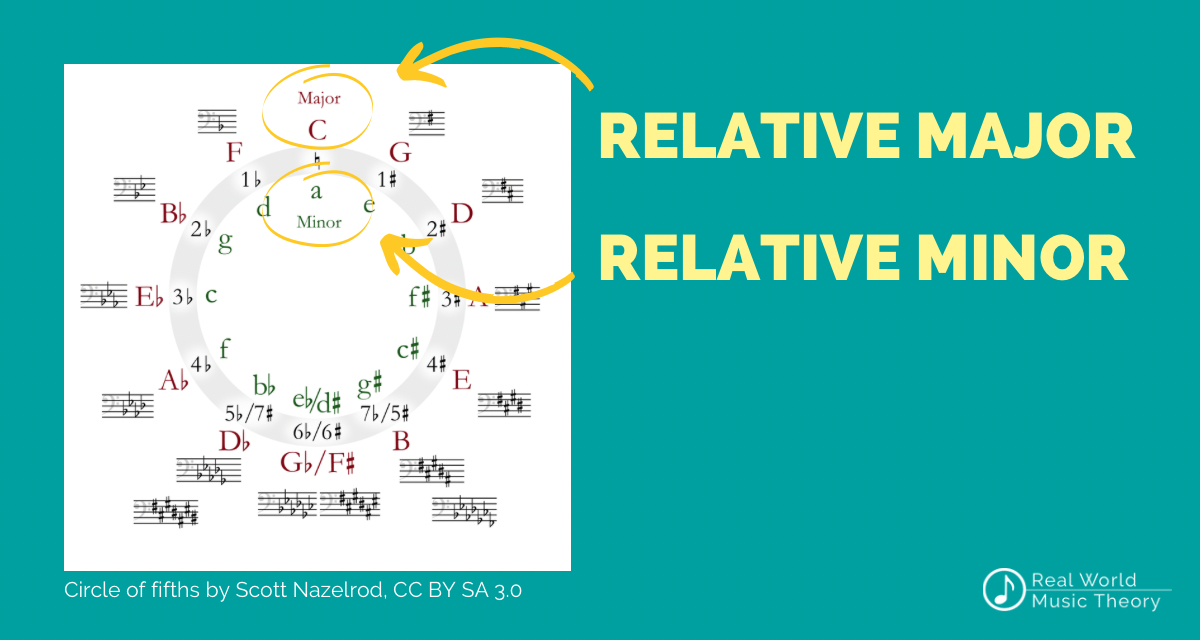
This visual tool confirms the rule we just learned. For any major key on the outer circle, its relative minor is directly inside it.
The Circle of Fifths - Minor Keys and Advanced Uses
Let's return to Michael New's series, where he introduces this "advanced" version of the circle with the inner minor ring.
Watch the segment from 02:22 to 04:16. He explains why the inner ring is needed and demonstrates how the relative minor keys are placed. Notice his point that the inner minor keys also have a fifth relationship with each other (A to E, E to B, etc.), mirroring the outer circle's structure. Then, watch from 04:57 to 05:58. This section drives home the most important consequence: relative keys share the same key signature.
Because relative keys use the same notes, they must also have the same set of accidentals (sharps or flats).
- C major and A minor have 0 sharps/flats.
- G major and E minor have 1 sharp (F).
- F major and D minor have 1 flat (B).
This is why the key signature alone is ambiguous. A signature of one sharp could indicate G major or E minor. To determine the actual key, you must analyze the music itself to find the tonal center, often by looking at the first and last notes or chords of a piece, as they tend to emphasize the tonic.
Conclusion
In this lesson, we have demystified the intimate connection between major and minor scales. You now understand that this is not a coincidence but a fundamental structural property of the diatonic system.
Key Takeaways:
- A major key and a minor key are relative if they are comprised of the exact same set of notes.
- The difference between relative keys is their tonal center, which dictates the mood and harmonic gravity of the music.
- The tonic of the relative minor is always three semitones below the tonic of its relative major. Conversely, the major tonic is three semitones above the minor tonic.
- A direct consequence of sharing the same notes is that relative keys share the same key signature.
- The Circle of Fifths, with its inner ring of minor keys, provides a complete visual map of these relationships.
With this knowledge, you are now equipped to navigate the broader landscape of musical keys. In our next lesson, we will use the Circle of Fifths as our primary tool to systematically identify the key signature for any major or minor key, completing your foundation in tonal frameworks.