Introduction
In our last lesson, we navigated the complete system of diatonic keys using the Circle of Fifths, understanding its structure through the lens of group theory and its tuning as a compromise to the physical reality of the Pythagorean comma. You are now equipped with a powerful map of the 24 major and minor keys that form the bedrock of Western music.
Today, we will venture beyond this 7-note diatonic framework to explore scales that are equally, if not more, fundamental to melody and groove, particularly in the electronic genres you're interested in. This lesson focuses on the pentatonic and blues scales. You will learn to construct their major and minor forms and analyze how their unique intervallic structures make them incredibly versatile tools for writing melodies, basslines, and lead lines. We will also investigate their physical origins, connecting these musical structures back to the principles of acoustics.
The Pentatonic Scale: A Universal Melodic Framework
The term "pentatonic" simply means "five-toned." While many five-note scales exist, in Western music we are typically referring to a specific type that is found in folk traditions all over the world. Its universal appeal stems from a unique intervallic structure that is inherently consonant and pleasing.
To begin, let's establish the fundamental properties of these scales.
What is the Pentatonic Scale? - Music Theory
The video "What is the Pentatonic Scale?" from Music Matters provides a concise introduction.
Watch the first segment from the beginning until 03:31. The presenter defines the pentatonic scale as a five-note scale, contrasting it with the seven-note (heptatonic) scales we've studied. Pay close attention to the distinction between hemitonic (containing semitones) and anhemitonic (lacking semitones) scales. The common pentatonic scales we will study are anhemitonic.
The key feature of these scales is the absence of the most dissonant intervals. If you recall our study of intervals, the tritone and the semitone (minor second) create the most tension. By omitting the notes that form these intervals, the pentatonic scale becomes a "safe" and melodically fluid tool.
Major Pentatonic Scale
The major pentatonic scale is a bright, open-sounding scale often associated with folk music and simple, memorable melodies. There are two primary ways to conceptualize its construction, both of which should feel familiar.
1. Derivation from the Major Scale:
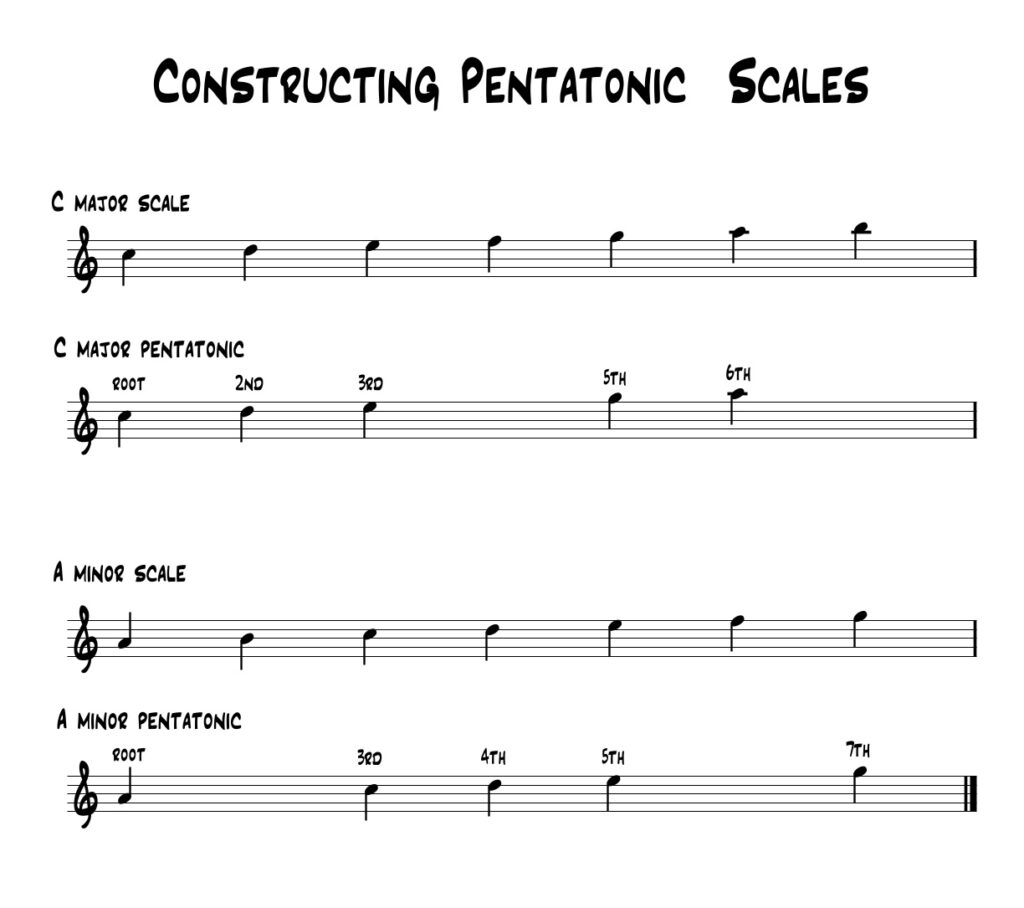
The simplest method is to take a standard major scale and remove the 4th and 7th degrees. The remaining notes are the 1st, 2nd, 3rd, 5th, and 6th.
- C Major Scale: C, D, E, F, G, A, B
- C Major Pentatonic: C, D, E, G, A (Scale degrees: 1, 2, 3, 5, 6)
2. Derivation from the Circle of Fifths:
Connecting directly to our previous lesson, the major pentatonic scale can also be generated by stacking five consecutive perfect fifths. Starting from C:
C G D A E
Arranging these notes within one octave gives us C, D, E, G, A—the C major pentatonic scale. This reveals the scale's deep connection to the most consonant interval after the octave.
Given your background in physics, you'll find its connection to the overtone series particularly interesting. The overtone series, or harmonic series, is the sequence of frequencies that are integer multiples of a fundamental frequency. It is the physical basis of timbre.
Section 7.5: The Pentatonic Scale - Offtonic Theory
The "Offtonic Theory" article offers an excellent discussion on the physical basis of the major pentatonic scale.
Read the latter part of the section on "Major Pentatonic", starting from this passage. The author shows how the notes of the major pentatonic scale closely align with prominent harmonics (overtones 6, 8, 9, 10, and 12) of a fundamental pitch. This physical resonance is a compelling explanation for the scale's perceived naturalness and its independent emergence in cultures worldwide.
Minor Pentatonic Scale
Just as every major key has a relative minor, the major pentatonic scale has a relative minor pentatonic. It is constructed from the 1st, 3rd, 4th, 5th, and 7th degrees of the natural minor scale.
- A Natural Minor Scale: A, B, C, D, E, F, G
- A Minor Pentatonic: A, C, D, E, G (Scale degrees: 1, b3, 4, 5, b7)
The most elegant way to understand the relationship is through the concept of relative keys. The A minor pentatonic scale uses the exact same set of notes as the C major pentatonic scale, just starting from a different tonic (A instead of C).
- C Major Pentatonic: {C, D, E, G, A}
- A Minor Pentatonic: {A, C, D, E, G}
This shared-note relationship makes modulating between them seamless and is a powerful tool in composition and improvisation.
What is the Pentatonic Scale? - Music Theory
Let's return to the "Music Matters" video to see both construction methods in action.
First, review the construction of the major pentatonic from 04:18 to 07:42. The presenter details the "1, 2, 3, 5, 6" formula. Then, watch the section on the minor pentatonic from 11:31 to 15:33. Focus on how he demonstrates that the A minor pentatonic is simply a reordering of the notes of the C major pentatonic.
The minor pentatonic scale is ubiquitous in rock, pop, and blues, and it's a workhorse in electronic music for crafting basslines and lead melodies that are both groovy and melancholic.
The Blues Scale: Adding Chromatic Color
The blues scale takes the robust framework of the pentatonic and introduces a single chromatic note—the "blue note"—to add tension, spice, and the characteristic sound of the blues.
Minor Blues Scale
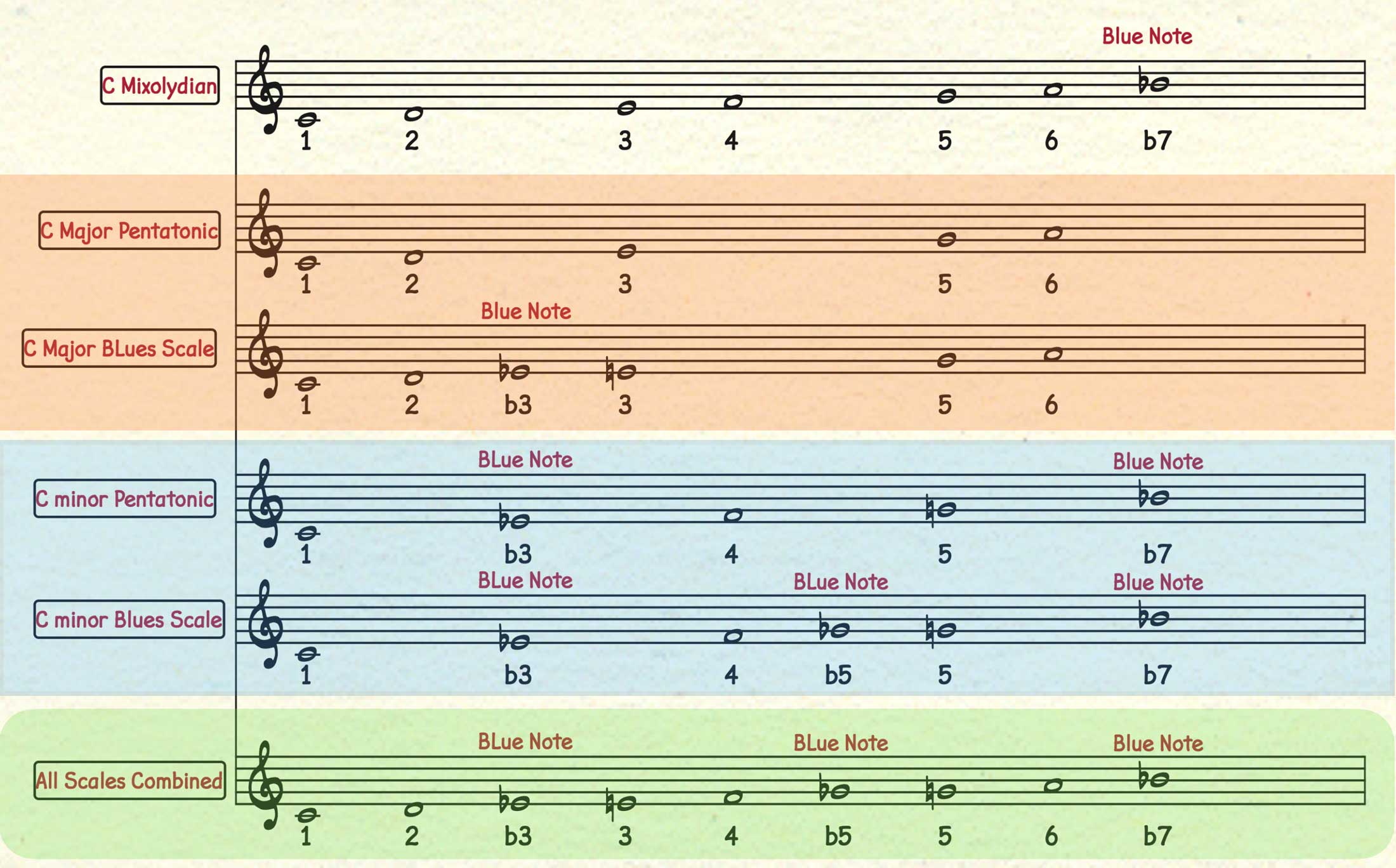
The most common blues scale is built upon the minor pentatonic. We add a note between the 4th and 5th degrees: the flattened 5th (). This transforms the 5-note pentatonic scale into a 6-note (hexatonic) scale.
- A Minor Pentatonic: A, C, D, E, G
- A Minor Blues Scale: A, C, D, E, E, G (Scale degrees: 1, b3, 4, b5, 5, b7)
The is the blue note. It creates a powerful dissonance against the underlying harmony, as it forms a tritone with the root. This clash is not a "wrong" note; it's the very source of the scale's expressive power.
What nobody teaches you about the BLUES SCALE
The video "What nobody teaches you about the BLUES SCALE" by guitarist Paul Davids provides a fantastic explanation. Though demonstrated on guitar, the concepts are universal.
Watch from 00:24 to 02:11 as he introduces the concept of turning the pentatonic into a hexatonic scale by adding the b5 blue note. Notice how this single note dramatically changes the character of the scale.
Major Blues Scale
A less common but equally useful variant is the major blues scale. This scale is built from the major pentatonic by adding a blue note between the 2nd and 3rd degrees: the flattened 3rd ().
- C Major Pentatonic: C, D, E, G, A
- C Major Blues Scale: C, D, E, E, G, A (Scale degrees: 1, 2, b3, 3, 5, 6)
Here, the blue note () creates a fascinating ambiguity by introducing a "minor" flavor into a major context. This major/minor clash is a hallmark of blues and related genres like jazz and soul.
Once again, the principle of relativity applies. The G major blues scale contains the exact same notes as the E minor blues scale, reinforcing the deep connection between relative keys.
Analysis and Application in Electronic Music
These scales are not just theoretical curiosities; they are foundational tools for production.
- Pentatonic Scales are perfect for creating melodies and basslines that need to sit well in a mix without creating complex harmonic clashes. Their inherent consonance makes them ideal for the repetitive, hypnotic loops found in house and techno. Because they lack semitones, any note can generally lead to any other note without sounding awkward, making them excellent for arpeggios and simple melodic patterns.
- Blues Scales introduce a point of friction. That blue note is a source of tension and release that can make a simple riff or lead line far more compelling. In industrial and heavier forms of techno, the grit of the blues scale can add an aggressive edge. In breakbeat, the syncopated, funky feel is often derived from melodies that dance around the blue notes.
Practical Exercise:
- In your DAW, program a simple 1-bar bassline using only the notes of C Major Pentatonic (C, D, E, G, A). Loop it over a simple C major chord.
- Now, change the root of the chord to A minor but keep the bassline notes the same. Notice how the feel instantly shifts from major to minor, demonstrating the relative key relationship. The bassline is now in A minor pentatonic.
- Finally, add the blue note E into your bassline pattern. Play this over the A minor chord. Feel the added tension and "funk" this single note provides. You have now created a bassline using the A minor blues scale.
This simple exercise demonstrates how these scales are not just abstract collections of notes but are living, breathing tools for shaping the emotional contour of your music.
Conclusion
In this lesson, we have expanded our melodic toolkit beyond the standard diatonic scales. We've seen how pentatonic and blues scales offer powerful, concise ways to create melodies and basslines with distinct emotional characteristics.
Key Takeaways:
- Major Pentatonic Scale: Built from degrees 1, 2, 3, 5, 6 of a major scale. It is highly consonant due to the absence of semitones and tritones, and it has roots in the physical overtone series.
- Minor Pentatonic Scale: Built from degrees 1, b3, 4, 5, b7 of a natural minor scale. It is the relative minor of the major pentatonic, sharing the same notes with a different tonic.
- Blues Scales: Created by adding a chromatic "blue note" to a pentatonic scale. The minor blues scale adds a , while the major blues scale adds a . These notes introduce expressive dissonance.
- These scales are fundamental to many genres you are interested in, providing a palette for everything from smooth house basslines to aggressive industrial leads.
In our next lesson, we will continue our exploration of non-diatonic scales by examining symmetric scales, such as the whole tone and chromatic scales. These scales possess a unique, tonally ambiguous character that results from their perfectly regular intervallic structure—a concept that will surely appeal to your mathematical sensibilities.