Introduction
In our last lesson, we explored pentatonic and blues scales, which derive their distinctive, consonant character from the strategic omission of dissonant intervals like the semitone and tritone. Today, we shift our focus to a completely different type of scale, one defined not by what it lacks, but by its perfect structural regularity.
This lesson introduces symmetric scales. Your background in physics and mathematics will provide a strong foundation for this topic, as the core principle is symmetry—a concept fundamental to understanding natural laws. We will investigate how repeating intervallic patterns create scales with a limited number of unique transpositions, a property first systemically explored by the composer Olivier Messiaen. You will learn to construct the chromatic and whole-tone scales and, most importantly, understand how their perfect symmetry gives them a unique, tonally ambiguous character that has been exploited by composers from Debussy to the producers of ambient techno.
What Makes a Scale Symmetric?
Most scales we've studied, like the major scale (W-W-H-W-W-W-H), have an irregular pattern of intervals. This irregularity is what gives the scale a strong sense of a tonal center, or tonic, because each scale degree has a unique relationship to the others. Symmetric scales, in contrast, are built from a repeating sequence of intervals—a "cell" that is iterated until it completes the octave.
Let's begin with a quick, high-level introduction to this concept and the unique sound it produces.
Trapped By Transposition: The Secret Of Symmetrical Scales
The video "Trapped By Transposition: The Secret Of Symmetrical Scales" by 12tone provides an excellent conceptual overview.
Watch the segment from 00:38 to 02:32. The creator contrasts normal scales with symmetrical ones, using the whole-tone scale as the prime example. Pay close attention to these key ideas: The concept of a repeating "cell." The term "modes of limited transposition," which he shortens to "symmetrical scales." The "disconnected ambient feel" that arises from their tonal ambiguity.
As the video explains, this repeating structure means that starting the scale on different notes within it can produce the exact same collection of pitches. This property, known as having "limited transpositions," is the defining feature of symmetric scales and the source of their ambiguous, floating quality.
Building Symmetric Scales by Dividing the Octave
A more formal way to think about this is to see symmetric scales as arising from the equal division of the octave. Since the octave contains 12 semitones, we can divide it into 1, 2, 3, 4, 6, or 12 equal parts. Each division creates a repeating interval, or "axis of symmetry," which can serve as the basis for a symmetric scale.
Symmetric Scales - Donald Régnier Music
This article by Donald Régnier provides a clear, mathematical framework for understanding this concept.
Please read the Introduction and the section titled The 5 main symmetrical scales. Focus on how the author uses a "relative definition" (the sequence of intervals) to define scales and how dividing the octave by different numbers (12, 6, 4, 3, 2) generates the five most basic symmetric structures.
The article you just read introduces the five fundamental symmetric structures, as shown in this image from the text:
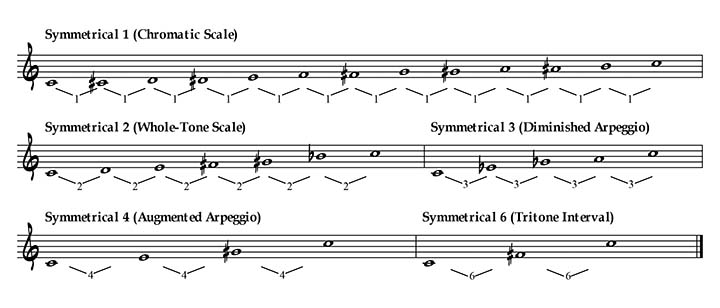
Let's examine the two most important of these scales in detail.
Symmetrical 1: The Chromatic Scale
The simplest case is dividing the octave by 12. This gives us a repeating interval of 1 semitone.
- Axis of Symmetry: Semitone (1)
- Repeating Cell: (1)
- Interval Pattern: 1-1-1-1-1-1-1-1-1-1-1-1
- Number of Transpositions: 1
This is, of course, the chromatic scale, which contains all 12 notes of our tuning system. It is the ultimate symmetric scale and is maximally ambiguous; it has no inherent tonal center. Any transposition of the chromatic scale results in the exact same collection of 12 notes.
Symmetrical 2: The Whole-Tone Scale
When we divide the octave by 6, we get a repeating interval of 2 semitones (a whole tone).
- Axis of Symmetry: Whole Tone (2)
- Repeating Cell: (2)
- Interval Pattern: 2-2-2-2-2-2
- Number of Transpositions: 2
This generates the whole-tone scale. Let's construct one starting on C:
C - D - E - F♯ - G♯ - A♯ - (C)
The "tonal ambiguity" here is profound. Because every note is separated by the same interval, there is no leading tone and no perfect fifth to establish a root. The result is a sound often described as dreamlike, unresolved, or mysterious.
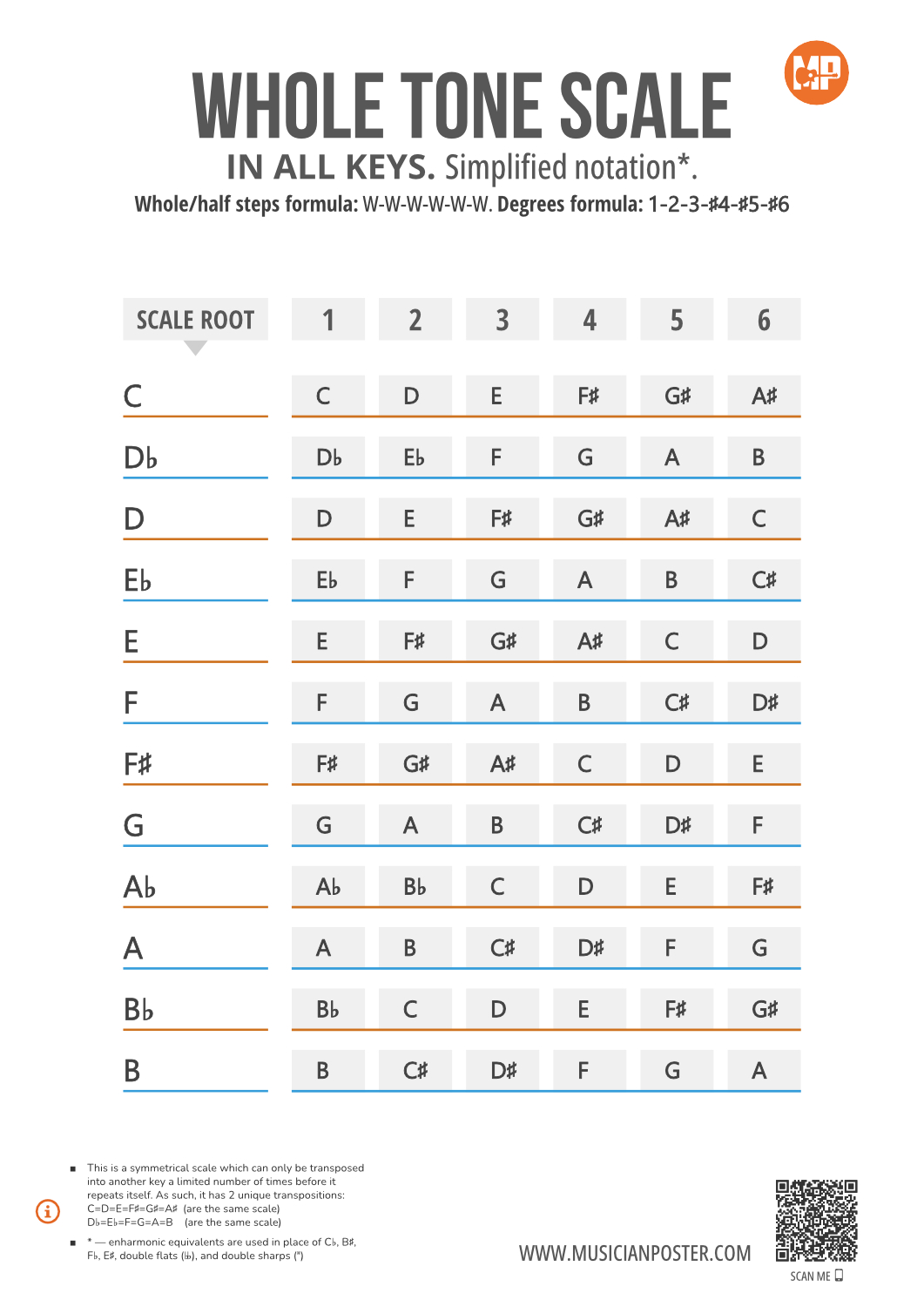
Crucially, this scale has only two unique transpositions. If you build a whole-tone scale starting on C, you get one set of notes {C, D, E, F♯, G♯, A♯}. If you build one starting on D, you get the same set of notes, just in a different order. To get a different set of notes, you must start on a note not in the first scale, such as C♯.
- Whole Tone Scale 1: C - D - E - F♯ - G♯ - A♯
- Whole Tone Scale 2: C♯ - D♯ - F - G - A - B
Any whole-tone scale you can build will contain one of these two sets of pitches.
Olivier Messiaen's "Modes of Limited Transposition"
The French composer Olivier Messiaen (1908-1992) was the first to systematically catalog these types of scales, which he called "Modes of Limited Transposition." The whole-tone scale is his "Mode 1." His "Mode 2" is another symmetric scale you will frequently encounter, often called the octatonic or diminished scale. It's built on a repeating cell of a semitone and a whole tone (1-2).
- Axis of Symmetry: Minor Third (3)
- Repeating Cell: (1-2)
- Interval Pattern: 1-2-1-2-1-2-1-2
- Number of Transpositions: 3
The following video provides an excellent walkthrough of Messiaen's first two modes.
What are Messiaen's Modes of Limited Transposition? - Music Theory
The video "What are Messiaen's Modes of Limited Transposition?" from Music Matters offers a clear, practical demonstration.
First, watch the introduction from the beginning to 03:20 to understand the historical context and the formal definition of "limited transposition." Next, focus on the explanation of Mode 1 (the whole-tone scale) from 03:20 to 06:28. This will reinforce how it has only two transpositions. Finally, watch the section on Mode 2 (the octatonic scale) from 06:28 to 08:21. This demonstrates a more complex repeating cell (semitone-tone) and its three possible transpositions.
A Formal View: Symmetry and Binary Representation
Given your background, you may appreciate a more abstract and computationally-oriented perspective on scale symmetry. We can represent any scale as a 12-bit binary number, where each bit corresponds to one of the 12 semitones of the octave. A '1' means the note is in the scale, and a '0' means it is not.
- The root is the 0th bit (least significant).
- The note a semitone above the root is the 1st bit, and so on.
For example:
- Chromatic Scale:
111111111111 - C Whole-Tone Scale:
101010101010(Notes: C, D, E, F#, G#, A#) - C Major Scale:
101011010101(Notes: C, D, E, F, G, A, B)
In this framework, transposing a scale up by one semitone is equivalent to a bitwise circular shift to the left. A scale is said to have rotational symmetry if a circular shift by n positions results in the identical binary number. This is the mathematical analogue to the musical concept of limited transposition. The whole-tone scale, 101010101010, returns to its original form after being shifted by 2, 4, 6, 8, or 10 positions. This is precisely why it has a limited number of transpositions.
A study of musical scales by Ian Ring
This comprehensive article by Ian Ring explores scales through this computational lens. It's a fantastic resource that aligns perfectly with a scientific mindset.
First, read the sections Assumptions and Representing a scale to understand the binary framework. Next, read the section on Symmetry and Messiaen's Modes. This part explicitly defines rotational symmetry and connects it directly to Messiaen's work. You don't need to memorize the decimal numbers; focus on the core concept of how transposition maps to bitwise rotation.
Application in Electronic Music
The tonally ambiguous nature of symmetric scales makes them powerful tools in electronic music production, particularly for the genres you're interested in.
- Atmosphere and Texture: In ambient, house, and techno, the floating quality of the whole-tone scale can be used to create pads and arpeggios that generate a hypnotic, non-directional atmosphere. They feel static and are perfect for creating textures over which rhythmic elements can evolve.
- Tension and Dissonance: In industrial and noise, the inherent "strangeness" of symmetric scales is a source of tension. Arpeggios based on the augmented triad (which is built from the whole-tone scale) or melodies using the octatonic scale can create an unsettling, aggressive, and futuristic feeling.
Practical Exercise:
- Open your DAW. Using your piano roll, create the C whole-tone scale: C, D, E, F♯, G♯, A♯.
- Program a simple 1-bar, 16th-note arpeggio using only these notes. Loop it and listen to its unresolved, floating character.
- Now, create the C♯ whole-tone scale: C♯, D♯, F, G, A, B. Program a similar arpeggio. Notice how it has a distinctly different pitch collection.
- Finally, create the D whole-tone scale: D, E, F♯, G♯, A♯, C. Notice that these are the exact same notes as your first C whole-tone scale. This should provide a tangible demonstration of the "two transpositions" concept.
Conclusion
This lesson has introduced you to the fascinating world of symmetric scales, where musical structure is governed by mathematical regularity. We have seen how this regularity produces a unique sonic character that is ripe for exploration in electronic music.
Key Takeaways:
- Symmetric scales are built from a small intervallic cell that repeats to fill the octave.
- This structure gives them rotational symmetry and results in modes of limited transposition, meaning they have fewer than 12 unique transpositions.
- The Chromatic Scale (1 transposition) and Whole-Tone Scale (2 transpositions) are the most fundamental examples.
- Their perfect symmetry removes the strong tonal hierarchy found in diatonic scales, leading to a tonally ambiguous and often unresolved sound.
- This ambiguity can be used to create hypnotic, ambient textures or tense, unsettling atmospheres in your music.
Our journey through different types of scales has equipped you with a diverse melodic and harmonic palette. In our next lesson, we will briefly touch upon a related concept that is crucial for navigating any instrument or piano roll: enharmonic equivalence, the idea that a single pitch can have multiple names (e.g., F♯ and G♭).