Hello! Welcome to the first lesson in our final module on Advanced Case Studies in Exciton Physics.
In our last lesson, we concluded our study of exciton Bose-Einstein Condensation. We examined the experimental signatures for BEC and, using Cu₂O as a key example, saw how challenging it can be to obtain unambiguous proof, especially at the high densities where effects like Auger recombination and phonon wind complicate the picture.
Today, we return to cuprous oxide (Cu₂O), a material you're quite familiar with from your research. However, we'll explore it in a completely different, low-density regime where it stands as a shining success story. Our goal is to analyze the properties of Rydberg excitons in Cu₂O, including their high principal quantum numbers and giant diamagnetism. We will see how this material serves as a near-perfect solid-state laboratory for physics analogous to the hydrogen atom, but on a vastly different scale.
1. Cu₂O: The Hydrogen Atom of Condensed Matter
The analogy between a Wannier-Mott exciton and a hydrogen atom is fundamental. In both cases, two oppositely charged particles are bound by a Coulomb potential. However, in most semiconductors, this analogy is imperfect. The exciton's binding energy is small, and its wavefunction is strongly influenced by the complexities of the crystal lattice, limiting the observation of a clean hydrogen-like energy spectrum to just a few low-lying states.
Cuprous oxide is a remarkable exception, making it the premier material for studying highly excited exciton states.
Why is Cu₂O so special?
-
Large Binding Energy: The exciton Rydberg energy in Cu₂O is approximately 92 meV. This is an order of magnitude larger than in common semiconductors like GaAs (4.2 meV). A large Rydberg energy means the energy levels are well-separated from each other and from the ionization continuum, allowing many distinct states to be resolved spectroscopically.
-
Unique Band Structure and Selection Rules: Cu₂O has a direct band gap, but both the conduction band minimum () and the valence band maximum () have the same (positive) parity. As a consequence of parity conservation, direct one-photon transitions to the lowest-energy S-state excitons (with envelope functions) are forbidden. However, transitions to P-states () are allowed via electric quadrupole interactions. This "unusual" selection rule is a blessing, as it gives direct optical access to the states, revealing a rich spectrum beyond the ground state.
The result is a beautifully clean, hydrogen-like absorption spectrum, known as the "yellow series."
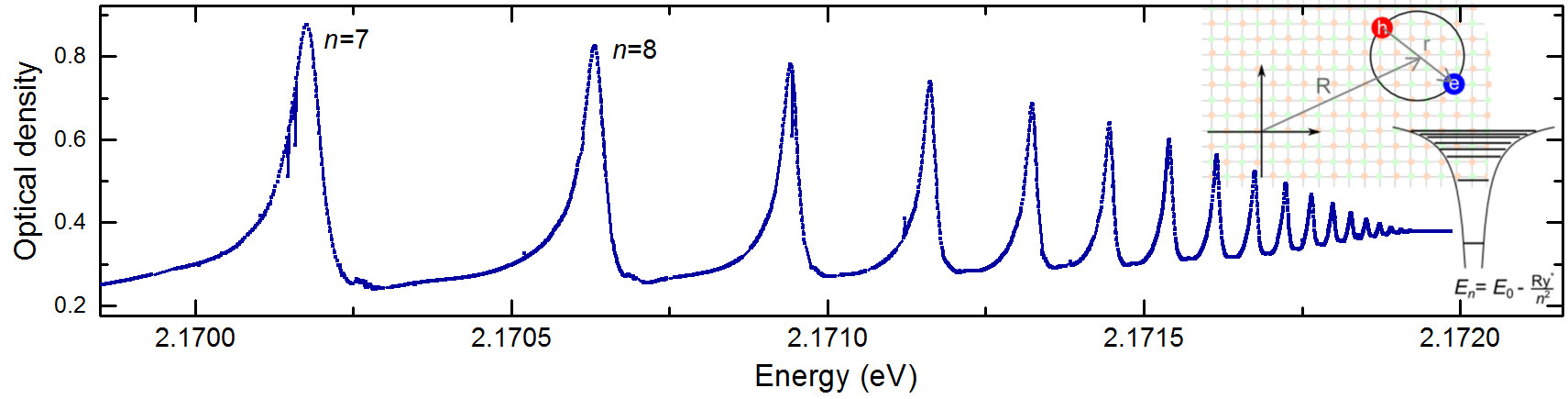
2. Observing Giant Excitons with High n
For decades, the exciton series in Cu₂O was observed up to around . However, advancements in high-resolution laser spectroscopy and the use of exceptionally high-quality natural crystals have pushed this limit dramatically.
The following paper reports the landmark observation of Rydberg excitons in Cu₂O with principal quantum numbers far higher than previously seen in any solid.
Giant Rydberg Excitons in Cuprous Oxide
Please read selections from the paper 'Giant Rydberg Excitons in Cuprous Oxide' by Kazimierczuk et al. This work demonstrates the incredible extent of the hydrogen analogy in Cu₂O.
Please read the section beginning 'For our search of giant excitons...' and ending '...extension of about 10-times the light wavelength (see Fig. 1d)'. Then, read the short section discussing the analysis of the spectrum, which begins 'The resonance energies follow the Rydberg formula...'. Focus on: The highest principal quantum number n observed. The formula used to calculate the exciton's average radius and the astonishing size of the n=25 state. The concept of the 'quantum defect' (\delta_P) used to refine the Rydberg formula.
As you've just read, researchers observed discrete exciton states up to a truly remarkable feat.
The most stunning consequence of such a high principal quantum number is the physical size of the exciton. The effective Bohr radius for P-excitons in Cu₂O is nm. The average radius of an exciton state scales roughly as . The paper uses a more precise formula for the expectation value of the radius for a hydrogenic state with quantum numbers and :
For the , (P-state) exciton, this gives an average radius of µm, meaning the exciton has a diameter over 2 micrometers! This single quantum object spans millions of unit cells of the crystal.
The Quantum Defect
The high-resolution spectra also reveal that the energy levels don't perfectly match the simple hydrogenic formula . They are more accurately described by incorporating a quantum defect, :
For the yellow P-series excitons (), the quantum defect is . This concept is borrowed directly from atomic physics. The defect arises because the envelope function of the exciton penetrates the core region (where ), where the potential is not purely Coulombic () and screening is less effective. The quantum defect accounts for this short-range deviation from the ideal hydrogen model.
3. Giant Diamagnetism
An object with a spatial extent of micrometers is expected to be extremely sensitive to external fields. This is particularly true for magnetic fields. The response of an exciton to a magnetic field consists of two main parts:
- Linear Zeeman Effect: A splitting of magnetic sublevels, linear in the field strength .
- Diamagnetic Effect: An energy shift proportional to .
The Hamiltonian for the relative motion of the electron-hole pair in a magnetic field (chosen along ) can be written as:
where is the zero-field hydrogenic Hamiltonian. The term of interest for us is the diamagnetic term:
Here, is the exciton reduced mass and is the radial coordinate in the plane perpendicular to the field.
In the weak-field regime, we can use first-order perturbation theory to find the energy shift:
The crucial point is how the expectation value depends on the principal quantum number . The average size of a hydrogenic wavefunction scales as , so the mean-square radius scales as .
This leads to a dramatic conclusion: the diamagnetic energy shift scales as the fourth power of the principal quantum number.
This scaling is the origin of the term "giant diamagnetism." While the diamagnetic shift is a tiny correction for the state, it becomes a massive effect for a Rydberg exciton with or , quickly dominating its response to the magnetic field.
The following resource provides a detailed look at both the experimental data and the theoretical treatment of excitons in a magnetic field.
Magneto-absorption spectra of hydrogen-like yellow exciton ...
Let's examine 'Magneto-absorption spectra of hydrogen-like yellow exciton...' This paper provides a rigorous treatment of the problem and shows the beautiful complexity that arises in the spectra.
Please review the following parts: Skim the Introduction to appreciate how the large exciton radius amplifies the effects of a magnetic field. Look closely at the experimental data in the Results section, especially Figure 2, which shows an 'Image plot' of the absorption spectra versus magnetic field. This is the experimental 'fan diagram' that results from the magnetic field effects. Read the section 'Motion of electron-hole pair in magnetic field'. This provides the formal Hamiltonian (Eq. 14) that describes the problem, confirming the origin of the diamagnetic term.
As you can see from Figure 2 in the paper, applying a magnetic field transforms the simple Rydberg series into a complex "fan diagram." Low-n states show a gentle curvature (the diamagnetic shift), while the high-n states, which are tightly packed near the band edge, are immediately scrambled and mixed, evolving into what will become Landau levels at very high fields. This extreme sensitivity is the direct experimental consequence of giant diamagnetism.
Test your understanding!
Using the scaling, calculate the ratio of the diamagnetic shift for the P-exciton to that of the P-exciton in Cu₂O under the same magnetic field.
Show answer
The ratio of the shifts is given by:
The diamagnetic shift is 625 times larger for the state than for the state. This illustrates why the effect is considered "giant" for highly excited states.
Conclusion
In this lesson, we have explored the fascinating world of Rydberg excitons, a domain where condensed matter physics and atomic physics beautifully converge.
Key Takeaways:
- Cu₂O is an ideal system for studying hydrogen-like excitons due to its large Rydberg energy and unique selection rules that allow optical access to P-states.
- Exciton states with extremely high principal quantum numbers (up to ) have been observed, corresponding to "giant" excitons with micron-scale diameters.
- The large size of Rydberg excitons leads to giant diamagnetism, a quadratic energy shift in a magnetic field that scales as and dominates the magneto-optical response of high-
nstates.
Preview of the Next Lesson
Having explored the delicate, giant, hydrogen-like excitons in Cu₂O, we will next turn our attention to a completely different and currently very popular class of materials. We will explain the origin of large exciton binding energies in halide perovskites and the role of strong polaronic effects. This will provide a stark contrast between the fragile excitons of Cu₂O and the remarkably robust excitons found in perovskites.