Hello! Welcome to our next lesson.
In our previous sessions, we've built a solid theoretical picture of exciton Bose-Einstein Condensation. We've derived the critical temperature for the phase transition in 3D, explored the unique BKT transition in 2D, and, most recently, used the Bogoliubov approximation to understand the collective quasiparticle excitations of a weakly interacting condensate. This has given us a clear theoretical prediction for what a BEC is and how it behaves at a microscopic level.
Today, we bridge the gap between this theory and the real world. Our goal is to evaluate experimental signatures of exciton BEC, such as macroscopic coherence, narrowed emission lines, and the formation of a spectral condensate. The central question is: if you have a cold, dense gas of excitons in your lab, what measurements would you perform to prove it has formed a condensate? As you'll see, the path to an unambiguous claim is paved with subtle effects and alternative explanations, making this a fascinating challenge in experimental physics.
1. The "Smoking Gun" Signatures of BEC
A Bose-Einstein condensate is not just a cold gas; it's a macroscopic quantum state. Several distinct, measurable phenomena arise from this fact.
a) Macroscopic Occupation and the Spectral Condensate
The very definition of BEC is the macroscopic occupation of the quantum ground state. For a gas of free excitons, this is the state with zero center-of-mass momentum (). This leads to the most direct and sought-after signature: the emergence of a spectral condensate.
Since the photoluminescence (PL) spectrum reflects the energy (and thus momentum) distribution of the exciton population, the formation of a BEC should manifest as a sharp, intense peak appearing at the bottom of the energy-momentum dispersion. This peak represents the massive population of excitons that have "condensed" into the ground state.
b) Spontaneous Macroscopic Coherence
In a condensate, all particles occupy the same quantum state, described by a single wavefunction, , where is the condensate density and is a well-defined phase across the entire sample. This is macroscopic coherence.
This coherence has two key observable consequences:
-
Interference: Just as two coherent laser beams can produce interference fringes, emission from two spatially separated points of a condensate should interfere. Experimentally, this can be measured by observing the spatial pattern of the emitted light, which will show fringes if long-range coherence is present.
-
Superradiance: The excitons within a coherent volume (defined by the coherence length) will decay radiatively in a collective manner. This leads to an enhancement of the radiative recombination rate. This phenomenon, often called superradiance, manifests as a sharp decrease in the measured radiative lifetime () or, equivalently, a sharp increase in the decay rate () as the system enters the condensed phase.
c) Emission Line Narrowing
A thermal gas has a distribution of kinetic energies, which, along with scattering events, contributes to the broadening of its emission spectrum. In contrast, the excitons in a condensate occupy a single quantum state. The emission from this state should be exceptionally narrow, with its linewidth ideally limited only by the lifetime of the condensate itself, according to the time-energy uncertainty principle (). Therefore, a dramatic narrowing of the PL line is expected at the onset of condensation.
d) Superfluidity
As we saw when deriving the Bogoliubov spectrum, the low-energy excitations of a condensate are phonons with a linear dispersion, . According to the Landau criterion for superfluidity, this means that an object moving through the condensate at a velocity cannot dissipate energy by creating excitations. The condensate should flow without viscosity. This implies anomalous transport: a sudden increase in exciton mobility and the ability to flow over long distances without dissipation.
2. A Case Study in Critical Evaluation: The Cu₂O Saga
With this list of ideal signatures, it might seem straightforward to identify a BEC. However, the history of experiments in cuprous oxide ()—a material of great interest to you—serves as a crucial lesson in the careful evaluation of evidence. Due to the very long lifetime of its ground-state paraexcitons, Cu₂O was the focus of intense research for decades.
Let's explore the initial promising results and their subsequent reinterpretations. The following reading provides an excellent historical overview.
Bose-Einstein Condensation of Excitons in Cu2O: Progress Over Thirty Years
The article 'Bose-Einstein Condensation of Excitons in Cu2O: Progress Over Thirty Years' chronicles the experimental search for exciton BEC. It's a perfect example of the scientific process, where initial interpretations are challenged by new data and more refined models.
Please read Section II, 'EARLY EXPERIMENTS ON EXCITON BEC IN CU2O'. Focus on subsections A ('Spectral analysis experiments') and B ('Transport experiments'). As you read, identify: The experimental observation that was initially interpreted as a signature of BEC. The subsequent, alternative explanation for that same observation.
Welcome back. As you've read, the early experiments in Cu₂O were tantalizing.
- The Spectral Signature: Researchers observed a PL lineshape that deviated from the classical Maxwell-Boltzmann distribution and could be well-fitted by a Bose-Einstein distribution with a chemical potential near zero. This was termed "Bose saturation" and looked like a system teetering on the edge of condensation.
- The Transport Signature: Other experiments observed a pulse of excitons propagating across the crystal at nearly the speed of sound, but only when the initial exciton density exceeded a certain threshold. This was interpreted as the onset of superfluid flow.
However, neither of these claims held up to scrutiny.
- Reinterpreting the Spectrum: The non-classical lineshape was later shown to be reproducible by models of a purely classical gas that was spatially inhomogeneous. A hot, dense exciton cloud near the surface combined with a cooler, more dilute cloud further into the crystal, when spatially integrated by a detector, can create a spectrum that coincidentally mimics a quantum distribution.
- Reinterpreting Transport: The "superfluid" pulse was convincingly explained by the phonon wind effect. The intense laser pulse used to create the excitons also creates a shockwave of non-equilibrium phonons. This phonon pulse travels at the speed of sound and can literally "blow" or push a cloud of excitons along with it, without any need for quantum coherence.
The primary culprit that complicates matters in Cu₂O at high densities is Auger recombination. This is a process where two excitons collide, one recombines non-radiatively, and gives its energy to the other, which is kicked apart into a high-energy electron and hole. This process scales with density squared () and has two devastating effects: it dramatically shortens the exciton lifetime and it heats the remaining exciton gas, both of which work directly against the conditions needed for BEC.
The story of Cu₂O is a powerful illustration of a key principle: for a phenomenon as significant as BEC, a single piece of evidence is rarely sufficient. A confluence of multiple, consistent signatures is required, and all plausible alternative explanations must be ruled out.
Test your understanding!
Imagine you are designing an experiment to distinguish between true exciton superfluid transport and transport via a phonon wind in a Cu₂O crystal. What is one experimental parameter you could change or an additional measurement you could make to tell them apart?
Show answer
There are several possible approaches. One powerful method would be to use a two-pulse experiment with a "pump" and a "probe".
- First, create a low-density, cold exciton gas throughout the crystal using a gentle, resonant laser.
- Then, use an intense, non-resonant laser pulse at one end to generate the high-density cloud and the phonon wind.
- Simultaneously, use a very weak, resonant laser pulse at the other end of the crystal to create a small, localized "test" cloud of excitons.
If the transport is due to a phonon wind, the phonons will propagate from the intense pulse and push both the main exciton cloud and your separate test cloud. You would see both clouds move.
If the transport is due to superfluidity within the main, high-density cloud, this property is intrinsic to that cloud. The separate, low-density test cloud would not be part of the condensate and would not experience this superfluid flow. It would remain largely stationary (or diffuse slowly), while the main cloud moves ballistically. This would decouple the motion of the excitons from the motion of any phonons.
3. Modern Approaches: Learning from the Past
The challenges faced in bulk Cu₂O spurred the community to develop more sophisticated experimental platforms that offer greater control and less ambiguity.
Indirect Excitons in Quantum Wells
Many modern experiments use coupled quantum wells (CQWs). By applying an electric field, one can pull the electron and hole into adjacent wells, creating an indirect exciton. These excitons have very long lifetimes (because the electron and hole wavefunctions have small overlap) and a built-in dipole moment, allowing their interaction strength to be controlled. This platform has yielded much clearer, though still debated, evidence for condensation.
The review article below summarizes some of these key findings in CQW systems.
Condensation & Pattern Formation in Cold Exciton Gases
Let's turn to 'Condensation & Pattern Formation in Cold Exciton Gases' by L. V. Butov. This review discusses experiments in quantum well systems, which were designed to overcome some of the issues seen in bulk materials.
Please read Section 3.1, 'Anomalous transport and luminescence of indirect excitons in AlAs/GaAs CQWs'. Focus on how the authors present evidence for (1) anomalous transport (superfluidity) and (2) superradiance (macroscopic coherence). Note the strong, sharp increase in mobility and radiative decay rate observed below a critical temperature.
As you read, experiments in these engineered structures show a sharp increase in exciton mobility and a dramatic increase (by a factor of ~60!) in the radiative decay rate below a critical temperature, consistent with the expected onset of superfluidity and superradiance. They also observe a huge broadband noise in the PL intensity near the transition, interpreted as fluctuations arising from the formation and disappearance of coherent condensate "lakes".
Trapping and Spatial Control
Inspired by the success in trapping cold atoms, experimentalists now use engineered potentials to trap excitons. This allows for the creation of a dense, cold gas in a controlled volume without the violent, non-equilibrium conditions of an intense laser spot.
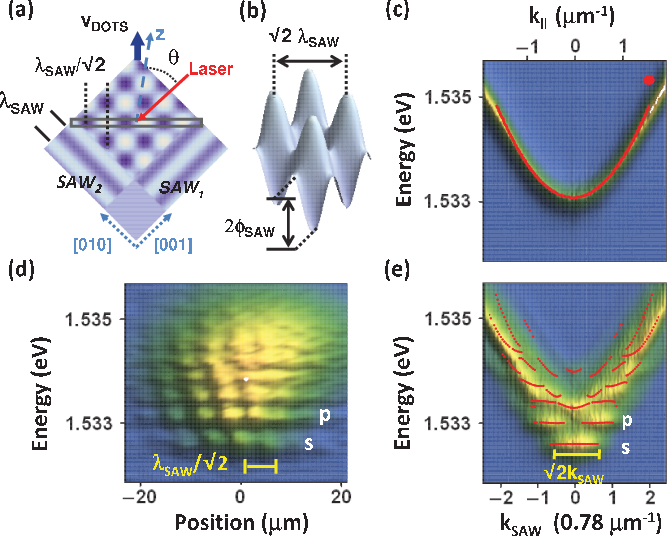
These modern techniques, combining material engineering with sophisticated trapping and probing methods, allow for a much more systematic investigation of the conditions for condensation and a clearer interpretation of the resulting signatures.
Conclusion
Today we have surveyed the primary experimental signatures used to identify exciton BEC and, crucially, learned to evaluate them critically.
Key Takeaways:
- The definitive signatures of exciton BEC include the formation of a spectral condensate (macroscopic occupation of the ground state), dramatic line narrowing, and evidence of macroscopic coherence (e.g., interference or superradiance).
- Anomalous transport (superfluidity) is another key signature derived from the condensate's Bogoliubov excitation spectrum.
- The historical search for BEC in
Cu₂Oserves as a vital case study, demonstrating how plausible signatures like non-classical spectral shapes and fast transport can be mimicked by classical, non-equilibrium effects such as spatial inhomogeneity and phonon wind. - Modern experiments often use engineered systems like coupled quantum wells and potential traps to create more controlled conditions, leading to less ambiguous evidence for condensation.
Preview of the Next Lesson
We have now concluded our module on the Bose-Einstein condensation of excitons. You have a theoretical toolkit and an appreciation for the experimental challenges. In our next module, "Advanced Case Studies in Exciton Physics," we will apply this knowledge to specific, cutting-edge systems. We will begin by returning to our friend, Cu₂O, but in a completely different regime: we will analyze the properties of Rydberg excitons in Cu₂O, including their high principal quantum numbers and giant diamagnetism. This will set the stage for our later discussions on excitons in extreme magnetic fields.